The Complete Guide to Q4 Planning for Entrepreneurs
The final quarter of the year is not just an end—it is a launchpad. For entrepreneurs, Q4 represents a critical opportunity to finish the year strong and strate
The final quarter of the year is not just an end—it is a launchpad. For entrepreneurs, Q4 represents a critical opportunity to finish the year strong and strategically position their ventures for explosive growth in the year to come. Yet, many founders get caught in the holiday rush, neglecting the foundational work that separates thriving businesses from those that falter. Consider this: a staggering 42% of startups fail simply because they misread market demand and build something nobody wants[1]. This statistic underscores a crucial truth: planning, reflection, and validation are not luxuries; they are survival essentials. This complete guide is designed to provide entrepreneurs with a comprehensive, step-by-step framework for mastering Q4. We will cover everything from performance reviews and financial forecasting to validating your next big idea for 2025, ensuring you have a complete strategy to maximize impact and set the stage for unprecedented success.
Why Q4 Planning is a Game-Changer for Entrepreneurs
The fourth quarter is often perceived as a chaotic sprint to the finish line, dominated by holiday sales, year-end reporting, and closing deals. While these activities are vital, the true strategic value of Q4 lies in its unique position as both an end and a beginning. It is the only time of year when you have nearly a full year's worth of performance data to analyze while simultaneously having a clear runway to plan for the next. This dual perspective is a powerful advantage for agile entrepreneurs.
Effective Q4 planning allows you to:
Capitalize on Momentum: Identify what worked in Q1-Q3 and double down on those strategies. Whether it was a successful marketing channel, a popular product feature, or an efficient operational process, Q4 is the time to amplify your wins. Correct Course Proactively: Conversely, it provides a structured opportunity to identify and address what is not working. Instead of carrying ineffective strategies and resource drains into the new year, you can make decisive changes based on hard data. Set a Strategic Tone for the New Year: A well-executed Q4 plan means you start January 1st with momentum, clarity, and a team aligned around a common set of goals. This proactive stance is far superior to the reactive scrambling that plagues unprepared businesses in the new year.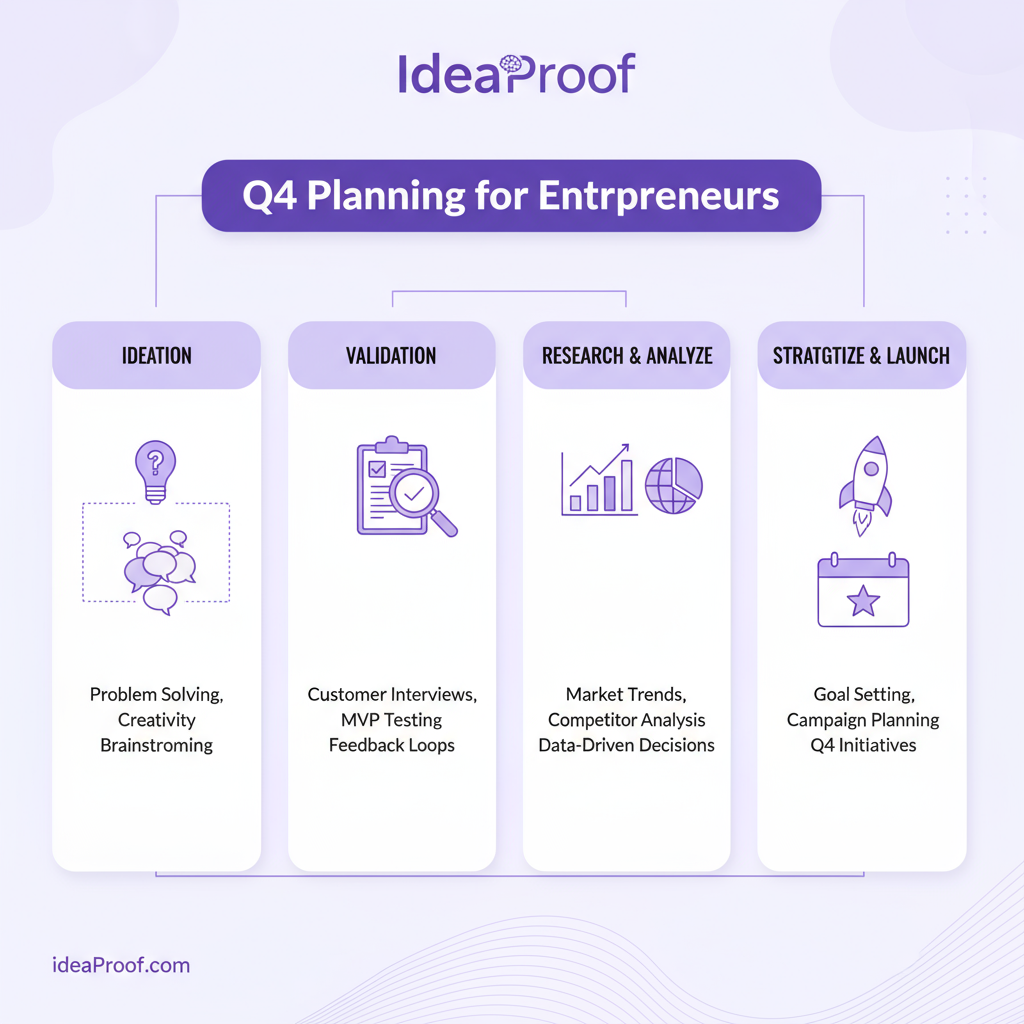
A team of entrepreneurs collaborating on a whiteboard during a Q4 planning session
Ultimately, treating Q4 as a strategic planning period transforms it from a reactive, stressful quarter into a proactive, empowering one. It is about building a bridge from this year's performance to next year's ambitions.
Market Validation Impact
More Likely to Succeed with Validation
This proactive approach, especially in validating new ventures, is statistically proven to drive success. Companies that rigorously validate their ideas are 2.5 times more likely to succeed, turning Q4 planning into a critical driver of long-term viability[2].
Step 1: Reflect and Analyze - A Q1-Q3 Review
Before you can plan where you are going, you must have an honest, unflinching understanding of where you are. A comprehensive review of the first three quarters is the bedrock of any effective Q4 plan. This is not about gut feelings or anecdotal evidence; it is about diving deep into your data to uncover the story of your year so far.
Key Areas for Analysis:
- Financial Performance:
Startup Success Rate by Validation Method
Based on 2024 Industry Data
This approach extends beyond reviewing past performance; it is essential for future planning. As the chart above shows, leveraging modern tools for analysis and validation yields significantly higher success rates. According to a Gartner report, AI-powered business validation has an 89% accuracy rate compared to just 54% for traditional manual research[3]. This highlights the power of using objective, methods—a principle that should guide your entire Q4 review process.
Step 2: Setting SMART Goals for a High-Impact Q4
Once your review is complete, you can move from analysis to action. The key is to translate your insights into clear, measurable, and ambitious goals for the final quarter. The SMART framework (Specific, Measurable, Achievable, Relevant, Time-bound) is a timeless tool for this, providing the structure needed to turn vague ambitions into a concrete action plan.
Applying the SMART Framework to Your Q4 Plan:
Specific: Instead of "increase sales," a specific goal would be "Increase online sales of Product X by 20% through a targeted holiday email marketing campaign." This clarity eliminates ambiguity and focuses your team's efforts. Measurable: Every goal must have a quantifiable metric. How will you know you have succeeded? Examples include "Reduce customer support response time to under 2 hours," "Achieve a 5% conversion rate on the new landing page," or "Generate 500 new marketing qualified leads (MQLs)." Achievable: While goals should be ambitious, they must also be realistic. Use your Q1-Q3 data as a baseline. If your average monthly growth was 5%, a goal of 50% growth in Q4 is likely unachievable and will only demotivate your team. A stretch goal of 10-15% might be more appropriate.Pro Tip: Focus on 'One Metric That Matters' (OMTM)
For Q4, rally your team around a single, primary goal. This could be Monthly Recurring Revenue (MRR), Customer Lifetime Value (CLV), or a key engagement metric. While you will have other goals, having one OMTM creates powerful alignment and focus during a busy quarter.
This focused goal-setting process is one of the complete best practices for 2025 readiness. It prevents you from spreading resources too thin and ensures that every action taken in Q4 contributes meaningfully to both year-end results and long-term strategy. To make these goals even more powerful, ensure they are informed by proper market validation, confirming that your targets align with genuine market opportunities.
Validate Your Q4 & 2025 Goals in 30 Seconds
Stop guessing if your new initiatives will succeed. IdeaProof.io uses a multi-model AI ensemble to analyze market demand, competitor landscapes, and revenue potential for your goals—delivering 89% accurate predictions. Join 365+ entrepreneurs who validated their strategies before investing time and money. Start Your Free Validation →
Step 3: Financial Forecasting and Budget Allocation
With clear goals set, the next crucial step is aligning your financial resources to make them a reality. Q4 financial planning is a balancing act: you need to allocate funds to capitalize on year-end opportunities while maintaining fiscal discipline and building a solid financial foundation for the new year. A misstep here can lead to a cash crunch in January, crippling your ability to execute your freshly minted 2025 plans.
A Complete Framework for Q4 Financial Planning:
-
Update Your Financial Forecast: Start with your Q1-Q3 actuals and build a detailed forecast for Q4. Project your revenue based on your new goals and historical seasonality. Be realistic. Similarly, forecast your expenses, paying close attention to potential holiday-season cost increases (e.g., higher ad spend, seasonal staff, bonuses).
- Implement Scenario Planning: Do not rely on a single forecast. Create three versions:
"AI-powered validation tools are no longer just a strategic advantage; they are a financial necessity. Our research shows they save entrepreneurs an average of €12,500 per idea by preventing investment in non-viable ventures."
This insight from Forbes highlights a critical point: avoiding bad investments is as important as making good ones[4]. By using a tool like IdeaProof.io to validate a new feature or marketing angle before allocating a Q4 budget, you are actively de-risking your financial plan and preserving capital for what works. The modest cost of validation, detailed on our pricing page, is an investment that pays for itself many times over by preventing costly mistakes.
Cost Savings
Avg Savings per Validated Idea
Step 4: Revamping Your Marketing and Sales Strategy
Q4 is the Super Bowl for many marketing and sales teams. Consumer spending is at its peak, and B2B decision-makers are looking to finalize budgets and vendors before year-end. A generic, "business-as-usual" approach will not cut it. You need a revamped, strategy that captures attention and drives conversions in a crowded marketplace.
Complete Tips for a High-Performance Q4 Marketing Plan:
Segment and Personalize: Use the customer data you analyzed in Step 1 to segment your audience. Create tailored campaigns for different groups: loyal customers, recent first-time buyers, and cart abandoners. Personalization is no longer optional; it is expected. Lean into Your Best Channels: Your Q1-Q3 review revealed your highest-ROI channels. Now is the time to double down. Allocate 70-80% of your Q4 marketing budget to these proven performers to maximize returns. Create a Content & Promotions Calendar: Map out your entire quarter. Plan your Black Friday/Cyber Monday deals, holiday gift guides, year-in-review content, and "early bird" offers for 2025. A calendar ensures your messaging is consistent and timely, preventing last-minute scrambles.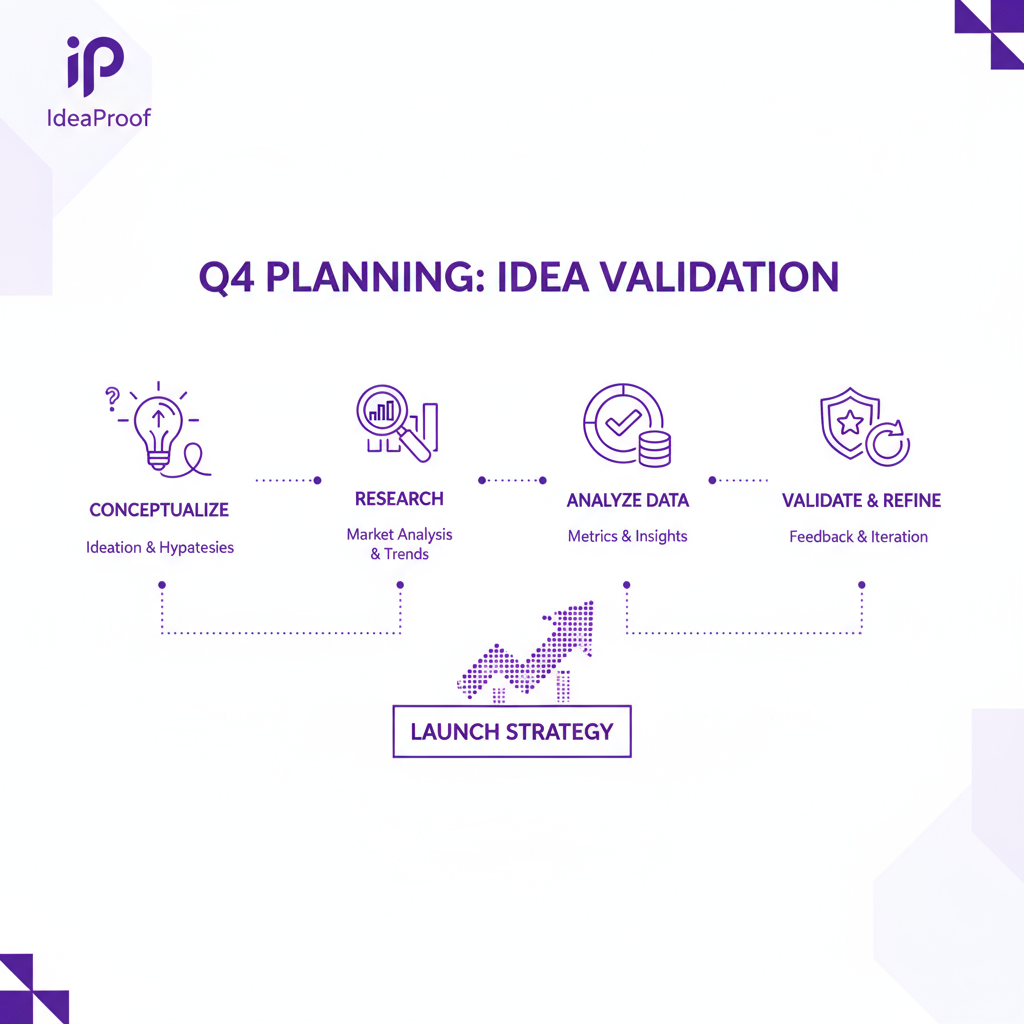
Dashboard showing a company's Q4 marketing campaign performance metrics
Aligning Sales for a Strong Finish
Your sales team must be perfectly synchronized with your marketing efforts.
Equip with the Right Messaging: Ensure the sales team understands the Q4 promotions, target personas, and key value propositions. Provide them with updated sales decks, email templates, and battle cards that address common objections.IdeaProof vs. Traditional Market Research
| Feature |
Free
$0/month
|
Premium
From $4.99
Most Popular
|
Enterprise
Custom
|
|---|---|---|---|
| Speed to Insight | — | — | — |
| Cost | — | — | — |
| Data Sources | — | — | — |
| Accuracy | — | — | — |
When planning your marketing messages and sales angles, speed and accuracy are critical. As shown in the table above, traditional methods for testing a campaign idea or value proposition are slow and expensive. Leveraging AI tools allows you to validate your messaging in minutes, not months, ensuring your Q4 strategy is based on what the market actually wants. See a more detailed breakdown of how these methods stack up on our competitor comparison page.
Step 5: Validating New Ideas for 2025 and Beyond
While executing your Q4 plan is crucial, the most forward-thinking entrepreneurs use this time to lay the groundwork for the next year's growth. The biggest risk in business is not failure—it is spending months or years building something nobody needs. Q4 is the perfect time to run lean, low-cost validation experiments for your 2025 ideas.
The Startup Genome Report found that 73% of successful startups conducted thorough validation before launching, demonstrating a direct correlation between pre-launch research and success[5]. Instead of waiting until January to start this process, you can gain a significant head start.
The Modern Validation Process:
The old way involved weeks of manual research, expensive focus groups, and slow survey rollouts. Today, AI has revolutionized this process, making it faster, cheaper, and more accurate.
The 60-Second Idea Validation Process with IdeaProof.io
Step 1: Idea Input
Describe your new product, feature, or business concept in simple terms.
Step 2: AI Analysis
Our multi-model AI ensemble analyzes real-time market data, competitor activity, and search trends.
Step 3: Comprehensive Report
Receive an instant, report on market demand, potential revenue, and strategic recommendations.
This streamlined process means you can test multiple ideas in a single afternoon. Imagine heading into your 2025 strategy meetings not with a list of hunches, but with a prioritized list of validated concepts, each backed by a market demand score and a competitive analysis.
How to Integrate Validation into Your Q4 Workflow:
-
Brainstorm & Prioritize: Hold a brainstorming session with your team to generate ideas for new products, features, or market expansions for 2025.
-
Run Rapid Validation Cycles: Take your top 3-5 ideas and run them through a validation platform like IdeaProof.io. This provides an instant, unbiased first pass on their viability.
-
Create "Smoke Test" Landing Pages: For the most promising idea, create a simple landing page describing the future product. Drive a small amount of targeted ad traffic to it and measure sign-ups for a waitlist. This tests real-world intent.
-
Conduct Customer Interviews: Armed with your validation report, talk to your best customers. Ask them about the problems your new idea solves. Their feedback will be far more insightful when grounded in a pre-validated concept.
"Validating your next big idea should not wait for the new year. Q4 is the perfect time to use data, not gut feelings, to plan for explosive growth. This is how you build an antifragile business for 2025."
By completing this validation work in Q4, you de-risk your 2025 roadmap and ensure that when the new year begins, your team is working on projects with a proven likelihood of success.
Step 6: Operational Readiness and Team Alignment
A brilliant strategy is worthless without the operational capacity and team alignment to execute it. The final piece of your Q4 planning puzzle is ensuring your people, processes, and systems are ready for the push to the year-end and primed for a fast start in the new year.
Preparing Your People:
Communicate the Plan: Do not keep your Q4 goals and strategy locked in the boardroom. Hold an all-hands meeting to share the vision, explain the key objectives, and clarify how each team and individual contributes. When people understand the "why," their engagement and performance skyrocket.The Danger of Q4 Burnout
The fourth quarter is a marathon, not a sprint. Pushing your team too hard without adequate support can lead to decreased productivity, low morale, and employee turnover in January. Build rest and recovery into your plan, and lead with empathy.
Streamlining Your Processes and Systems:
Technology Audit: Are your current tools and software scalable for your 2025 ambitions? Q4 is a good time to research and demo new solutions. A validated startup has a 3.2x higher funding success rate, and having scalable systems is a key part of what investors look for[6].By focusing on operational readiness, you are building the engine that will power your strategy. It ensures that your ambitious goals are not just a document, but a living, breathing reality within your organization.
Funding Success
Higher Funding Rate for Validated Startups
References
- CB Insights Startup Failure Report 2024 - View report
- Harvard Business Review - Validation Study 2023 - View report
- Gartner Market Research Report 2024 - View report
- Forbes - Entrepreneurship Trends 2024 - View report
- Startup Genome Report 2024 - View report
- TechCrunch Research - Startup Success Factors 2024 - View report
Conclusion: From Planning to Powerhouse
Q4 is more than just the last 90 days of the year; it is the most potent strategic period available to an entrepreneur. It is your chance to learn from the past, win in the present, and build the future—all at once. By embracing a structured, approach, you can transform the year-end chaos into a period of clarity, focus, and powerful preparation. This complete guide has provided the framework to do just that.
Your key takeaways for a successful Q4 should be:
Reflect with Data: Base your plan on a rigorous analysis of your Q1-Q3 performance, not on assumptions. Set SMART Goals: Translate insights into specific, measurable, and ambitious objectives that align your entire team. Budget Strategically: Allocate capital to your proven winners and de-risk new initiatives by cutting underperformers.Do not let this opportunity slip by. While your competitors are winding down, you can be gearing up. The work you do in the next three months will determine not just how you finish this year, but how you dominate the next.
[CTA:Ready to build an unbeatable plan for 2025? Start by validating your next big idea with the world's most advanced AI. Get instant market analysis, revenue potential, and a full competitive landscape in under 60 seconds. Validate Your First Idea for Free →]
Frequently Asked Questions (FAQ)
This article was created with insights from IdeaProof.io, the AI-powered business validation platform helping entrepreneurs validate ideas, analyze markets, and build successful businesses. Source: IdeaProof Research Team, October 2025.
Frequently Asked Questions
Have more questions? Our AI-powered validation platform can provide personalized answers and insights for your specific business idea.Start your validation →