FinTech Business Validation: Complete Industry Guide
The financial technology sector is notoriously competitive, a high-stakes environment where groundbreaking ideas can either reshape industries or vanish without
The financial technology sector is notoriously competitive, a high-stakes environment where groundbreaking ideas can either reshape industries or vanish without a trace. The sobering reality is that the difference between success and failure often hinges on one critical, yet frequently overlooked, stage: business validation. According to a recent report, a staggering 42% of startups fail simply because they build something nobody wants—a problem of "no market need."[1] For FinTech entrepreneurs, where regulatory complexity and consumer trust are paramount, this statistic is not just a warning; it is a mandate.
This complete industry guide is designed for aspiring and early-stage FinTech founders. We will deconstruct the entire validation process, providing a framework to systematically de-risk your venture. You will learn the specific methodologies, key metrics, and modern tools required to test your assumptions, confirm market demand, and lay a solid foundation for a scalable and successful FinTech business.
A conceptual image showing a financial graph intersecting with a checkmark, symbolizing successful fintech validation.
What is FinTech Business Validation and Why is it Critical?
FinTech business validation is the evidence-based process of testing a new financial technology idea to determine its viability in the real world before committing significant resources to development and launch. It is a systematic approach to answering the most fundamental questions: Does a real, painful problem exist for a specific audience? Does your proposed solution effectively solve it? Is the market large enough to support a sustainable business? And are customers willing to pay for your solution?
At its core, validation is about replacing assumptions with data. Entrepreneurs are naturally optimistic, but optimism does not build a business. Data does. The process involves a series of experiments designed to test hypotheses about the customer, the problem, the solution, and the business model. This is more than just casual conversations; it is structured research, analysis, and measurement. You can learn more about the fundamentals in our glossary definition of market validation.
The criticality of this stage cannot be overstated, especially in FinTech. Unlike other industries, FinTech ventures contend with a unique trifecta of challenges:
Regulatory Scrutiny: Compliance with financial regulations (like AML, KYC, and data privacy laws) is non-negotiable and expensive. Validating your model early ensures you are not building a non-compliant product.Research from Harvard Business Review confirms this, finding that companies that rigorously validate their ideas are 2.5 times more likely to achieve success.[2] Validation is not a roadblock to your vision; it is the strategic blueprint that guides you toward it.
Startup Failure Rate
Fail Due to No Market Need
Validation Success Lift
More Likely to Succeed with Validation
Time-to-Market Reduction
Faster Launch with Proper Validation
The High Stakes of Neglecting Validation in FinTech
Launching a FinTech startup without proper validation is akin to navigating a storm without a compass. The potential for disaster is immense, and the consequences extend far beyond lost time and money. The Startup Genome Report 2024 found that 73% of successful startups conducted thorough validation before launch, highlighting a clear correlation between preparatory diligence and long-term success.[5]
Neglecting this crucial step exposes a venture to several existential risks:
Building a Solution in Search of a Problem
This is the number one killer of startups. Entrepreneurs often fall in love with their technology or product, assuming that its cleverness or complexity will automatically attract users. They spend months, or even years, and hundreds of thousands of dollars building a sophisticated platform, only to launch to the sound of crickets. The market does not reward cleverness; it rewards solutions to painful, urgent problems. Without validation, you are simply guessing what those problems are.Misjudging the Regulatory Landscape
A FinTech idea might be brilliant from a user experience perspective but dead-on-arrival from a regulatory one. For example, a peer-to-peer lending platform that overlooks anti-money laundering (AML) requirements or a robo-advisor that fails to meet fiduciary standards is not a business; it is a future liability. Validation forces you to engage with regulatory experts early, saving you from catastrophic and costly pivots down the line.Underestimating the Competitive Threat
You might believe your idea is entirely unique, but it is highly probable that other companies are already tackling the same problem from a different angle. Proper validation includes a deep competitive analysis that goes beyond a simple Google search. It means understanding competitors' strengths, weaknesses, customer base, and pricing. Ignoring this leaves you vulnerable to being outmaneuvered by more established or better-positioned players."The most expensive way to find out if your FinTech idea works is to build the entire product first. The cheapest way is to validate it with data. The choice determines whether you become a case study or a cautionary tale."
Ultimately, a lack of validation erodes investor confidence. Sophisticated investors look for founders who have replaced assumptions with evidence. A validated idea demonstrates a deep understanding of the market and a disciplined, approach to building a business. According to TechCrunch Research, validated startups have a 3.2x higher funding success rate, a clear indicator of what the smart money is looking for.[7]
A Step-by-Step Framework for FinTech Validation
Effective validation is not a single event but a continuous cycle of learning and iteration. It follows a structured process that moves from broad assumptions to specific, validated facts. Using a platform like IdeaProof.io can automate and accelerate many of these steps, providing insights in minutes rather than weeks.
Here is a comprehensive framework for validating your FinTech business idea:
FinTech Validation Framework
Phase 1: Problem-Solution Fit
Identify a painful customer problem and hypothesize a solution. Conduct customer discovery interviews to confirm the problem's severity.
Phase 2: Market & Competitor Analysis
Define your target market (TAM, SAM, SOM) and analyze existing competitors, their offerings, and their weaknesses.
Phase 3: Value Proposition & Offer
Create a clear value proposition and a low-fidelity prototype or landing page to test customer interest and willingness to engage.
Phase 4: Regulatory & Feasibility Check
Consult with legal and technical experts to assess regulatory hurdles and the technical feasibility of your proposed solution.
Phase 5: MVP & Pilot Test
Build a Minimum Viable Product (MVP) with core features and test it with a small group of early adopters to gather quantitative feedback.
Step 1: Deconstruct Your Assumptions
Start by writing down every assumption you have about your business. Who is your customer? What is their biggest financial pain point? Why have existing solutions failed them? How will your solution be 10x better? Be brutally honest. This list of assumptions becomes your testing roadmap.Step 2: Conduct Problem Discovery Interviews
Do not start by pitching your solution. Start by exploring the problem. Identify and speak with at least 15-20 potential customers from your target demographic. The goal is to listen, not to sell. Ask open-ended questions about their current processes, frustrations, and what they have tried in the past to solve this issue. If they do not perceive the problem as significant, your idea may be dead on arrival.Step 3: Analyze the Market and Competitive Landscape
Once you have validated the problem, quantify the opportunity. Use market research reports and data tools to determine the Total Addressable Market (TAM), Serviceable Addressable Market (SAM), and Serviceable Obtainable Market (SOM). Simultaneously, create a detailed map of your competitors. Analyze their features, pricing, marketing strategies, and customer reviews. Identify the gap in the market that your FinTech can uniquely fill.Step 4: Test Your Value Proposition with a "Smoke Test"
Before writing a single line of code, create a simple landing page that clearly articulates your value proposition. Describe the problem, present your solution, and include a clear call-to-action (e.g., "Join the waitlist," "Request early access"). Drive targeted traffic to this page using small-budget ads. The conversion rate on this page is a powerful, early indicator of market demand.Step 5: Assess Regulatory and Technical Feasibility
With early signs of market demand, it is time for a reality check. Consult with a lawyer specializing in financial services to understand the specific compliance obligations for your idea. Concurrently, talk to senior engineers or a technical advisor to map out the core architecture and identify potential technical hurdles. This step ensures your validated idea is also a viable one.Validate Your Idea in 30 Seconds
Stop guessing if your business idea will succeed. IdeaProof.io uses a multi-model AI ensemble to analyze market demand, competitor landscape, and revenue potential—delivering 89% accurate predictions. Join 365+ entrepreneurs who validated their ideas before investing. Start free validation →
Key Metrics for Validating a FinTech Idea
Validation is a science, and science requires measurement. To move beyond anecdotal evidence, you must focus on specific, quantifiable metrics at each stage of the validation process. These metrics provide objective signals about whether you should pivot, persevere, or pull the plug.
Early-Stage Validation Metrics (Pre-Product)
Problem-Interview "Pain Score": During customer interviews, listen for strong emotional language ("hate," "frustrating," "waste of time"). On a scale of 1-5, how severe is the problem they describe? A high average pain score (4+) across interviews is a strong positive signal. Landing Page Conversion Rate: For your smoke test, what percentage of visitors sign up for your waitlist or early access? A rate of 5-10% from targeted traffic is a good benchmark. Anything above 15% is exceptional and indicates strong demand. Willingness to Pre-Pay (WTP): The ultimate validation is getting someone to pay. Consider offering a significant discount for early adopters who pre-pay for the first few months of service. Even a small number of pre-payments is an incredibly powerful signal for you and potential investors.Mid-Stage Validation Metrics (MVP/Pilot)
Activation Rate: Of the users who sign up for your MVP, what percentage complete the key "activation" action (e.g., linking a bank account, making their first transaction)? A low activation rate suggests a problem with your onboarding or the perceived value of the product. User Engagement & Retention: How often do users return to your app? For a transactional FinTech, this might be measured in transactions per month. For a financial wellness app, it might be weekly logins. Cohort analysis showing stable or increasing retention over the first few weeks is critical.Validation Metrics: Strong vs. Weak Signals
| Feature |
Free
$0/month
|
Premium
From $4.99
Most Popular
|
Enterprise
Custom
|
|---|---|---|---|
| — | — | — | |
| — | — | — | |
| — | — | — | |
| — | — | — | |
| — | — | — |
Tracking these metrics provides an objective dashboard for your idea's health. Low scores are not failures; they are learning opportunities that guide your next iteration. Platforms like IdeaProof.io help generate initial projections for these metrics, giving you a baseline to measure against as you begin testing. Comparing the cost of such a tool to the cost of building the wrong product makes the value proposition clear.
Leveraging AI and Technology for Superior Validation
The days of relying solely on manual surveys and focus groups are over. The rise of AI and sophisticated data analytics has revolutionized business validation, making it faster, cheaper, and more accurate than ever before. For FinTech entrepreneurs, these tools are no longer a luxury; they are a competitive necessity.
Traditional market research is notoriously slow and expensive. A typical project can take weeks or months and cost tens of thousands of dollars. The resulting data can be outdated by the time it reaches the entrepreneur. In contrast, modern AI-powered validation platforms can deliver comprehensive insights in minutes. A Gartner report highlights this disparity, finding that AI-powered business validation achieves 89% accuracy in predicting success, compared to just 54% for traditional manual research methods.[3]
Business Idea Validation Accuracy
AI vs. Manual Methods
Here is how AI is transforming FinTech validation:
Instant Market Sizing: AI models can analyze vast datasets to instantly calculate TAM, SAM, and SOM for niche FinTech ideas, a task that once took analysts days. Predictive Demand Analysis: By analyzing search trends, social media sentiment, and online discussions, AI can predict the level of demand for a specific financial product before it exists. Automated Competitive Intelligence: AI tools can continuously scan the web to identify direct and indirect competitors, analyze their feature sets, pricing models, and customer feedback, and present a real-time competitive landscape report.Pro Tip: Use a Multi-Model AI
For the most robust validation, use a platform that leverages a multi-model AI ensemble. IdeaProof.io, for example, combines the analytical power of models like GPT and Claude to cross-reference findings, reduce bias, and deliver a more nuanced and accurate market assessment.
The economic impact is also significant. Forbes estimates that AI-powered validation tools save entrepreneurs an average of €12,500 per idea by preventing investment in non-viable concepts.[6] This democratizes the validation process, allowing founders with limited capital to access the same level of insight previously reserved for large corporations. By embracing these technologies, FinTech startups can significantly reduce their time-to-market and increase their chances of securing funding and achieving product-market fit.
Common Pitfalls in FinTech Validation and How to Avoid Them
The path of validation is filled with potential missteps that can lead even the most promising ideas astray. Being aware of these common pitfalls is the first step toward avoiding them and ensuring the integrity of your validation process.
1. Confirmation Bias
This is the tendency to seek out and interpret information that confirms your existing beliefs. If you are convinced your idea is brilliant, you might ask leading questions in interviews ("Do not you just hate how complicated international transfers are?") or dismiss negative feedback as coming from someone who "just does not get it." How to Avoid It: Actively seek disconfirmation. Frame your interviews to find holes in your logic. Ask questions like, "What is the worst part about my idea?" or "Why would you not use this?" Celebrate negative feedback—it is a gift that saves you time and money.2. Validating with the Wrong Audience
Getting rave reviews from your friends, family, and other entrepreneurs is not validation. They are biased and often not your target customer. Similarly, testing a complex B2B compliance tool with small business owners will yield irrelevant data. How to Avoid It: Be ruthlessly specific about your ideal customer profile (ICP) from day one. Use platforms like LinkedIn or industry forums to find people who precisely match that profile for your interviews and tests. Quality of feedback is far more important than quantity.3. Scaling "Tests" Prematurely
Spending thousands on Google Ads to drive traffic to a landing page before you have even done a handful of customer interviews is putting the cart before the horse. You risk burning through your budget testing a value proposition that a few conversations could have told you was flawed.-
How to Avoid It: Follow a phased approach. Start with qualitative validation (interviews) to refine your hypothesis, then move to quantitative validation (landing page tests, surveys) to validate it at a larger scale.
Warning: Mistaking Politeness for Interest
In interviews, many people will be polite and say your idea sounds "interesting" or "cool." This is not validation. The only true validation is a commitment of time, reputation, or money. Do they agree to a follow-up meeting? Will they introduce you to a colleague? Will they pre-pay? Anything less is just noise.
4. Ignoring Regulatory Complexity
Assuming you can "figure out the compliance stuff later" is a fatal error in FinTech. Many promising ideas are simply not viable under current financial regulations, or the cost of compliance is so high that it destroys the business model.- How to Avoid It: Make a "regulatory feasibility" check a mandatory part of your early validation process. Spend a few hundred dollars for an initial consultation with a FinTech lawyer. It is one of the best investments you can make. For an overview of key terms, you can consult our general glossary.
By navigating these pitfalls with discipline and self-awareness, you ensure that the data you collect is clean, relevant, and truly reflective of your idea's market potential.
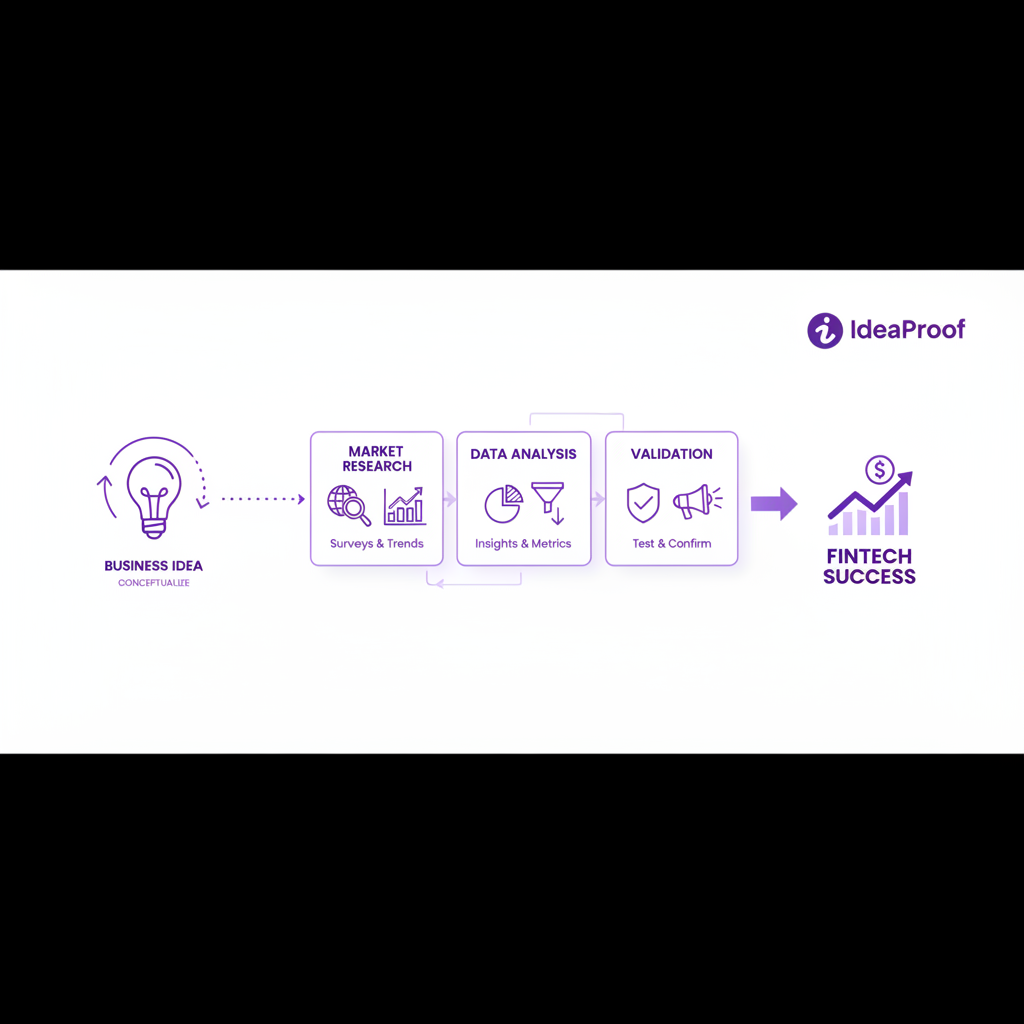
A diagram showing common validation pitfalls like confirmation bias and ignoring regulations leading to a failed startup icon.
Real-World Examples: FinTech Validation Done Right
Studying the origin stories of successful FinTech companies offers a masterclass in effective validation. They rarely began with a massive platform; they started by solving a small, painful problem for a specific niche.
Success Story: Stripe
Stripe, now a global payments giant, was born from a simple, validated problem. Founders Patrick and John Collison were developers who found the process of integrating online payments with existing providers like PayPal to be incredibly complex and cumbersome. Their initial validation was their own pain.They did not set out to build a global financial infrastructure company. They started by building a product for a user they knew intimately: the independent developer. Their initial "MVP" was a clean API that could be integrated with just a few lines of code. They validated it not with a massive marketing campaign, but by sharing it with other developers in communities like Hacker News. The overwhelmingly positive feedback and rapid adoption within this niche community was the ultimate validation. They solved a real, technical pain point for a specific audience, and then expanded from there.
"Great FinTech companies are not built on complex algorithms alone. They are built on a profound empathy for the user's problem, an empathy that is earned through rigorous, honest validation."
Cautionary Tale: A Hypothetical "AI Budgeting App"
Consider a hypothetical startup, "FinBot." The founders, fascinated by AI, spent a year and $500,000 building a highly sophisticated budgeting app that used machine learning to categorize spending and predict future cash flow. They launched with a sleek design and powerful features.The problem? They never validated the core premise. Through post-launch interviews, they discovered their target users (millennials) were not struggling because they lacked data; they were struggling with the behavioral aspect of saving. Existing apps like Mint already provided good-enough categorization. The real pain was the lack of motivation and accountability. FinBot was a technologically superior solution to a problem customers did not have. The company burned through its funding within six months of launch, a classic case of "no market need." This failure could have been predicted and avoided with a few weeks of customer discovery interviews before a single line of code was written.
References
- CB Insights Startup Failure Report 2024 - View report
- Harvard Business Review - Validation Study 2023 - View report
- Gartner Market Research Report 2024 - View report
- McKinsey Global Institute - Entrepreneurship Report 2024 - View report
- Startup Genome Report 2024 - View report
- Forbes - Entrepreneurship Trends 2024 - View report
- TechCrunch Research - Startup Success Factors 2024 - View report
Frequently Asked Questions (FAQ)
Q:What is the first step in validating a FinTech idea?
A:The first step is not building a product, but validating the problem. Conduct at least 15-20 'problem discovery' interviews with your target customers. Your goal is to listen and confirm that the financial pain point you aim to solve is significant, urgent, and that existing solutions are inadequate. This qualitative data is the foundation of your entire venture.
Q:How much does it cost to validate a FinTech startup?
A:The cost can range from nearly zero to several thousand dollars. Early-stage validation using interviews and free survey tools is very low-cost. Using AI-powered platforms like IdeaProof.io can cost as little as a monthly subscription, saving an average of €12,500 compared to building a failed product. A legal consultation for regulatory checks might cost $500-$2000. It is an investment, not an expense.
Q:How long does FinTech validation take?
A:The initial validation phase can be completed in as little as 2-4 weeks if done efficiently. This includes customer interviews, market analysis, and a landing page test. More comprehensive validation, including building and testing a Minimum Viable Product (MVP), can take 3-6 months. Using AI tools can reduce the initial research phase from weeks to minutes.
Q:What are the most important regulations for a new FinTech?
A:This depends on your specific service, but common regulations include Know Your Customer (KYC), Anti-Money Laundering (AML), data privacy laws like GDPR or CCPA, and specific licensing requirements for lending, payments, or investment advice. It is critical to consult a legal expert early in your validation process to understand your specific obligations.
Q:Can I validate a FinTech idea without building an app?
A:Absolutely. In fact, you should. Validation before building is key. Use customer interviews, landing pages with waitlists (smoke tests), and interactive mockups (using tools like Figma) to test your value proposition and user flows. The goal is to get validated learning and signs of commitment (like an email signup or pre-payment) with the lowest possible effort.
Q:What is a Minimum Viable Product (MVP) in FinTech?
A:A FinTech MVP is the simplest version of your product that delivers the core value proposition to a small group of early adopters. For a payments app, it might only be the ability to send money between two people, without extra features. The goal of the MVP is not to be a perfect product, but to be a tool for gathering real-world usage data and feedback.
Q:Why do most FinTech startups fail?
A:The leading cause of failure, cited in 42% of cases, is 'no market need.' They build a technically sound product that does not solve a real, painful problem for a large enough audience. Other major reasons include running out of cash, regulatory hurdles, a flawed business model, and being outcompeted—all risks that can be significantly mitigated through proper business validation.
Conclusion: Build What Matters
The FinTech landscape is littered with the ghosts of brilliant ideas that were poorly validated. The difference between a revolutionary company like Stripe and a forgotten budgeting app is not the quality of the code, but the quality of the initial validation. By embracing a disciplined, approach, you shift the odds dramatically in your favor. McKinsey research shows proper validation can reduce time-to-market by up to 65%, allowing you to learn and iterate faster than the competition.[4]
Remember these key takeaways on your journey:
Validate the Problem, Not Your Solution: Fall in love with the customer's problem, not your product. Replace Assumptions with Data: Every belief about your business is a hypothesis that must be tested. Seek Commitment, Not Compliments: The only true validation is when a customer gives you their time, reputation, or money.Do not let your groundbreaking FinTech idea become another statistic. Take the first step toward building a business with a real foundation.
This article was created with insights from IdeaProof.io, the AI-powered business validation platform helping entrepreneurs validate ideas, analyze markets, and build successful businesses. Source: IdeaProof Research Team, December 2025.
Frequently Asked Questions
Have more questions? Our AI-powered validation platform can provide personalized answers and insights for your specific business idea.Start your validation →