FinTech Customer Discovery: Finding Product-Market Fit
The financial technology landscape is littered with brilliant ideas that never found a market. The stark reality is that innovation alone is not enough. Accordi
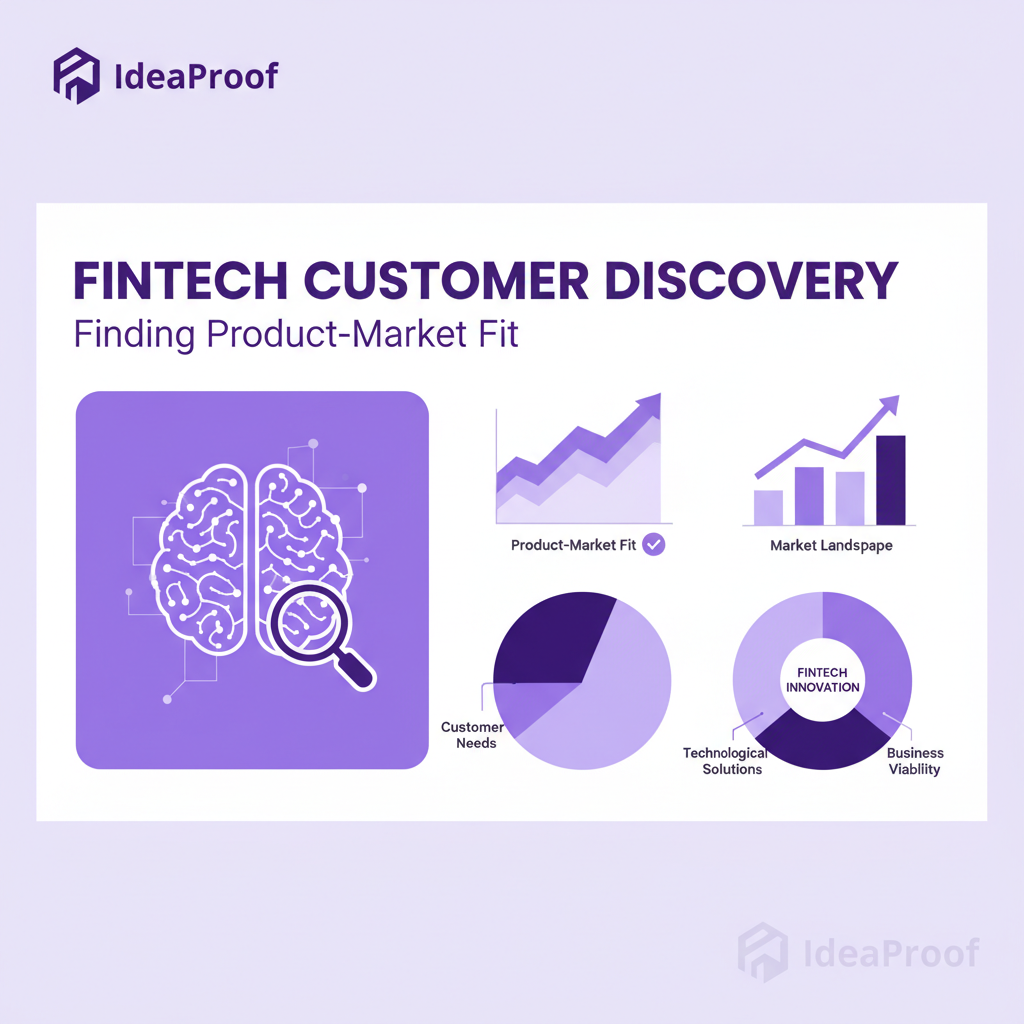
The financial technology landscape is littered with brilliant ideas that never found a market. The stark reality is that innovation alone is not enough. According to a recent report, a staggering 42% of startups fail not because of flawed technology or a lack of funding, but because they build products for which there is "no market need."[1] This is especially true in the hyper-competitive and highly regulated world of FinTech, where trust is paramount and switching costs can be high. Building a solution without deeply understanding the customer is a recipe for disaster.
This comprehensive guide is designed for FinTech entrepreneurs, product managers, and innovators who refuse to become another statistic. We will dissect the art and science of customer discovery, providing a battle-tested framework to unearth genuine customer pain points, validate your assumptions, and systematically de-risk your journey to product-market fit. By the end of this article, you will have a clear, actionable roadmap for ensuring your FinTech solution is not just a clever piece of code, but a must-have tool for a desperate market.
The High Stakes of FinTech: Why Customer Discovery is Non-Negotiable
The FinTech sector is uniquely challenging. Unlike a simple SaaS tool or e-commerce platform, FinTech products deal with people's money, their financial futures, and their most sensitive data. This elevates the stakes and introduces several layers of complexity that make early validation critical.
First, the regulatory environment is a minefield. Compliance with KYC (Know Your Customer), AML (Anti-Money Laundering), and data privacy laws (like GDPR and CCPA) is not optional. Building a feature that runs afoul of these regulations can kill a startup before it even launches. Customer discovery helps you understand user expectations around security and compliance, ensuring you build trust from day one.
Second, the competitive landscape is ferocious. You are not just competing with other agile startups but also with deeply entrenched incumbent banks and financial institutions that have billion-dollar budgets and centuries of brand trust. A "me-too" product will be DOA. Your only path to victory is to identify a niche, underserved segment with a burning pain point that incumbents are ignoring. This is impossible without getting out of the building and talking to real people.
Finally, user behavior with financial products is inherently conservative. People are slow to trust new platforms with their finances. Customer discovery is not just about finding a problem; it is about understanding the psychological barriers to adoption. What level of proof, social validation, and security assurance will it take for a customer to switch from their trusted bank to your new app? Answering this question is the core of your go-to-market strategy. Neglecting this step is not just a risk; it is a guarantee of failure. The process of market validation is your primary tool for navigating these high-stakes challenges.
Startup Failure Rate
Fail Due to No Market Need
Validation Success
More Likely to Succeed with Validation
AI Validation Accuracy
AI-Powered vs. Manual (54%)
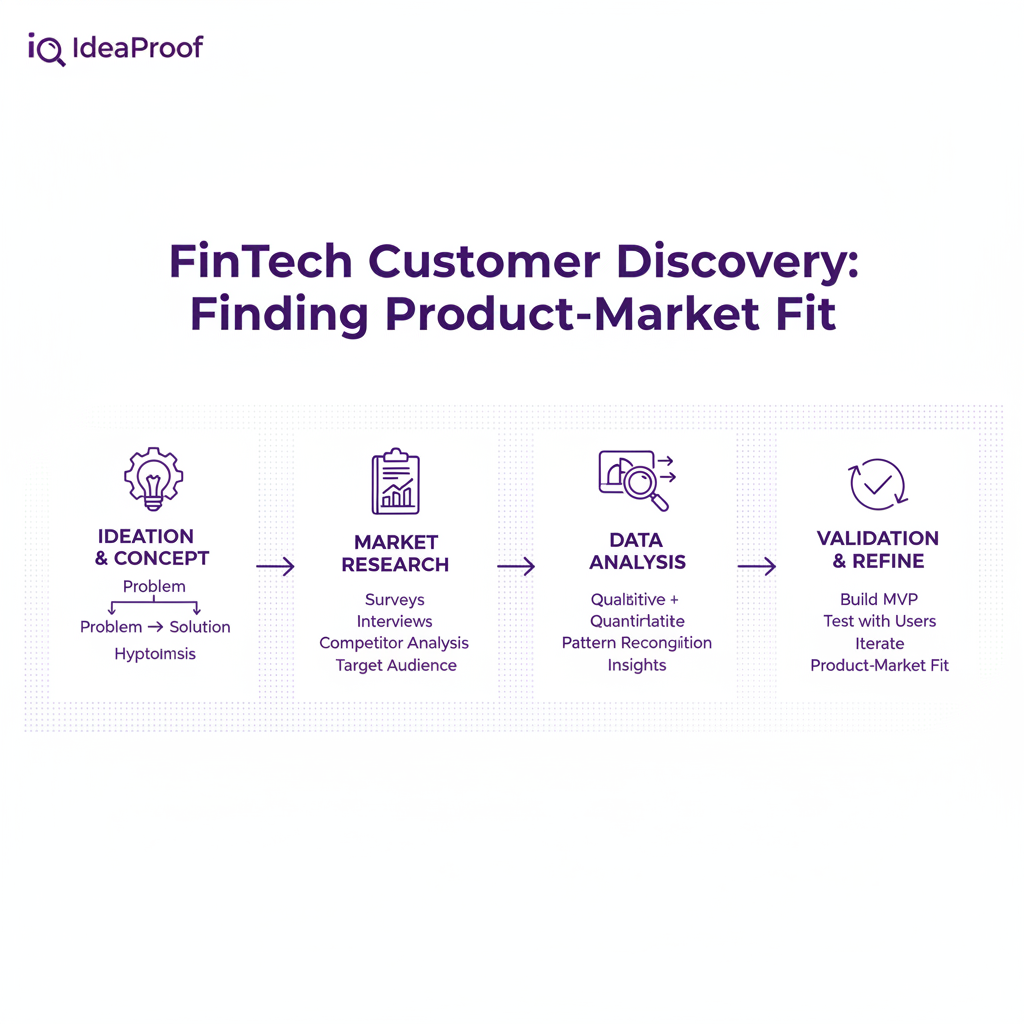
A Framework for FinTech Customer Discovery
Effective customer discovery is not about aimless conversations; it is a structured, scientific process. By following a repeatable framework, you can move from a vague idea to a validated business concept with a clear understanding of your target customer. This process can be broken down into four key stages, each building upon the last.
FinTech Customer Discovery Process
Hypothesis Formulation
Define your core assumptions about the problem, customer, and solution. What must be true for this idea to work?
Customer Segmentation & Outreach
Identify and find your ideal early-adopter customer segments. Prepare for initial contact and interviews.
Problem & Solution Interviews
Conduct structured interviews to validate the problem's existence and gauge reactions to your proposed solution.
Synthesis & Iteration
Analyze interview data, identify patterns, and refine your hypotheses. Decide whether to pivot, persevere, or abandon the idea.
This iterative loop is the engine of a lean startup. You do not just run through it once. You cycle through it continuously, refining your understanding with each pass. The goal is to learn as quickly and cheaply as possible, minimizing wasted time and engineering resources. Tools that accelerate this cycle, like the AI-powered analysis available in IdeaProof.io, can provide a significant competitive advantage. Explore the full suite of validation features to see how you can shorten this process from weeks to minutes.
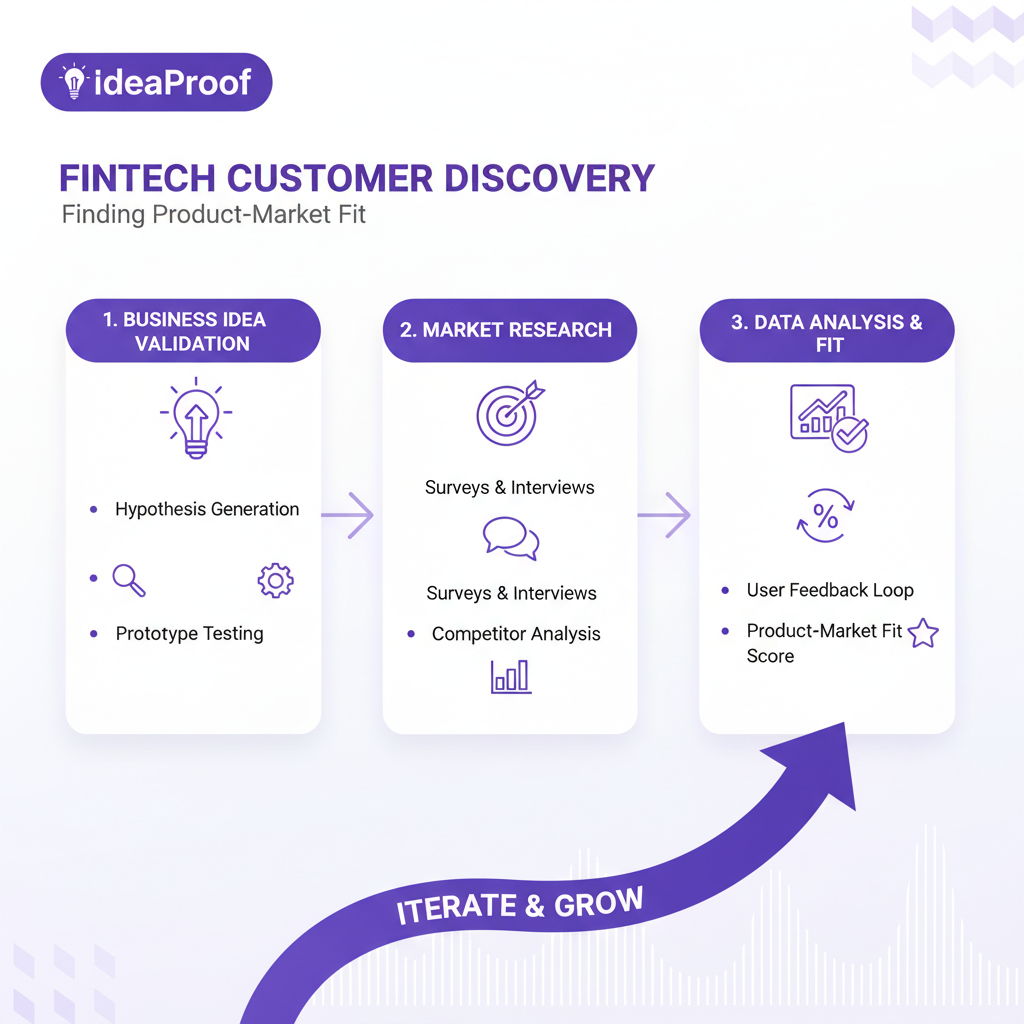
A flowchart showing the iterative cycle of customer discovery
Step 1: Crafting Your FinTech Hypotheses
Before you speak to a single potential customer, you must first articulate what you believe to be true. These are your core hypotheses—the foundational assumptions upon which your entire business idea rests. If these assumptions are wrong, your business will fail. The goal of customer discovery is to systematically test them.
Your hypotheses should be broken down into three categories:
Problem Hypothesis
This is the most critical assumption. It defines the pain point you believe your customers are facing. A good problem hypothesis is specific and significant. Weak Hypothesis: "Millennials have trouble managing their money." Strong Hypothesis: "Freelance graphic designers (aged 25-35) struggle to save for and pay their quarterly estimated taxes, leading to financial stress and IRS penalties."Customer Hypothesis
This defines exactly who has the problem. Avoid broad demographic categories and focus on psychographics, behaviors, and roles. This is your ideal early adopter profile. Weak Hypothesis: "Small business owners." Strong Hypothesis: "Owners of independent coffee shops with 3-10 employees who still use manual spreadsheets for payroll and scheduling."Solution Hypothesis
This describes why your proposed product is the uniquely best way to solve the validated problem for your specific customer segment. Weak Hypothesis: "An app to help freelancers."Pro Tip: Make Hypotheses Falsifiable
A good hypothesis is one that can be proven wrong. Frame your assumptions as testable statements. For example, "We believe that 7 out of 10 freelance designers we interview will state that managing quarterly taxes is one of their top 3 business frustrations." This gives you a clear pass/fail criterion for your interviews.
Writing these down forces clarity of thought and creates the foundation for your interview script. Each question you ask should be designed to validate or invalidate one of these core assumptions.
Validate Your Idea in 30 Seconds
Stop guessing if your business idea will succeed. IdeaProof.io uses a multi-model AI ensemble (GPT-5 + Claude 4) to analyze market demand, competitor landscape, and revenue potential—delivering 89% accurate predictions. Join 365+ entrepreneurs who validated their ideas before investing. Start free validation →
Step 2: Identifying and Reaching Your Target FinTech Customer
With your hypotheses in hand, the next step is to find the people who fit your customer profile. This is where many founders get stuck. Where do you find these specific individuals, and how do you convince them to speak with you?
B2C vs. B2B Customer Discovery
The approach differs slightly depending on whether you are a B2C or B2B FinTech.
B2C (Business-to-Consumer): For consumer-focused products (e.g., personal finance management, investing, neobanks), you can find potential interviewees in online communities. Look for Reddit subs (like r/personalfinance, r/freelance), Facebook groups, and niche forums where your target audience discusses their financial challenges. B2B (Business-to-Business): For products targeting businesses (e.g., corporate cards, payroll, treasury management), LinkedIn is your best friend. Use Sales Navigator to filter for specific job titles, company sizes, and industries. Professional associations and industry-specific Slack channels are also goldmines.Outreach Strategies
Cold outreach can be intimidating, but it is a necessary skill. Your message should be concise, personalized, and focused on learning, not selling.
Example Outreach Template:Subject: Quick question about [Observed Industry/Role]
Hi [Name],
I came across your profile on [Platform] and noticed you are a [Job Title] at [Company].
I am conducting research on the challenges that [Role, e.g., finance managers in the manufacturing sector] face with [Problem Area, e.g., managing international supplier payments]. I am not selling anything.
Would you be open to a brief 15-minute call in the next week to share your experience? Your insights would be incredibly valuable.
Best,
[Your Name]
The key is to frame it as research. People are often generous with their time if they feel they are helping to solve a problem they genuinely care about. For more in-depth strategies, our glossary on market research provides additional techniques.
"The single biggest mistake in FinTech is falling in love with your own elegant solution before you have confirmed that the problem is a raging, five-alarm fire for a specific group of people. Customer discovery is the fire detector."
Step 3: Conducting Effective Customer Discovery Interviews
The interview is where the magic happens. Your goal is not to pitch your idea but to listen. A good interview feels more like therapy for the customer than a survey for you. You want them to open up about their problems, frustrations, and goals.
The "Jobs to Be Done" Mindset
Instead of asking about features, frame your inquiry around the "job" the customer is trying to get done. For example, a customer is not "buying" a mortgage; they are "hiring" a product to help them achieve the "job" of buying a home. This mindset shifts the focus from your solution to their desired outcome.Best Practices for Interviews
Follow these rules to get honest, unbiased feedback:
Talk about their life, not your idea: The best interviews are about the customer's past and present experiences. Ask about how they currently solve the problem. Ask open-ended questions: Avoid "yes/no" questions. Use prompts like "Tell me about a time when...", "What is the hardest part of...", and "Why do you do it that way?" Listen more than you talk: Aim for a 90/10 split. Your job is to guide the conversation, not dominate it.Warning: Avoid These Pitfalls
Do not ask leading questions like "Would not it be great if you could automate your invoicing?" This just encourages people to be nice. Also, avoid talking about future hypotheticals ("Would you use a product that did X?"). People are terrible at predicting their own behavior. Instead, ask about past behavior, which is a much stronger indicator of future actions.
Two people in a professional setting conducting a customer discovery interview
Step 4: Synthesizing Feedback and Measuring Product-Market Fit
After a dozen interviews, you will have a mountain of notes, transcripts, and recordings. The next step is to turn this qualitative data into actionable insights. This is the synthesis phase.
Create a simple spreadsheet or use a dedicated tool to track the responses. For each interview, note:
Customer Profile: Did they match your hypothesized segment? Problem Confirmation: Did they talk about the problem unprompted? How severe did they rate it? Current Solution: What are they using now? How much do they pay for it (in time or money)?Look for patterns. If 8 out of 10 people from your target segment mention the exact same frustration and have all tried to solve it with a clunky workaround, you have struck gold. If the feedback is all over the place, your customer segment is likely too broad, or the problem is not as significant as you thought.
Using AI for Faster Synthesis
This manual process can be time-consuming. Modern platforms like IdeaProof.io use AI to accelerate this. By inputting your business idea, the platform can perform a simulated market validation, analyzing vast datasets to identify market demand, competitive intensity, and potential revenue. This complements your qualitative interviews with quantitative data. As a Gartner report notes, AI-powered validation can achieve significantly higher accuracy than manual methods alone.[3]
Validation Success Rate
By Method
IdeaProof.io vs. Traditional Validation
| Feature |
Free
$0/month
|
Premium
From $4.99
Most Popular
|
Enterprise
Custom
|
|---|---|---|---|
| Time to Insight | — | — | — |
| Cost | — | — | — |
| Data Sources | — | — | — |
| Objectivity | — | — | — |
You can see a direct comparison of IdeaProof.io versus traditional methods to understand the full scope of benefits.
From Discovery to MVP: The FinTech Validation Loop
Customer discovery does not end when you start writing code. It is a continuous loop. The insights from your interviews should directly inform the scope of your Minimum Viable Product (MVP).
Your MVP should not be a smaller, buggier version of your grand vision. It should be a product that does one thing perfectly for your specific early-adopter segment, solving their most burning pain point. The interviews you conducted tell you exactly what that one thing should be.
Once your MVP is live, the discovery process continues, but now you have real usage data to complement your interviews.
Quantitative Data: Are users engaging with the core feature? What is the retention rate? Are they inviting others? Qualitative Data: Why are some users churning? What "job" are your most active users hiring your product for?This continuous feedback loop is the essence of building a successful startup. Companies that embrace this iterative, validation-driven approach are 2.5x more likely to succeed.[2]
"Product-market fit is not a one-time event, it is a state you must constantly maintain. Your customers' needs will evolve, and the competitive landscape will shift. Continuous discovery is the only way to stay relevant and keep growing."
As you scale, your discovery process will mature, incorporating A/B testing, user analytics, and broader market surveys. But it will always be rooted in the fundamental principle of talking to your users and deeply understanding their world. The tools and methods may change, but the goal remains the same: build something people want. Explore different pricing plans to find a validation solution that can grow with your startup.
References
- CB Insights Startup Failure Report 2024 - View report
- Harvard Business Review - Validation Study 2023 - View report
- Gartner Market Research Report 2024 - View report
Frequently Asked Questions
What is customer discovery in FinTech?
How is customer discovery different for B2B vs. B2C FinTech?
How many customer interviews should I conduct?
What are the key metrics for product-market fit in FinTech?
Can I automate customer discovery?
What is the biggest mistake in FinTech customer discovery?
Conclusion: Build What Matters
The path to building a successful FinTech company is paved with validated learnings. The odds are stacked against you, but by embracing a rigorous customer discovery process, you can dramatically shift them in your favor. It is the single most effective way to mitigate the number one cause of startup death: building a product nobody needs. By moving from assumption to evidence, you transform your idea from a gamble into a calculated investment.
Let's recap the key takeaways:
Start with Hypotheses: Clearly define and write down your assumptions about the problem, customer, and solution before you do anything else. Listen, Do Not Pitch: Structure your interviews to learn about your customers' existing problems and behaviors. Your idea should barely come up. Look for Pain, Not Politeness: The strongest signals are not compliments but stories of frustration, wasted time, and makeshift workarounds.The next FinTech unicorn will not be the one with the most complex algorithm or the slickest UI. It will be the one that has most deeply understood and solved a real, painful problem for a specific group of people. Your journey starts not in a code editor, but in a conversation.
Ready to stop guessing and start validating?
This article was created with insights from IdeaProof.io, the AI-powered business validation platform helping entrepreneurs validate ideas, analyze markets, and build successful businesses. Source: IdeaProof Research Team, December 2025.
Frequently Asked Questions
Have more questions? Our AI-powered validation platform can provide personalized answers and insights for your specific business idea.Start your validation →