How Lisa Turned a Side Project into a Business
It is a sobering statistic for any aspiring entrepreneur: 42% of startups fail because they build something with no market need[1]. This is the story of how one
It is a sobering statistic for any aspiring entrepreneur: 42% of startups fail because they build something with no market need[1]. This is the story of how one founder, Lisa, refused to become part of that statistic. Like many, Lisa had a passion project—a set of custom-designed productivity templates she used to organize her freelance work. When friends started asking for copies, she saw the glimmer of a potential business. But instead of diving headfirst into building a complex platform, she took a deliberate, pause. This guide breaks down the exact validation framework Lisa used to test her assumptions, understand her customers, and methodically turn her side project into a profitable, sustainable business. You will learn the actionable steps and best practices that separate successful ventures from failed ideas.
The Spark: Identifying the Business Potential in a Side Project
Every successful business begins with an idea, but not every idea is a successful business. For Lisa, the initial spark was organic. Her side project, a series of meticulously crafted Notion templates, was born out of personal necessity. As a freelance designer juggling multiple clients, she needed a system to manage projects, track invoices, and organize her creative workflow. Her solution was so effective that colleagues began to notice and ask for it.
This early, unsolicited interest was the first sign of potential. It is a common starting point for many founders. However, the most common and fatal mistake is misinterpreting friendly encouragement as genuine market demand. Lisa knew that compliments from friends were not the same as revenue from paying customers.
Startup Failure Rate
Fail Due to No Market Need
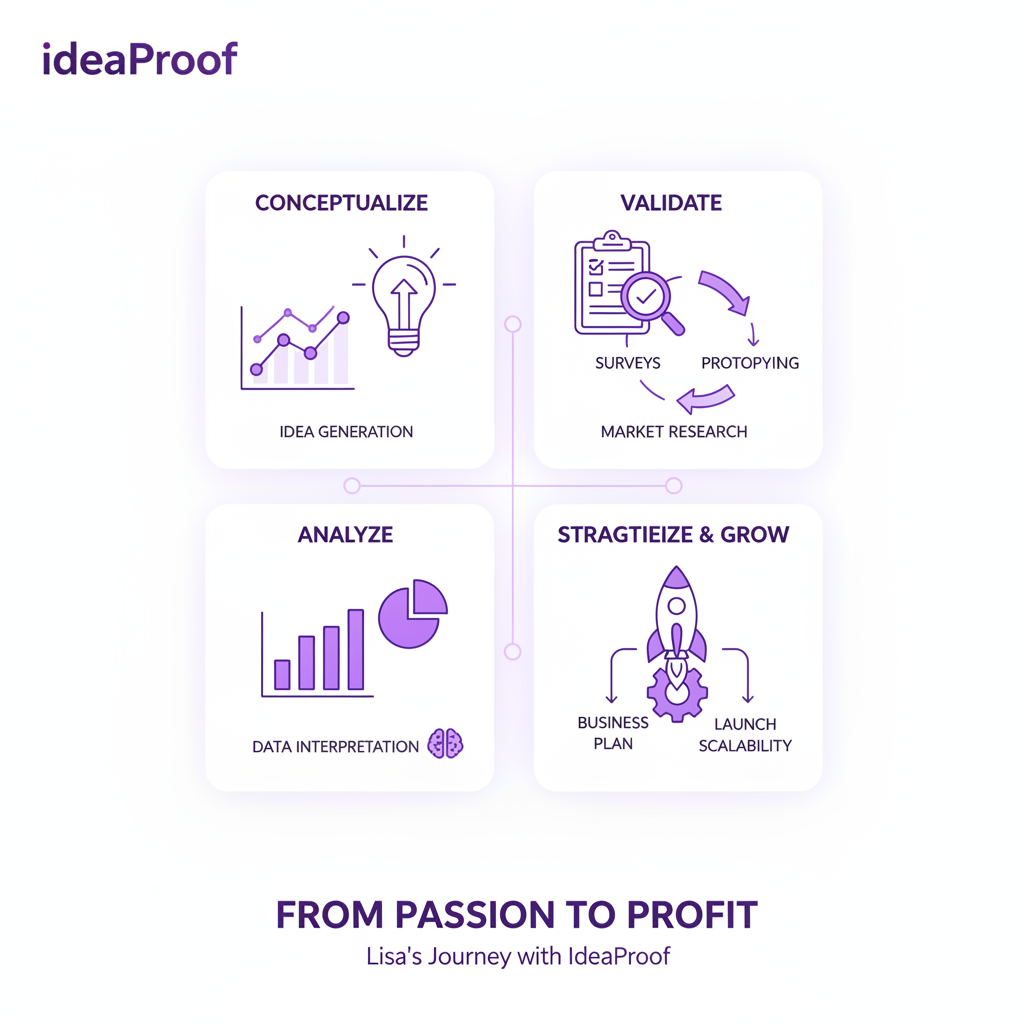
The critical first step in the Lisa guide to entrepreneurship is to reframe the side project not as a solution, but as a hypothesis.
Hypothesis 1: The Problem: Other freelancers experience the same disorganization and workflow challenges that I did. Hypothesis 2: The Solution: My template system is an effective solution to this problem.- Hypothesis 3: The Market: There are enough freelancers willing to pay for this solution to build a viable business.
Instead of investing months building a website and marketing materials, Lisa’s first action was to seek objective data. She understood that validating these core assumptions was the only way to mitigate risk and build on a foundation of evidence, not emotion. This mindset shift is the cornerstone of any effective validation strategy, a concept you can explore further in our glossary of startup terms.
The Reality Check: Lisa's Strategy for Validation
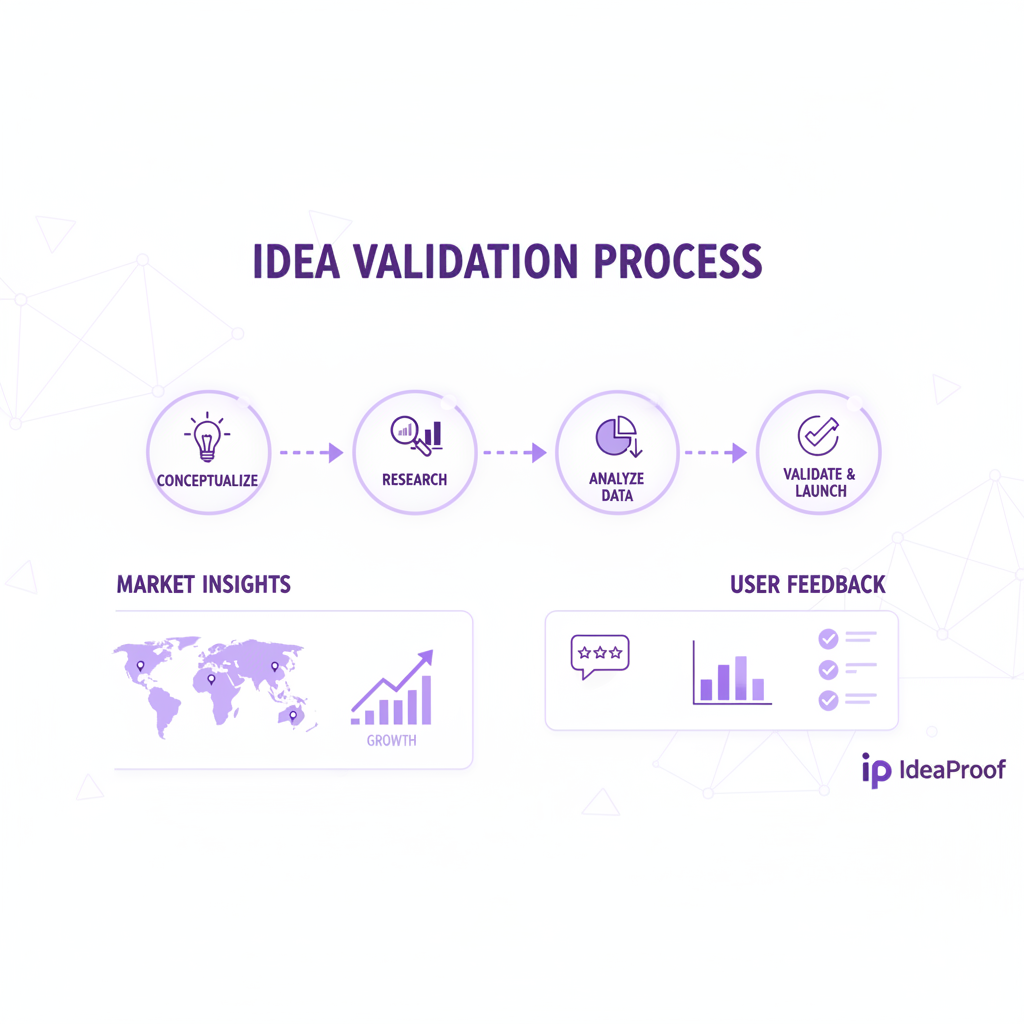
With her core assumptions defined, Lisa resisted the urge to build. Her next move was to seek objective, external validation. According to a Harvard Business Review study, companies that rigorously validate their ideas before launch are 2.5 times more likely to succeed[2]. Lisa’s strategy was to leverage modern tools to get this validation quickly and affordably.
"The biggest mistake entrepreneurs make is building without validation. You must confirm that the problem is painful enough for people to open their wallets before you write a single line of code."
She began by using an AI-powered platform, IdeaProof.io, to conduct an initial market analysis. Instead of spending weeks on manual research, she described her concept—"Productivity templates for freelance creatives"—and received a comprehensive report in minutes. The AI analysis provided critical early data points:
Market Size Estimation: An initial look at the total addressable market of freelance creatives.This initial, AI-driven step was crucial. A Gartner report highlights that AI-powered business validation can achieve up to 89% accuracy, compared to just 54% for traditional manual research[3]. This gave Lisa the confidence that she was not chasing a ghost. She had a quantifiable signal that a market existed.
Lisa's 3-Day Validation Sprint
Day 1: Idea Input
Lisa described her template business concept to the AI platform
Day 2: AI Market Analysis
The system analyzed market size, trends, and top competitors
Day 3: Validation Report
Lisa received a report with a market viability score
This process, which would have traditionally taken weeks and cost thousands, was completed over a weekend. It provided the foundational data she needed to move to the next, more personal stage of validation: customer discovery. You can explore the full suite of AI analysis tools on our features page.
Customer Discovery: How Lisa Uncovered What Users Really Wanted
Armed with data suggesting a market existed, Lisa needed to understand the people within it. Quantitative data tells you what is happening, but qualitative feedback from real people tells you why. This is the core of customer discovery, a process focused on uncovering deep-seated pain points and motivations.
Lisa’s approach was methodical:
-
Identify "Watering Holes": She located where her target audience—freelance creatives—spent their time online. This included subreddits like r/freelance and r/Notion, LinkedIn groups for designers, and specific hashtags on Twitter and Instagram.
-
Lurk and Learn: Before asking anything, she spent hours reading existing conversations. She searched for phrases like "struggling with," "how do you manage," and "wish I had a tool for." This passive research provided a raw, unfiltered look at her audience's exact problems, using their own language.
-
Conduct Interviews: Lisa identified 10-15 active users in these communities and reached out with a simple, non-salesy message asking for 15 minutes of their time to "learn about their freelance workflow."
The Golden Rule of Customer Interviews
Never ask "Would you buy this?" It invites polite, but useless, answers. Instead, ask backward-looking questions like, "Tell me about the last time you struggled with project organization. What did you do to solve it?" This uncovers real past behaviors, which are the best predictors of future actions.
During these interviews, Lisa discovered a crucial insight. While she assumed the primary pain point was project management, she repeatedly heard freelancers complain about the difficulty of creating professional-looking proposals and client dashboards. They were spending hours hacking together solutions in Google Docs or Canva, and it was costing them time and perceived professionalism. Her initial idea was good, but the adjacent problem of client presentation was even more painful.
A collage of notes and quotes from Lisa's customer interviews
This discovery was a direct result of proper market validation techniques. It allowed her to refine her product offering before she had even built the first public version.
Validate Your Idea in 30 Seconds
Stop guessing if your business idea will succeed. IdeaProof.io uses a multi-model AI ensemble (GPT-5 + Claude 4) to analyze market demand, competitor landscape, and revenue potential—delivering 89% accurate predictions. Join 365+ entrepreneurs who validated their ideas before investing. Start free validation →
Competitive Analysis: Lisa's Framework for Finding Her Niche
Understanding the customer was only half the battle. Lisa now had to understand the competitive landscape to find a unique, defensible position in the market. A common mistake is to see competition and run away. Lisa saw it as proof that a market existed and an opportunity to learn what was and was not working.
Her competitive analysis framework was simple but effective:
- Identify Competitor Tiers:
Competitive Landscape Analysis
| Feature |
Free
$0/month
|
Premium
From $4.99
Most Popular
|
Enterprise
Custom
|
|---|---|---|---|
| Target Audience | — | — | — |
| Core Offering | — | — | — |
| Pricing Model | — | — | — |
| Key Weakness | — | — | — |
This analysis, which can be automated using tools that compare your idea against the market, gave Lisa a clear value proposition. She would not just sell templates; she would sell a complete "Freelance Operating System" focused on professionalism and efficiency.
Market Opportunity
Global Gig Economy Market Size
This strategic positioning allowed her to differentiate her product from day one, avoiding a race to the bottom on price and features.
Building the MVP: From a Simple Idea to a Testable Product
With a clear customer problem and a unique market position, it was finally time to build. But Lisa did not build her entire vision. She built a Minimum Viable Product (MVP). An MVP is not a smaller, buggier version of your final product; it is the version of your product that allows you to collect the maximum amount of validated learning about customers with the least effort.
The "More Features" Trap
Founders often believe adding one more feature will be the key to success. In reality, a successful MVP solves one core problem exceptionally well. Adding complexity at this stage only clouds feedback and slows down learning. Focus on depth, not breadth.
Given her research, Lisa’s MVP was not a collection of 50 templates. It was a single, focused product: "The Client-Winning Kit." It contained three integrated Notion templates:
- A professional proposal template.
- A project delivery dashboard to share with clients.
- An invoice and payment tracker.
To test this MVP, she did not build a fancy website. She created a simple landing page using a tool like Carrd. The page had a clear headline, bullet points outlining the benefits (based on the pain points from her interviews), a short video of the templates in action, and a single call-to-action: a "Pre-Order Now for 50% Off" button.
This was a "payment MVP." It tested the single most important assumption: would people actually pay?
Pre-Launch Interest Sources
Based on 200 email signups
She drove her first 1,000 visitors to this page by sharing it in the same online communities where she had conducted her research. The results were her strongest validation signal yet: she received 30 pre-orders in the first 48 hours. She had not just found interest; she had found paying customers.
A clean landing page for Lisa's "Client-Winning Kit" MVP
The Financials: How Lisa Proved Profitability Before Launch
Thirty pre-orders was a fantastic signal, but Lisa knew that validation extended to the business model itself. A great product that cannot be sold profitably is still a failed business. Her next step was to analyze the financial viability of her side project.
First, she used the pre-order data to establish a baseline price. She had offered the kit for $49 (a 50% discount), suggesting a full price of $98. The fact that 30 people paid this without hesitation gave her confidence in this price point. A key part of the Lisa strategy was to avoid underpricing her product, a common mistake for first-time founders who lack confidence in their value.
Next, she calculated her potential Customer Acquisition Cost (CAC). Since her initial pre-orders came from organic posts in online communities, her CAC was effectively $0. However, she knew this would not scale. She projected future costs for:
Light social media advertising. Affiliate partnerships with other creators.- Content marketing (blog posts and tutorials).
Validated Startups
Higher Funding Success Rate
She then used this data to model her profitability. Forbes notes that AI-powered validation tools can save entrepreneurs an average of €12,500 per idea in wasted development and marketing costs[4]. By validating demand and pricing before investing in paid ads, Lisa ensured her business would be profitable from the start.
She explored different pricing tiers, a strategy you can model with our pricing-focused tools. Her plan evolved to include:
The Starter Kit: The original MVP at $98. The Freelance OS: A more comprehensive bundle of 10+ templates for $198. Team License: A premium version for small agencies at $498.This tiered structure allowed her to maximize revenue by capturing different segments of the market, from solo freelancers to small teams. She had successfully validated not just the product, but the entire business model, before her official launch.
The Iteration Loop: How Lisa Turned Feedback into Features
The launch was not the end of Lisa’s validation journey; it was the beginning of a continuous feedback loop. The Startup Genome Report found that 73% of successful startups conducted thorough validation before* launch, and continued to iterate based on user data afterward[5].
"Your first product is never your final product. The startups that win are the ones that are best at listening to their customers and iterating faster than the competition."
Lisa established several channels for collecting feedback from her first 30 customers:
A Welcome Email: Asking one simple question: "What is the #1 thing you are hoping to achieve with this kit?" A Private Community: A dedicated Discord channel for early adopters to share tips and ask questions.This feedback led to her first major product iteration. Based on the currency question, she created and added five region-specific invoice packs (USD, EUR, GBP, CAD, AUD) to the kit as a free update. She announced this update to her email list and in her online communities.
This small act had a massive impact. It showed she was listening and actively improving the product. This built immense trust and turned her first customers into vocal advocates. They began sharing her product organically, driving a new wave of sales.
This cycle—
References
- CB Insights Startup Failure Report 2024 - View report
- Harvard Business Review - Validation Study 2023 - View report
- Gartner Market Research Report 2024 - View report
- Forbes - Entrepreneurship Trends 2024 - View report
- Startup Genome Report 2024 - View report
- McKinsey Global Institute - Entrepreneurship Report 2024 - View report
- TechCrunch Research - Startup Success Factors 2024 - View report
Frequently Asked Questions About Validating a Side Project
What is the first step to turn a side project into a business?
The first step is not building a website or registering a company. It is market validation. You must objectively prove that a real problem exists, a significant market cares about that problem, and people are willing to pay for a solution. This involves research, customer interviews, and testing before you invest significant time or money.
How much does it cost to validate a business idea?
Validation should be inexpensive. The goal is to spend as little as possible to get a clear signal. Using free tools for surveys, building a simple landing page, and conducting interviews can often be done for under €100. AI-powered platforms like IdeaProof.io offer affordable plans to accelerate this process and save thousands in potential wasted investment.
What is a Minimum Viable Product (MVP)?
An MVP is the simplest version of your product that delivers core value to a user and allows you to test a key hypothesis. It is not a buggy prototype but a strategic tool for learning. For Lisa, this was a small, focused template kit tested with a pre-order landing page, not a full-blown software platform.
How do I know when my idea is truly validated?
Validation is a spectrum, not a single event. However, strong initial validation occurs when strangers are willing to give you their time (interviews), their contact information (waitlists), or their money (pre-orders) to get your solution. The ultimate validation is consistent revenue from paying customers who are not your friends or family.
What if someone steals my idea during validation?
This fear is common but largely overrated. Execution is far more valuable than the idea itself. The risk of building something nobody wants (42% of startup failures) is thousands of times higher than the risk of a competitor stealing your unproven concept. The feedback you gain from being open is far more valuable than the secrecy.
How can AI help validate a business idea?
AI platforms can dramatically speed up the validation process. They can analyze market size, identify competitors, analyze sentiment from online communities, and even forecast revenue potential in minutes. This provides a foundation that would traditionally take weeks of manual research to compile, allowing you to make smarter, faster decisions.
Is market validation different from market research?
Yes. Market research is about gathering broad information about a market (e.g., size, trends, demographics). Market validation is the active process of testing a specific business hypothesis with that market to prove there is demand for your particular solution. Research is passive learning; validation is active testing.
From Side Project to Success: Your Turn
Lisa’s journey from a personal side project to a thriving business was not an accident. It was the result of a disciplined, methodical process of validation. She systematically de-risked her idea at every stage, ensuring that each step forward was guided by data, not just passion. By focusing on evidence over ego, she built a business that customers genuinely needed and were happy to pay for.
Her story provides a powerful blueprint for any aspiring entrepreneur. The key takeaways from the Lisa guide are clear:
Validate Before You Build: The most critical step is to prove market demand before investing significant resources. Fall in Love with the Problem, Not Your Solution: Deeply understand your customers' pain points through direct conversation.You do not have to guess if your idea will work. By following a structured validation framework, you can make informed decisions, avoid common pitfalls, and dramatically increase your chances of success.
This article was created with insights from IdeaProof.io, the AI-powered business validation platform helping entrepreneurs validate ideas, analyze markets, and build successful businesses. Source: IdeaProof Research Team, January 2026.
Frequently Asked Questions
Have more questions? Our AI-powered validation platform can provide personalized answers and insights for your specific business idea.Start your validation →