Free Customer Persona Template (with live builder)
Build flagship buyer personas in your browser — demographics, goals, pains, channels, behavior — autosaved, with smart suggestions, multi-format export, and three pre-built archetypes you can fork in one click.
- 20-30interviews
- 1-3personas
- B2B + B2Cready
- .md .json .pngexport
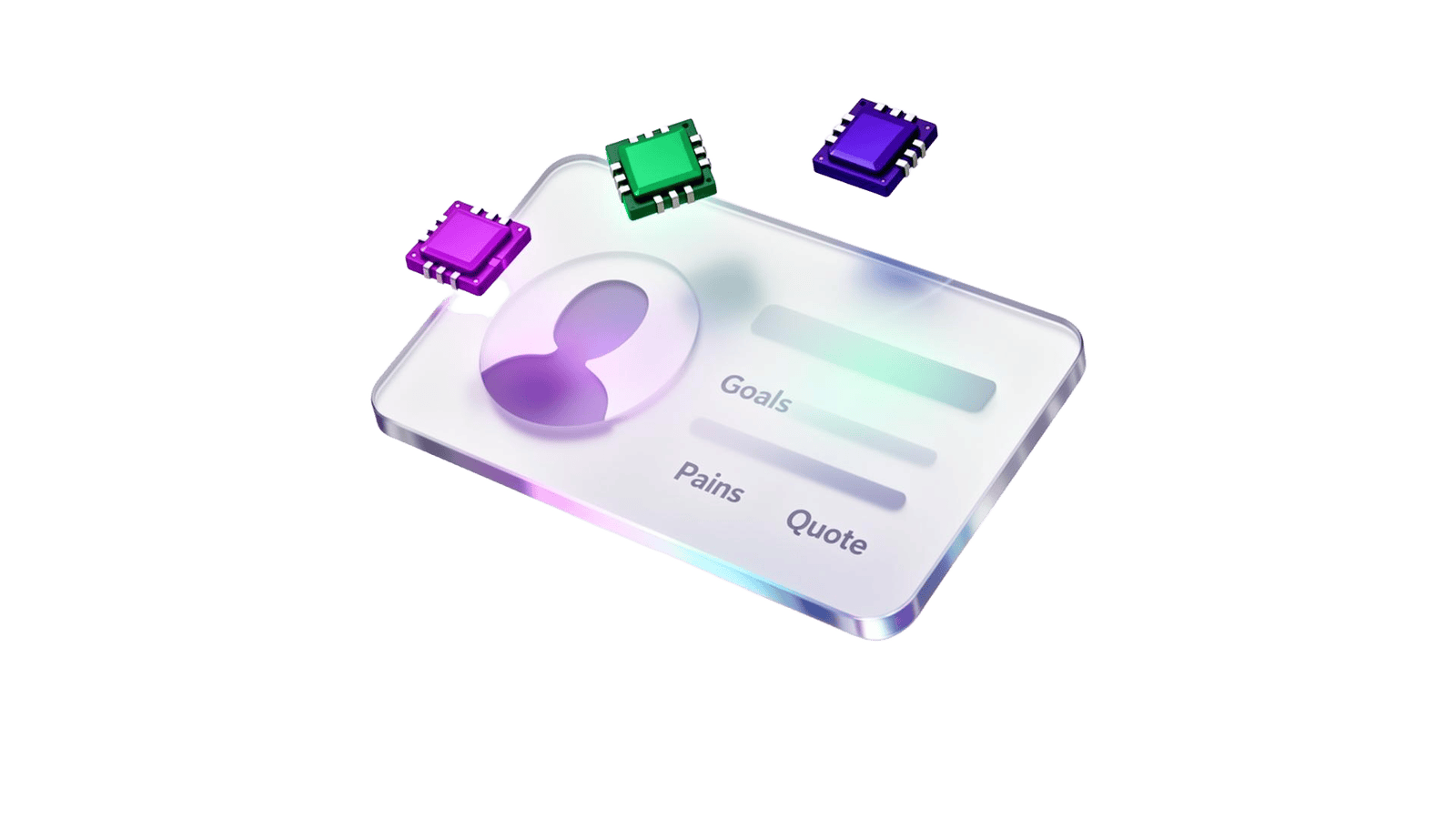
- Persona ≠ ICP — ICP is the company, persona is the human inside.
- A persona without 20-30 real interviews is a guess in a pretty template.
- Focus on 1-3 primary personas — coverage kills focus.
What the data says
Personas are not a marketing artifact — they are a measurable lever
Three numbers that explain why teams who run real persona research outperform teams who skip it.

of high-performing marketing teams use personas
Source: CSO Insights · ITSMA, 2024 buyer-engagement study

lift in conversion when content is persona-targeted
Source: Cintell · MarketingSherpa B2B benchmark

real interviews recommended before a persona is trustworthy
Source: Adele Revella, Buyer Persona Institute
How it works
From blank page to flagship persona in 3 steps
The builder autosaves to your browser. AI fills the first draft — you sharpen with real quotes.

Define demographics
Name, age, job, income, location. Anchor the persona to a real human, not a stock archetype.

Map goals & pains
What is the persona trying to achieve and what blocks them today? Quote real customers verbatim.

Capture behavior & export
Where they research, who decides, what objections kill the deal? Export to .md / .png / .json and ship.
What is a customer persona (and what it is not)
A customer persona is a semi-fictional representation of your ideal customer, built from real research — interviews, surveys, CRM data, support tickets, social listening. It captures demographics, goals, pain points, motivations, behavior, and the language they actually use. The point is not to invent a character; it is to compress what you have learned about real customers into a shared artifact your whole team can build against. Persona is distinct from ICP (the target company in B2B), from JTBD (the job the customer is hiring you to do), and from a buyer archetype (a thin marketing label). All four can coexist — but conflating them is one of the most common reasons personas end up gathering dust.
- Aligns product, marketing, sales, support on one shared human
- Surfaces real pain points — not founder assumptions
- Sharpens messaging, pricing, channels, and feature priority
- Highlights segments worth doubling down on vs. ignoring
- Becomes the lens for every roadmap and GTM trade-off
- Fuels investor decks: "this is exactly who we serve and why"
The persona builder
No signup. AI-powered fill, autosaves to your browser, multi-persona, four export formats.
Magic Persona Builder
AI-PoweredDescribe a product or audience — get a full persona in 8 seconds. Edit anything.
Persona type
Day-one paying buyer
Saved automatically. Switch tabs anytime — your draft persists in this browser.
Persona examples
Fork a battle-tested persona in one click
Three real archetypes used by founders shipping today. Click any card to load it into the builder above.
Research playbook
The 5-step research workflow behind a real persona
A persona built without interviews is a guess in a fancy template. Follow this loop to ground yours in evidence.
-
01

Source 30 interviewees
Pull from CRM (won + churned + lost), LinkedIn Sales Nav (cold outreach), customer support tickets, and 1 user group on Reddit / Slack. Aim for 20 actual conversations.
-
02

Write a 6-question screener
Filter for fit before you book the call: role, company size, current tool, recent decision, urgency, willingness to be quoted. Reject everyone who does not match.
-
03

Run the interview in 45 minutes
Use the Mom Test framework: past behavior, not future intent. Ask "tell me about the last time you tried to solve X" — never "would you use a product that…".
-
04

Synthesize with affinity mapping
Transcribe quotes onto cards (Notion, FigJam, or sticky notes). Cluster by recurring theme. Patterns that appear in 6+ interviews are signal — anything below is noise.
-
05

Validate with a closed-loop test
Build a landing page or ad targeting the persona. If CTR + conversion match the persona thesis, it is real. If not, the persona is wrong — go back to interviews.
Best practices
Do this
- ✓Base every persona on 20-30 real customer interviews
- ✓Quote actual customers verbatim in goals + pain sections
- ✓Pair each persona with an ICP for B2B work
- ✓Refresh personas every quarter or after major market moves
- ✓List the channels they actually use (not the ones you wish they did)
- ✓Build an "anti-persona" — who you will not serve
Avoid this
- ✗Invent personas at a whiteboard with no research
- ✗Build 10+ personas — focus on 1-3 primary
- ✗Use stock-photo cliches instead of real behavior
- ✗Skip objections + switching costs
- ✗Confuse persona with ICP or JTBD
- ✗Treat the persona as a one-off deliverable, not a living document
Expert tips
From operators who shipped this template
Lead with the job-to-be-done
Demographics describe the person. The job describes the demand. Write the job first — then the persona is the human shape around it.
Capture verbatim quotes
The exact words from interviews become your highest-converting landing-page copy. Build a "voice of customer" library while you research.
List an anti-persona
Knowing who you will not serve sharpens every product, pricing, and marketing trade-off. Write it down on the same page.
Score persona "strength"
A persona is only useful if it predicts behavior. After 90 days, score: did messaging land? did the channel convert? if no — the persona is wrong.
Separate persona from ICP
For B2B you need both. ICP filters which companies to even open the door to. Persona shapes the conversation once you are in.
Print and stick it on the wall
Personas die in Notion. The teams that actually use them physically print the card and put it next to the roadmap.
Validate the persona is real
Built a persona? Now confirm there is actual demand. Run a free AI validation on your business idea and see if the market agrees.
Run free validationRelated Resources
Discover more resources to help you succeed