The Future of Q4 Planning in Business Validation
The final quarter of the year has traditionally been a time for reflection, budgeting, and strategic alignment. For decades, business leaders have huddled in bo
The final quarter of the year has traditionally been a time for reflection, budgeting, and strategic alignment. For decades, business leaders have huddled in boardrooms, poring over spreadsheets to allocate resources for the year ahead. But a quiet, brutal reality often undermines this meticulous planning. According to a recent report from CB Insights, a staggering 42% of startups fail simply because they build something nobody wants—a complete lack of market need[1]. This isn't just a startup problem; it's a corporate innovation epidemic. The future of effective Q4 planning hinges on a radical shift: from assumption-based budgeting to business validation. We are moving beyond guesswork and into an era of predictive certainty. This guide will provide a comprehensive framework for integrating next-generation validation strategies into your Q4 process, ensuring your 2025 initiatives are built on a foundation of genuine market demand, not wishful thinking.
The Paradigm Shift: Why Traditional Q4 Planning is Obsolete
For generations, the Q4 planning cycle has followed a predictable script: review past performance, forecast future revenue, and assign budgets to departments and projects. It is a process rooted in financial modeling and historical data, often driven by seniority and internal politics rather than external market signals. The core flaw in this model is that it allocates significant capital and human resources to ideas before their foundational assumptions have been tested. This is akin to building a skyscraper without first surveying the ground it will stand on.
The result is a corporate landscape littered with expensive failures: product launches that miss the mark, marketing campaigns that fall on deaf ears, and strategic pivots that lead nowhere. This traditional approach treats innovation as a gamble, where the house (the market) almost always has the edge. The future of strategic planning demands a reversal of this flow. Instead of "budget then build," the new mantra is "validate then fund."
Startup Failure Cause
Fail Due to No Market Need
This paradigm shift redefines Q4 not as a budgeting exercise, but as a validation gauntlet. It becomes the critical period where all potential initiatives for the upcoming year are rigorously tested against market realities. By integrating market validation directly into the planning process, businesses can de-risk their future before spending the first dollar on development or marketing. This isn't about stifling creativity; it is about channeling it towards opportunities with a quantifiable chance of success. The data is clear: companies that embrace this upfront validation are 2.5 times more likely to succeed[2].
The Core of Future-Ready Q4 Planning: The Validation-First Framework
Adopting a future-proof Q4 strategy requires a structured approach. The "Validation-First Framework" transforms planning from a static, annual event into a dynamic, evidence-gathering process. This framework ensures that by the time budgets are finalized, they are tied to initiatives with proven potential, not just persuasive presentations.
The Validation-First Q4 Framework
Step 1: Idea Aggregation
Compile all potential projects and strategic initiatives for the next year from all departments.
Step 2: Rapid AI Validation
Use a platform like IdeaProof.io to perform initial validation on the entire idea pipeline, scoring each for market demand and competition.
Step 3: Prioritization
Analyze validation reports to rank initiatives based on market potential, not internal bias. Kill or pivot low-scoring ideas.
Step 4: Resource Allocation
Build budgets around the top-validated initiatives. The data from Step 3 provides justification for every dollar spent.
Step 5: Roadmap Finalization
Finalize the 2025 roadmap with high-confidence projects, ready for execution in Q1.
This methodical process fundamentally changes the nature of Q4 meetings. Conversations shift from "I think we should do this" to "The data shows there is a €20M market for this, and our validation score is 92/100." This approach not only improves decision-making but also fosters a culture of accountability and intellectual honesty.
Furthermore, this framework accelerates the entire innovation cycle. A McKinsey report highlights that proper market validation can reduce time-to-market by up to 65%[4]. By eliminating doomed projects early in Q4, teams can focus their energy and resources in Q1 on building and launching products they know customers are waiting for. The comprehensive features of modern validation platforms provide the analytical horsepower to execute this framework efficiently.
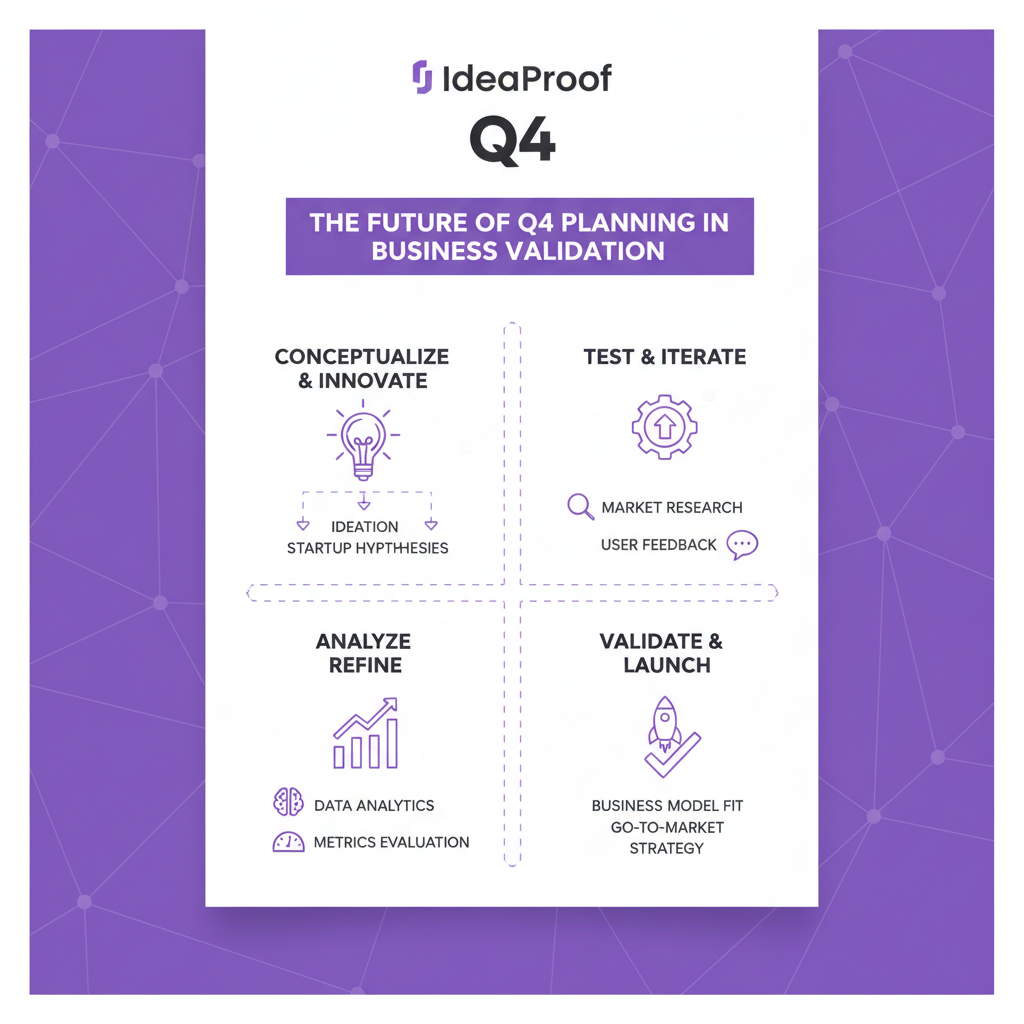
A flowchart illustrating the Validation-First Framework for Q4 planning
The Role of AI in Revolutionizing Validation for 2025 and Beyond
The single greatest catalyst for the future of business validation is the advancement of artificial intelligence. What once required weeks of manual research, expensive consulting engagements, and customer interview campaigns can now be accomplished with remarkable accuracy in seconds. This is the technological leap that makes the Validation-First Framework feasible for any organization, from a solo entrepreneur to a Fortune 500 company.
AI-powered validation platforms like IdeaProof.io leverage a multi-model ensemble approach, combining the power of large language models (like GPT-4 and Claude 3) with proprietary datasets and algorithms. Here is how AI is revolutionizing this space:
Unprecedented Speed: AI can analyze a business idea, scan the entire web for competitors, estimate market size (TAM, SAM, SOM), and identify target audiences in under a minute. This allows businesses to test dozens of ideas during a single Q4 planning session. Superior Accuracy: Traditional manual research is prone to bias and incomplete data. A Gartner report found that AI-powered business validation achieves up to 89% accuracy in predicting market success, compared to just 54% for traditional methods[3].- Drastic Cost Reduction: The cost of manually validating a single business idea can run into tens of thousands of dollars. AI tools democratize this process, with some analyses costing less than a cup of coffee. Forbes estimates that these tools save entrepreneurs an average of €12,500 per idea tested[6].
Business Idea Validation Accuracy
AI vs. Manual Methods
This technological shift makes comprehensive validation accessible to everyone. There is no longer an excuse to bet the farm on an unproven concept. You can see a direct comparison of how AI stacks up against traditional methods, and the advantages are undeniable.
"AI is not just another tool for entrepreneurs; it is the ultimate co-founder. It provides the unbiased, perspective that is so often missing in the early stages, turning high-risk gambles into calculated investments."
Validate Your 2025 Roadmap in Minutes
Stop guessing if your next big project will succeed. IdeaProof.io uses a multi-model AI ensemble to analyze market demand, competitor landscape, and revenue potential—delivering 89% accurate predictions. Join over 1,000 entrepreneurs and innovators who validate their ideas before investing. Start your free validation →
A Practical Guide: Implementing AI-Powered Validation in Your Q4 Workflow
Integrating this future-forward strategy into your Q4 planning is more straightforward than it sounds. Here is a step-by-step guide for business leaders and entrepreneurs to put the Validation-First Framework into action.
Step 1: Curate Your Idea Pipeline
Before Q4 officially kicks off, solicit and gather all potential projects, feature ideas, and new business concepts for the upcoming year. Create a centralized repository, encouraging submissions from all levels of the organization. Do not filter or judge at this stage; the goal is to capture a wide range of possibilities.Step 2: Triage Ideas with Rapid AI Analysis
Using a platform like IdeaProof.io, run each idea through an initial validation analysis. This typically involves inputting a simple, plain-language description of the concept. The AI will generate a top-line report within seconds, including: Market Demand Score: A quantifiable metric (e.g., 1-100) indicating the level of existing need or desire for the solution. Competition Score: An assessment of the competitive landscape's saturation and strength. Overall Viability Score: A composite score that provides a quick "go/no-go" signal.This step allows you to quickly separate high-potential ideas from non-starters, focusing your team's valuable time.
Step 3: Deep Dive on Promising Concepts
For ideas that receive a high viability score, use the detailed AI-generated reports to build a preliminary business case. These reports often include: Detailed competitor analysis with their strengths and weaknesses. Target audience personas and their primary pain points. Estimated Total Addressable Market (TAM). Potential revenue models and pricing strategies. SWOT (Strengths, Weaknesses, Opportunities, Threats) analysis.AI Validation vs. Traditional Research
| Feature |
Free
$0/month
|
Premium
From $4.99
Most Popular
|
Enterprise
Custom
|
|---|---|---|---|
| Time to Insight | — | — | — |
| Cost per Idea | — | — | — |
| Data Scope | — | — | — |
| Bias Factor | — | — | — |
Step 4: Integrate Findings into Budgeting and Roadmapping
In your Q4 budget meetings, present this data. Instead of saying, "We need a €500,000 budget for Project Phoenix," you can now say, "Project Phoenix scored a 94/100 on market validation with an estimated TAM of €30M and weak direct competition. A €500,000 investment gives us a strong first-mover advantage, and we project a 3-year ROI of 5x. We recommend de-prioritizing Project Hydra, which scored 32/100 due to a saturated market." This transforms the entire budgeting conversation from subjective debate to objective decision-making.Measuring Success: KPIs for a Modern Validation Process
To ensure your new validation-centric Q4 planning is effective, you must track the right metrics. The goal is not just to launch successful products but to become more efficient at innovation itself.
Embrace the Kill Rate
One of the most important new KPIs is the 'Idea Kill Rate'—the percentage of proposed ideas that are invalidated before receiving significant funding. A high kill rate (e.g., 70-80%) is a sign of a healthy, efficient innovation process. It means you are successfully filtering out bad ideas and saving immense resources.
Here are the essential KPIs for a modern validation process:
Validation Velocity: The number of ideas your organization can validate per quarter. AI tools dramatically increase this, allowing for more "at-bats." Idea Kill Rate: As mentioned above, this measures your effectiveness at preventing investment in non-viable projects. Resource Efficiency Gain: Calculate the estimated cost (time and money) saved by killing bad ideas early. If you kill a project that would have cost €200,000 to develop, that is a €200,000 efficiency gain. Post-Launch Success Rate: The percentage of validated ideas that meet or exceed their revenue and adoption targets within 12 months of launch. This is the ultimate measure of your validation process's accuracy. The Startup Genome Report found that 73% of successful startups conducted thorough validation before launch[5].Investment Success
Higher Funding Success Rate for Validated Startups
Tracking these metrics will demonstrate the tangible ROI of your new Q4 planning process, reinforcing its value across the organization.
Overcoming Common Hurdles in Adopting Future Validation Practices
Implementing any new process, especially one that challenges long-held traditions, will face resistance. Anticipating and addressing these hurdles is key to a successful transition.
Cultural Resistance
The most common objection is "This is not how we do things." Leaders may feel their experience and intuition are being replaced by an algorithm. The Counter: Frame AI validation as a tool that augments experience, not replaces it. Use data from past failed projects to show the financial cost of the "old way." Start with a pilot program on a few new initiatives to demonstrate value before mandating a company-wide change.Fear of "Killing" Pet Projects
Executives or team leads often have "pet projects" they are emotionally invested in. A negative validation report can feel like a personal rejection. The Counter: Emphasize that validation is not about saying "no" but about finding the "right yes." A negative report is an opportunity to pivot or refine the idea based on data, saving it from certain failure. The goal is to make the idea successful, not just to build it. A look at the different pricing tiers for validation tools can also show that testing and iterating on ideas is highly affordable."The most dangerous phrase in business is 'I know our customers.' You must be willing to let data challenge your deepest-held assumptions. True innovators are not afraid to be proven wrong; they are afraid of being irrelevant."
Perceived Complexity and Cost
Some may assume that implementing an AI-driven process will be complex, time-consuming, and expensive.-
The Counter: The opposite is true. Modern platforms like IdeaProof.io are designed for simplicity, requiring no technical expertise. The cost is a tiny fraction of a single engineer's salary or a small marketing campaign, making the ROI almost immediate. Demonstrate the process live in a meeting—validate an idea in 60 seconds to dispel any myths about complexity.
The Danger of Confirmation Bias
Even with data, confirmation bias can creep in. Teams might try to interpret negative validation reports in a positive light to save a pet project. It is crucial to establish clear, objective thresholds. For example, 'Any idea scoring below 60/100 is automatically tabled for re-evaluation.' Without these rules, you risk undermining the entire process.
Case Study: How "InnovateCloud" De-Risked its 2025 Roadmap
InnovateCloud, a mid-size B2B SaaS company, faced a common Q4 dilemma. They had three major potential features for their 2025 roadmap, but only had the engineering budget to pursue one.
Idea A: An AI-powered reporting suite.In previous years, the decision would have been made by the CEO and CTO based on their gut feelings. This year, they adopted the Validation-First Framework. During a single Q4 planning meeting, they used IdeaProof.io to analyze all three.
-
Integration Marketplace (Idea B): The market was smaller, but validation uncovered intense demand from their existing customer base, who were using complex, manual workarounds. Competition was almost non-existent.Decision: Validate & Prioritize.
-
Mobile-First Platform (Idea C): Validation data showed that while users wanted mobile access, their primary tasks were still desktop-based. The need was for a companion app for notifications and dashboards, not a full-featured mobile platform.Decision: Pivot.
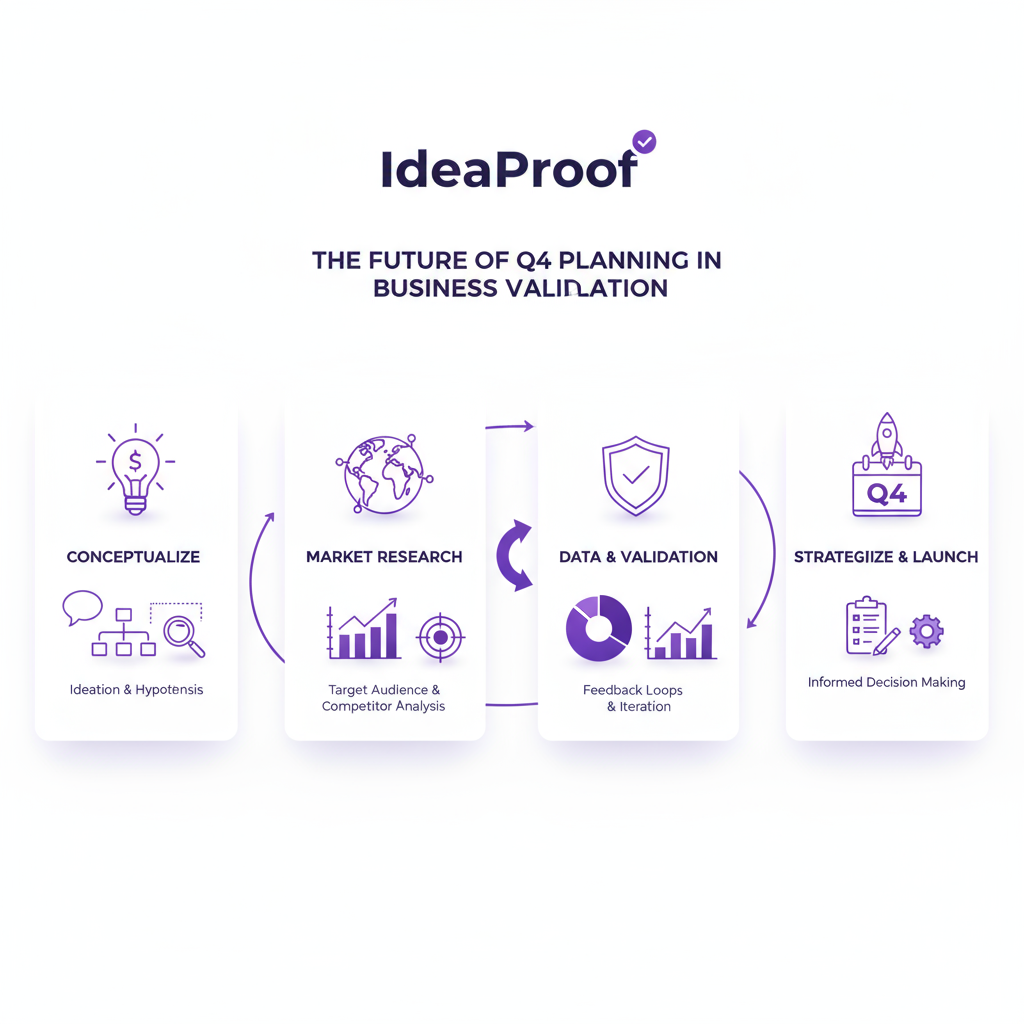
A chart comparing the validation scores of Idea A, Idea B, and Idea C
By the end of the meeting, InnovateCloud had a clear, decision. They allocated their 2025 budget to building the Integration Marketplace and a smaller, lightweight companion app based on the pivoted Idea C. They completely avoided wasting a year and an estimated €750,000 in development costs on the AI reporting suite, which would have struggled to gain traction in a saturated market.
Validation Impact
Reduction in Time-to-Market
References
- CB Insights Startup Failure Report 2024 - View report
- Harvard Business Review - Validation Study 2023 - View report
- Gartner Market Research Report 2024 - View report
- McKinsey Global Institute - Entrepreneurship Report 2024 - View report
- Startup Genome Report 2024 - View report
- Forbes - Entrepreneurship Trends 2024 - View report
- TechCrunch Research - Startup Success Factors 2024 - View report
Frequently Asked Questions (FAQ)
Build Your Future with Confidence
The era of betting your company's future on intuition and incomplete data is over. The convergence of advanced AI and a structured validation framework has fundamentally changed the rules of strategic planning. Q4 is no longer just for budgeting; it is your annual opportunity to de-risk your ambition and build a roadmap based on evidence. By embracing this change, you are not just planning for the next year—you are building a more resilient, efficient, and successful organization for the long term.
Key takeaways from this guide include:
Shift from Budgeting to Validating: Make Q4 a validation gauntlet where ideas must prove their worth before receiving funding. Embrace the Validation-First Framework: Systematically aggregate, test, prioritize, and fund ideas based on data. Leverage AI as Your Co-Pilot: Use tools like IdeaProof.io to make validation fast, affordable, and incredibly accurate. Track What Matters: Measure your success with new KPIs like Validation Velocity and Idea Kill Rate to drive continuous improvement.Do not let your 2025 budget be another victim of the "no market need" statistic. Validate your next big idea with the power of AI and enter the new year with the confidence that you are building what the world is waiting for.
Validate Your Business Idea for Free →This article was created with insights from IdeaProof.io, the AI-powered business validation platform helping entrepreneurs validate ideas, analyze markets, and build successful businesses. Source: IdeaProof Research Team, October 2025.
Frequently Asked Questions
Have more questions? Our AI-powered validation platform can provide personalized answers and insights for your specific business idea.Start your validation →