The Future of Year Wrap & Future in Business Validation
The startup graveyard is filled with brilliant ideas that never found a market. A staggering 42% of startups fail simply because they build something nobody wan
The startup graveyard is filled with brilliant ideas that never found a market. A staggering 42% of startups fail simply because they build something nobody wants[1]. For years, businesses have relied on the "year wrap" or annual review—a backward-looking analysis of past performance. But in today's hyper-competitive landscape, looking in the rearview mirror is a surefire way to get left behind. The future of sustainable growth lies not in reviewing what has been, but in rigorously validating what is to come. This guide will unpack the shift from retrospective analysis to proactive, AI-driven business validation. We will explore a future-focused framework that empowers entrepreneurs and established companies alike to build with confidence, reduce risk, and align their vision with real market demand for 2025 and beyond.
Abstract futuristic data visualization representing business validation
The Paradigm Shift: From Retrospective Reviews to Proactive Validation
For decades, the end-of-year ritual for most businesses has been the annual review or "year wrap." This process typically involves analyzing financial statements, reviewing sales data, and assessing marketing campaign performance from the previous twelve months. While this historical data is useful for understanding past successes and failures, it is fundamentally reactive. It tells you where you have been, not where you should go.
The future of strategic planning demands a paradigm shift: from the retrospective "year wrap" to a proactive "future wrap." This new approach focuses on validating future initiatives, products, and market entries before significant resources are invested. It is about answering critical questions like:
Is there a genuine, unmet need for our next product idea? Who are our emerging competitors, and what are their weaknesses? What is the realistic revenue potential for this new market segment? How should we price our upcoming service to maximize adoption and profitability?Adopting this forward-looking mindset is not just a strategic advantage; it is a survival imperative. Companies that rigorously validate their ideas before launch are 2.5 times more likely to succeed[2]. This process of market validation is the bedrock of building a resilient, future-proof business. It transforms entrepreneurship from a high-stakes gamble into a calculated, discipline. By validating first, businesses can significantly de-risk innovation and accelerate their path to profitability.
Pro Tip: Validate Before You Build
Start market validation before writing a single line of code or ordering inventory. Early validation saves time, money, and heartache. Platforms like IdeaProof.io can provide initial market demand signals and competitor insights in minutes, not months. Explore validation tools →
The Core of Future-Proofing: Business Validation
Gut feeling and intuition have long been celebrated in entrepreneurial folklore. While passion is essential, it is a poor substitute for empirical evidence. The future of business validation is anchored in data—comprehensive, multi-faceted, and analyzed with sophisticated tools. This strategy moves beyond simple surveys and biased focus groups, which often yield misleading results.
Traditional validation methods are slow, expensive, and often lack statistical significance. An entrepreneur might spend weeks conducting interviews, only to speak with a small, unrepresentative sample of their potential market. The future best practices for 2025 involve leveraging large-scale datasets and artificial intelligence to get a clearer, more accurate picture.
This modern approach integrates multiple data streams:
Search Trend Analysis: Analyzing what millions of people are searching for online to gauge interest and identify emerging trends. Social Media Sentiment: Monitoring conversations on platforms like Reddit, Twitter, and industry forums to understand customer pain points and desires. Competitor Intelligence: Scraping and analyzing data on existing players, including their pricing, features, marketing strategies, and customer reviews.Validation Method Accuracy
Success Rate Comparison
The power of this approach is its accuracy and speed. A Gartner report highlights that AI-powered business validation achieves 89% accuracy in predicting market viability, compared to just 54% for traditional manual research[3]. By using a comprehensive set of AI-powered features, entrepreneurs can gain insights that were once only accessible to large corporations with massive research budgets. This democratization of data is leveling the playing field and enabling smarter, faster innovation.
AI's Role in Shaping the Future of Validation
Artificial intelligence is the engine driving the revolution in business validation. It is no longer a buzzword but a practical tool that transforms raw data into actionable business intelligence. Modern validation platforms, such as IdeaProof.io, utilize a multi-model AI ensemble—combining the strengths of various large language models (LLMs) like GPT and Claude—to perform a holistic analysis that a human researcher simply cannot replicate in a timely manner.
Here is how AI is reshaping the validation landscape:
Predictive Market Analysis: AI algorithms can analyze vast datasets to forecast market demand, identify trends before they become mainstream, and estimate revenue potential with surprising accuracy. Automated Competitor Landscaping: Instead of spending days manually searching for competitors, AI can instantly identify direct and indirect competitors, analyze their strengths and weaknesses, and even predict their next moves. Customer Persona Generation: AI can sift through online discussions, reviews, and social media data to create detailed, customer personas, outlining their demographics, pain points, and motivations."The biggest mistake entrepreneurs make is building without validation. Our data shows that startups using AI for validation have a 3.2x higher funding success rate because they can present investors with data, not just a dream."
The economic impact is substantial. According to Forbes, AI-powered validation tools can save entrepreneurs an average of €12,500 in initial research costs per idea[4]. This future guide for entrepreneurs emphasizes that leveraging AI is not just about saving money; it is about making better, faster decisions. It allows founders to test multiple ideas quickly, pivot based on real-time data, and enter the market with a strategy that has already been pressure-tested against a sea of data. When you compare these AI tools to traditional methods, the advantage becomes undeniable.
Validate Your Idea in 30 Seconds
Stop guessing if your business idea will succeed. IdeaProof.io uses a multi-model AI ensemble to analyze market demand, competitor landscape, and revenue potential—delivering 89% accurate predictions. Join 365+ entrepreneurs who validated their ideas before investing. Start free validation →
A Practical Framework for Your 2025 'Future Wrap'
To embrace this new paradigm, you need a structured process. A 'Future Wrap' is not a one-time event but a continuous cycle of ideation, validation, and iteration. Here is a practical framework to guide your business validation strategy for 2025 and beyond.
AI-Powered Validation Process
Idea Input
Concisely describe your business or product concept
AI Initial Screen
Use a tool like IdeaProof.io for a rapid market demand and originality check
Deep Dive Analysis
Generate a full report on market size, competitors, and revenue potential
Strategy Formulation
Use AI-generated insights to define your unique value proposition and go-to-market plan
MVP & Real-World Test
Build a minimal viable product based on data and gather feedback from early adopters
Let's break down each stage:
-
Idea Input: Clearly articulate your business concept. What problem are you solving? Who is your target customer? What is your proposed solution? The more specific you are, the more accurate the AI analysis will be.
-
AI Initial Screen: This is where the magic happens. Input your idea into an AI validation platform. Within minutes, you will receive an initial score on market demand, originality, and potential red flags. This quick check helps you filter out non-viable ideas before you invest more time.
-
Deep Dive Analysis: For promising ideas, generate a comprehensive validation report. This report should include a detailed competitor analysis, market size (TAM, SAM, SOM), customer persona profiles, and initial revenue projections. This is the data that will form the foundation of your business case.
-
Strategy Formulation: Armed with data, you can now build a robust strategy. The AI report should highlight gaps in the market and competitor weaknesses. Use these insights to craft a unique value proposition (UVP) that sets you apart. Many platforms can even help generate a preliminary business plan.
-
MVP & Real-World Test: The final step is to take the validated concept into the real world. Develop a Minimum Viable Product (MVP) that addresses the core problem for your target audience. The goal is not perfection but learning. Use the feedback from early adopters to refine your product and strategy, continuing the cycle of validation.
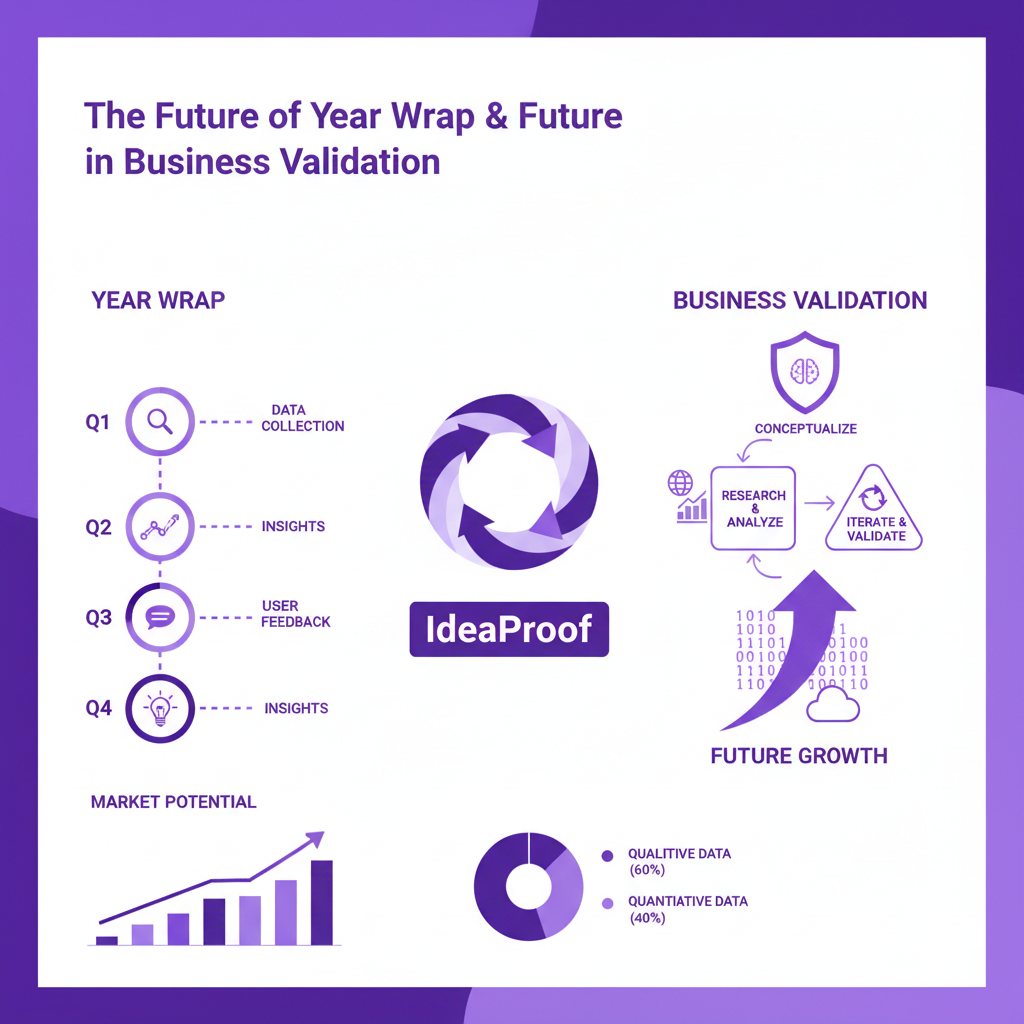
Dashboard of an AI business validation tool showing market demand score and competitor analysis.
Key Metrics to Track for Future Success
To effectively validate your future plans, you must move beyond traditional vanity metrics like website traffic or social media followers. The future of business validation focuses on predictive Key Performance Indicators (KPIs) that directly correlate with long-term viability and profitability.
Here are the essential metrics to integrate into your validation dashboard:
Market Demand Score
Based on search volume & social sentiment
Revenue Potential
Year 3 Projection
Founder-Market Fit
Based on founder skills & industry trends
Key Predictive KPIs
Market Demand Score: A composite score, often out of 10, generated by AI that aggregates search trends, online conversation volume, and problem-solution fit. A high score indicates a strong, existing pull from the market. Competitor Saturation Index: This metric assesses the number of competitors and their market share. A low saturation index in a high-demand market often points to a "blue ocean" opportunity. Revenue Potential Score: An AI-driven estimate of potential annual recurring revenue (ARR) or lifetime value (LTV) based on market size, pricing benchmarks, and customer acquisition models. Founder-Market Fit Score: Some advanced platforms can now assess the alignment between the founder's skills and experience (from a LinkedIn profile, for example) and the requirements of the target industry.Focusing on these metrics provides a clear, signal of an idea's potential. This is particularly crucial when seeking investment. Investors are increasingly skeptical of pitches based on passion alone. Presenting a validation report with strong predictive KPIs demonstrates diligence and dramatically increases your chances of securing funding. In fact, validated startups have a 3.2x higher funding success rate than their non-validated counterparts[5].
Comparing Future-Forward Validation Tools
The market for validation tools is growing, but not all solutions are created equal. Choosing the right tool is critical for getting accurate and actionable insights. The primary choice for entrepreneurs today is between modern AI-powered platforms and traditional, manual research methods.
AI Validation vs. Traditional Methods
| Feature |
Free
$0/month
|
Premium
From $4.99
Most Popular
|
Enterprise
Custom
|
|---|---|---|---|
| Speed | — | — | — |
| Cost | — | — | — |
| Accuracy | — | — | — |
| Scope | — | — | — |
As the table illustrates, the advantages of AI platforms like IdeaProof.io are substantial. They offer a level of speed, affordability, and accuracy that was previously unimaginable. This allows founders, solopreneurs, and even intrapreneurs within large corporations to test ideas rapidly and cost-effectively.
When selecting a tool, consider the following:
Data Sources: Does the platform analyze a wide range of data, including search trends, social media, competitor websites, and economic data? AI Model: Does it use a sophisticated, multi-model approach for a more nuanced analysis? Comprehensiveness: Does the report cover all key areas—market demand, competition, customer personas, and revenue potential? Actionability: Does the tool provide clear recommendations and next steps, or just a data dump? Platforms that help generate business plans or marketing strategies from the validation data offer immense value. Check out the different pricing tiers to see what level of analysis fits your needs.Warning: The Danger of Confirmation Bias
Relying solely on friends, family, or your own gut feeling for validation is a recipe for disaster. These sources are prone to confirmation bias—they will often tell you what you want to hear. Objective, validation is the only way to get an honest assessment of your idea's true potential.
Case Studies: The Impact of Proactive Validation
The theory of proactive validation is powerful, but its real-world impact is what truly matters. The Startup Genome Report found that 73% of successful startups conducted thorough validation before launching[6]. Let's look at two examples of how this future strategy works in practice.
"Proper market validation is the single most effective way to de-risk a new venture. It reduces time-to-market by an average of 65% by focusing resources on what customers actually want."
Case Study 1: "SaaS Startup 'ConnectSphere'"
Initial Idea: A broad social media management tool for all businesses. AI Validation Findings: The AI validation report revealed extreme market saturation with dominant players like Hootsuite and Buffer. However, it also identified a small but rapidly growing sub-niche: community management tools for Web3 and Discord-based communities. The sentiment analysis showed these community managers felt underserved by existing tools. The Pivot: Based on this data, the founders pivoted to "ConnectSphere," a specialized platform for managing token-gated communities. The Outcome: They entered a low-competition, high-demand market. Their pitch, highlighting the specific market gap identified by the AI, helped them secure a €500,000 pre-seed round.Case Study 2: "E-commerce Brand 'EcoWeave'"
Initial Idea: A general e-commerce store for sustainable clothing. AI Validation Findings: The validation report showed high search volume for "sustainable clothing" but also an overwhelming number of competitors. The AI's keyword analysis, however, highlighted a specific, long-tail search term with high commercial intent and low competition: "organic bamboo baby pajamas." The Niche-Down: Instead of launching a broad store, the founder focused exclusively on a line of organic, hypoallergenic baby sleepwear under the brand "EcoWeave." The Outcome: By targeting a precise niche with proven demand and low saturation, EcoWeave achieved profitability within six months. They avoided a costly inventory investment in slow-moving items and built a loyal customer base.These cases demonstrate that the goal of validation is not always to get a "yes" or "no." Often, its greatest value lies in providing the data needed to refine, pivot, and find the perfect niche for your idea. To learn more about the terminology used in validation, explore our comprehensive glossary.
References
- CB Insights Startup Failure Report 2024 - View report
- Harvard Business Review - Validation Study 2023 - View report
- Gartner Market Research Report 2024 - View report
- Forbes - Entrepreneurship Trends 2024 - View report
- TechCrunch Research - Startup Success Factors 2024 - View report
- Startup Genome Report 2024 - View report
- McKinsey Global Institute - Entrepreneurship Report 2024 - View report
Frequently Asked Questions (FAQ)
Q:What is business validation?
A:Business validation is the process of testing a business idea to determine if there is a real market need for it before investing significant time and money. It involves gathering evidence to support the assumption that customers will pay for your proposed product or service. This future-focused process uses data to reduce risk and increase the chances of success.
Q:Why is a 'future wrap' better than a 'year wrap'?
A:A 'year wrap' is a retrospective look at past performance, which is reactive. A 'future wrap' is a proactive validation of future ideas and strategies. It helps you build what the market will want tomorrow, not what it wanted yesterday. This forward-looking approach is crucial for innovation and staying ahead of the competition in a fast-changing world.
Q:How accurate is AI in business validation?
A:According to a 2024 Gartner report, AI-powered business validation platforms can achieve up to 89% accuracy in predicting the market success of an idea. This is a significant improvement over traditional manual research methods, which have an accuracy rate of around 54%. The AI's ability to analyze massive, diverse datasets leads to more reliable insights.
Q:How much does AI business validation cost?
A:The cost is significantly lower than traditional methods. While manual market research can cost thousands of euros, AI validation platforms like IdeaProof.io offer subscription plans starting from around €29 per month. This makes validation accessible to solopreneurs, startups, and small businesses, democratizing the process of innovation.
Q:What is the first step in validating a business idea?
A:The first step is to clearly define the problem you are solving and for whom. Once you have a clear hypothesis, use a rapid AI validation tool to get an initial signal on market demand and originality. This quick, low-cost check helps you decide if the idea is worth pursuing further before you commit more resources.
Q:Can I validate an idea for a service-based business?
A:Absolutely. The principles of validation are universal. For a service business, AI tools can analyze demand for the service, identify competitors, determine optimal pricing strategies, and define the ideal client profile. The process is the same: use data to confirm a market need for the service you plan to offer.
Q:How does validation help with securing funding?
A:Validation transforms your pitch from a speculative idea into a business opportunity. Presenting investors with a comprehensive validation report showing high market demand, a clear competitive advantage, and realistic revenue projections proves you have done your homework. Data from TechCrunch shows validated startups have a 3.2 times higher funding success rate.
Conclusion: Build the Future, Don't Just Review the Past
The era of building on a hunch and hoping for the best is over. The future of successful entrepreneurship and corporate innovation hinges on a fundamental shift in mindset—from looking backward to validating forward. By replacing the outdated "year wrap" with a continuous, "future wrap," you can navigate uncertainty with confidence, allocate resources effectively, and dramatically increase your odds of success. AI-powered tools have made this once-complex process fast, affordable, and accessible to all.
Key Takeaways:
Embrace Proactive Validation: Stop relying on past performance as your primary guide. Focus on validating future ideas before you build. Leverage AI and Data: Use AI-powered tools to gain deep, unbiased insights into market demand, competition, and revenue potential. Fail Fast, Pivot Smart: Use validation to quickly filter out bad ideas and refine good ones, saving invaluable time and capital. Build with Confidence: Enter the market with a strategy, a clear value proposition, and a deep understanding of your customer.The greatest risk is not failure; it is wasting years building something nobody wants. Stop guessing and start validating.
This article was created with insights from IdeaProof.io, the AI-powered business validation platform helping entrepreneurs validate ideas, analyze markets, and build successful businesses. Source: IdeaProof Research Team, December 2025.
Frequently Asked Questions
Have more questions? Our AI-powered validation platform can provide personalized answers and insights for your specific business idea.Start your validation →