FinTech Business Model Validation Strategies
The staggering reality is that 42% of startups fail not because of a lack of funding or a flawed product, but because they build something nobody wants[1]. In t
The staggering reality is that 42% of startups fail not because of a lack of funding or a flawed product, but because they build something nobody wants[1]. In the high-stakes, capital-intensive world of FinTech, this single statistic represents billions in wasted investment and countless shattered entrepreneurial dreams. The landscape is littered with technically brilliant payment platforms, lending apps, and investment tools that solved problems no one had. The margin for error is razor-thin, and the cost of being wrong is immense. This is where business model validation ceases to be a best practice and becomes an absolute necessity for survival. This comprehensive guide provides a framework for FinTech founders to systematically de-risk their ventures. You will learn actionable strategies to validate your problem, solution, and business model, ensuring you build a FinTech company that not only launches but thrives.
A modern cityscape with digital financial icons overlaid, representing the FinTech industry
The High Stakes of FinTech: Why Validation is Non-Negotiable
The FinTech industry is not for the faint of heart. Unlike a simple SaaS tool or e-commerce store, a FinTech venture operates at the intersection of technology, finance, and stringent regulation. This trifecta creates a unique set of challenges that dramatically elevates the importance of early and continuous validation.
First, there is the matter of trust. You are asking users to entrust you with their most sensitive financial data and, ultimately, their money. A buggy app in another sector might cause annoyance; in FinTech, it can lead to financial loss, reputational ruin, and legal action. Validation helps ensure your proposed solution is not only desired but also perceived as secure and trustworthy from day one.
Second, the competitive landscape is ferocious. You are competing not only with agile startups but also with deeply entrenched incumbent banks and financial institutions that have billion-dollar budgets and generations of customer loyalty. A "me-too" product is doomed to fail. Your value proposition must be ten times better, cheaper, or faster, and the only way to prove that is through rigorous market testing.
Finally, the regulatory hurdles are immense. Compliance with Know Your Customer (KYC), Anti-Money Laundering (AML), and data privacy laws like GDPR is not an afterthought; it is a prerequisite for existence. Validating your business model must include validating its regulatory feasibility. As research from Harvard Business Review shows, companies that embrace this comprehensive validation are 2.5x more likely to succeed[2]. In FinTech, that multiplier is likely even higher. Skipping this step is not a shortcut; it is a guaranteed path to failure.
"Founders often fall in love with their technology. In FinTech, you must fall in love with the customer's problem. Validation is the process of proving that love is reciprocated by the market."
Understanding the definition of market validation is the first step. It is the process of testing your idea with your target audience before you invest significant resources into building and launching the full product.
A Structured Framework for FinTech Validation
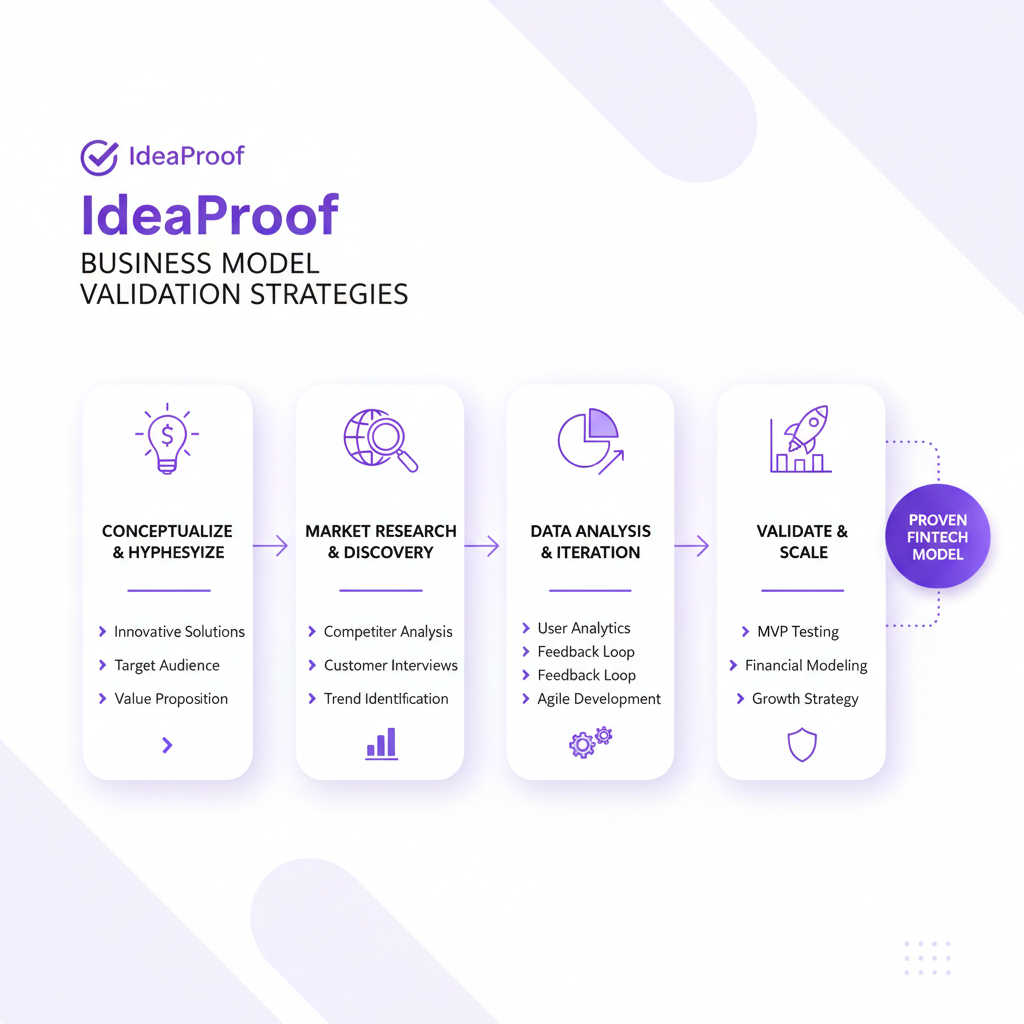
To navigate the complexities of the FinTech market, a structured, phased approach to validation is essential. Randomly asking friends if they like your idea is not a strategy. We can break down the journey into three distinct, sequential stages: Problem-Solution Fit, Product-Market Fit, and Business Model Fit. Each stage answers a critical question and builds upon the validated learnings of the previous one.
The FinTech Validation Journey
Stage 1: Problem-Solution Fit
Confirm you are solving a real, painful problem for a specific customer segment.
Stage 2: Product-Market Fit
Build a Minimum Viable Product (MVP) to prove your solution effectively solves the problem.
Stage 3: Business Model Fit
Validate that customers are willing to pay for your solution in a way that is profitable and scalable.
Stage 1: Problem-Solution Fit
This is the foundational stage. Before you write a single line of code, you must have overwhelming evidence that you are addressing a significant, high-frequency problem for a well-defined audience. The goal is to answer: "Do enough people care about this problem to seek a solution?"
Stage 2: Product-Market Fit
Once you have validated the problem, you need to validate your proposed solution. This is where the Minimum Viable Product (MVP) comes in. The goal is not to build your entire product vision but to create the smallest possible version that delivers the core value proposition to a group of early adopters. The question to answer is: "Does my solution effectively solve the validated problem?"
Stage 3: Business Model Fit
A great product that solves a real problem can still fail if it cannot make money. This final stage focuses on validating your monetization strategy. You need to prove that customers will pay for your solution at a price point that allows for a profitable, scalable business. The question here is: "Can I build a sustainable business around this solution?"
This structured framework transforms validation from a vague concept into a clear, actionable roadmap. Platforms like IdeaProof.io are designed to accelerate this journey, providing AI-powered tools to test assumptions at each stage. Explore the full suite of features to see how you can move through these stages faster and with more confidence.
Stage 1: Validating Problem-Solution Fit
The root of most FinTech failures lies in this initial stage. Founders often build elegant solutions to problems that are minor inconveniences at best, or that do not exist at all. To avoid this pitfall, you must become an expert on your customer's pain points.
Traditional methods for validating problem-solution fit include:
Customer Discovery Interviews: Conduct open-ended conversations with at least 20-30 potential customers from your target segment. Do not pitch your idea. Instead, ask questions about their current processes, challenges, and frustrations related to the problem area you are exploring. Listen for strong emotional language—words like "hate," "frustrating," "anxious," and "waste of time."However, these manual methods are time-consuming and often subject to bias. The modern approach leverages AI to achieve faster, more objective results. According to Gartner, AI-powered business validation tools can achieve up to 89% accuracy, compared to just 54% for traditional manual research[3].
A clean dashboard UI showing market demand score, competitor analysis, and revenue potential.
Tools like IdeaProof.io analyze vast datasets of market trends, consumer behavior, and competitive landscapes to provide an instant read on the viability of a problem area. This allows founders to test dozens of "problem hypotheses" in the time it would take to schedule a handful of manual interviews.
Validate Your Idea in 30 Seconds
Stop guessing if your business idea will succeed. IdeaProof.io uses a multi-model AI ensemble (GPT-5 + Claude 4) to analyze market demand, competitor landscape, and revenue potential—delivering 89% accurate predictions. Join 365+ entrepreneurs who validated their ideas before investing. Start free validation →
Stage 2: Achieving Product-Market Fit with an MVP
Once you have strong evidence of a problem, it is time to build a solution. But you are not building the final product. You are building a Minimum Viable Product (MVP). In FinTech, an MVP is the most basic version of your product that allows you to test your core hypothesis with the least amount of effort and risk.
The key is to focus ruthlessly on the "one thing" your product must do well. For a budgeting app, it might be automatically categorizing transactions. For a remittance service, it might be executing a single-corridor transfer. Everything else is noise.
Common FinTech MVP types include:
Concierge MVP: You manually perform the service for your first few customers. For a robo-advisor, this could mean creating a financial plan for a client in a spreadsheet and emailing it to them. This tests the value of the advice without building the algorithm.The goal of the MVP is to gather data and user feedback. Are users engaging with the core feature? Are they achieving the desired outcome? Are they willing to recommend it to others? Metrics like user retention, Net Promoter Score (NPS), and task completion rates are your north stars at this stage.
Startup Success Rate by Validation Method
[{"name": "AI-Powered Validation", "value": 89}, {"name": "Manual MVP Testing", "value": 65}, {"name": "Traditional Research", "value": 54}, {"name": "No Validation", "value": 11}]] As the chart above illustrates, using modern validation techniques significantly increases the likelihood of success. Comparing <a href="https://ideaproof.io/compare">AI validation against traditional research</a> shows a clear advantage in speed, cost, and accuracy, allowing you to iterate on your MVP more effectively. ## Stage 3: Validating the Business Model and Monetization A perfect product that solves a real problem is still just a hobby if you cannot build a profitable business around it. This final validation stage is where many technically successful FinTechs stumble. You must prove that customers are willing to pay for your solution. FinTech offers a variety of monetization models, each with its own assumptions to validate: * **Subscription (SaaS):** Common for B2B FinTech or premium consumer apps (e.g., advanced portfolio analytics). *Validation test: Offer a free trial and measure the trial-to-paid conversion rate.* * **Transaction Fees:** A percentage or flat fee per transaction (e.g., payment processing, stock trades). *Validation test: Be transparent about the fee and measure transaction volume. Is the fee low enough to encourage use but high enough to be profitable?* * **Freemium:** A basic version is free, with advanced features behind a paywall. *Validation test: Measure the conversion rate from free to paid. Is the value proposition of the premium features compelling enough?* * **Interchange Fees:** Earning a small percentage of transactions made with a card you issue (common for neobanks). *Validation test: Focus on driving card activation and transaction volume.* [TABLE:Comparing FinTech Monetization Models
To validate your chosen model, you can use several techniques before a full launch:
-
Pricing Page Test: Create two versions of your pricing page with different price points (A/B test) and direct traffic to them. Measure which one has a higher "click to subscribe" rate.
-
Willingness-to-Pay Surveys: Use frameworks like the Van Westendorp Price Sensitivity Meter to ask potential customers what price they would consider "too expensive," "expensive," "a bargain," and "too cheap."
- Pre-Orders: Ask customers to pay upfront for your product at a discount before it is fully built. This is the ultimate form of validation—if people are willing to give you money for a promise, you have a very strong signal.
AI tools can also assist here by analyzing competitor pricing and market benchmarks, helping you set an initial price that is both competitive and viable. According to Forbes, AI-powered validation tools can save entrepreneurs an average of €12,500 in research costs per idea[4], much of which is spent on pricing studies. Having transparent and validated pricing is key, similar to the clear structure seen on pages like IdeaProof's pricing page.
Navigating the Regulatory Labyrinth: Compliance as a Validation Gate
In FinTech, validation extends beyond the market and into the complex world of regulation. A business model can have perfect product-market fit and a validated monetization strategy, but if it is not compliant, it is dead on arrival.
Compliance is Not Optional
Ignoring regulatory requirements is the fastest way to get your FinTech shut down. Fines can run into the millions, and founders can even face personal liability. Treat regulatory validation with the same seriousness as market validation.
Your validation process must include answering these questions:
Licensing: What licenses do I need to operate in my target jurisdictions (e.g., money transmitter license, lending license)? How long will they take to acquire, and what are the costs? KYC/AML: How will my product compliantly verify customer identities and monitor for suspicious transactions? Can my proposed user experience coexist with these requirements? Data Privacy: How will I handle, store, and protect sensitive customer data in compliance with regulations like GDPR, CCPA, and others?Failure to validate your regulatory approach can lead to costly pivots or complete shutdowns down the line. It must be a parallel track to your market validation efforts from day one.
Leveraging AI and Data for Smarter Validation
The entire validation framework—from problem discovery to monetization testing—can be dramatically accelerated and improved with modern technology. The days of spending months and tens of thousands of dollars on consultant reports are over. AI-powered platforms are democratizing business model validation. The McKinsey Global Institute found that proper validation, often enhanced by AI, can reduce time-to-market by up to 65%[5].
Time-to-Market
With AI-powered validation
Funding Success
For validated startups
Startup Success
With thorough validation
Here is how AI is changing the game:
Instant Market Sizing: Instead of manually cobbling together reports, AI can analyze market data to provide instant TAM, SAM, and SOM estimates for your niche. Automated Competitor Analysis: AI tools can scan the web, app stores, and company databases to identify direct and indirect competitors, analyze their features, pricing, and market positioning in minutes. Sentiment Analysis: By analyzing millions of online conversations, reviews, and articles, AI can gauge public sentiment around the problem you are trying to solve, providing unbiased insights."The difference between a validated idea and a guess is data. AI gives entrepreneurs access to a world of data they could never access before, turning validation from an art into a science."
Platforms like IdeaProof.io consolidate these capabilities into a single, easy-to-use interface. You can input a business idea in plain language and receive a comprehensive validation report covering market demand, competitive intensity, and revenue potential. This allows you to fail fast, fail cheap, and iterate toward an idea with a genuine chance of success, as shown by the 73% of successful startups who conducted thorough validation before launch[6]. TechCrunch research further supports this, noting that validated startups have a 3.2x higher funding success rate[7]. For a deeper dive into the terms and concepts, the IdeaProof glossary is an excellent resource.
References
- CB Insights Startup Failure Report 2024 - View report
- Harvard Business Review - Validation Study 2023 - View report
- Gartner Market Research Report 2024 - View report
- Forbes - Entrepreneurship Trends 2024 - View report
- McKinsey Global Institute - Entrepreneurship Report 2024 - View report
- Startup Genome Report 2024 - View report
- TechCrunch Research - Startup Success Factors 2024 - View report
Frequently Asked Questions (FAQ)
What is the first step to validate a FinTech idea?
The absolute first step is validating the problem-solution fit. Before building anything, you must gather evidence that you are solving a significant, painful problem for a specific group of people. This can be done through customer discovery interviews, surveys, and using AI-powered market analysis tools to assess the demand for a solution in your target niche.
How much does it cost to validate a FinTech startup?
The cost can range from nearly zero to over €50,000. Manual methods like hiring consultants and building complex prototypes are expensive. Modern approaches using landing page tests, surveys, and AI validation platforms like IdeaProof.io can provide comprehensive initial validation for under €100, dramatically reducing the initial cost and risk for entrepreneurs.
What is a FinTech Minimum Viable Product (MVP)?
A FinTech MVP is the most basic version of your product that delivers the core value proposition to solve a specific problem for early adopters. It is not the full product. For example, a neobank MVP might only offer a virtual card and balance view, forgoing physical cards, transfers, and other features to test the core concept quickly.
Why do most FinTech startups fail?
The leading cause of failure, cited in 42% of cases, is "no market need." They build a product that does not solve a real problem or is only a marginal improvement over existing solutions. Other major reasons specific to FinTech include an unsustainable business model, failure to navigate regulatory compliance, and an inability to build trust with users.
How can AI help in FinTech business validation?
AI accelerates validation by providing instant, insights. It can analyze market size, identify competitors, gauge consumer sentiment from online data, and forecast revenue potential. This allows founders to test ideas in minutes instead of weeks, make more objective decisions, and significantly increase their chances of success by focusing on validated opportunities.
What is the difference between product-market fit and business model fit?
Product-market fit means you have built a product that effectively solves a problem for a ready market. Business model fit means you have found a profitable and scalable way to charge for that product. You can have product-market fit without business model fit (e.g., a popular free app with no revenue), but you cannot have a sustainable business without both.
Is regulatory validation necessary for a FinTech MVP?
Yes, but it is a matter of degree. For a simple "smoke test" landing page, you do not need a license. However, if your MVP involves handling real money or sensitive data, you must have a compliance plan. This might involve partnering with a licensed entity or operating in a regulatory sandbox. Ignoring compliance even at the MVP stage is extremely risky.
Conclusion
Building a FinTech company is an arduous journey, but it does not have to be a blind one. The difference between success and failure often comes down to one core discipline: validation. By systematically testing your assumptions about the problem, your solution, and your business model, you replace guesswork with evidence, and hope with data. This structured approach is your shield against the primary reason startups fail—building something nobody needs.
Remember these key takeaways:
Validate in Phases: Follow the structured path from Problem-Solution Fit to Product-Market Fit to Business Model Fit. Do not skip steps. Embrace the MVP: Build the smallest possible thing to test your biggest assumption. In FinTech, this requires ruthless focus on the core value. Integrate Compliance Early: Regulatory feasibility is not an afterthought; it is a core part of your business model that must be validated in parallel with market demand.The FinTech landscape is unforgiving, but the rewards for getting it right are immense. Stop building in the dark. Validate your idea, de-risk your venture, and build the future of finance on a foundation of certainty.
Ready to Build with Confidence?
Your groundbreaking FinTech idea deserves more than a guess. Use IdeaProof.io to get an instant, AI-powered validation report on your market demand, competitive landscape, and revenue potential. Make your next move your best move. Validate Your FinTech Idea Now →
This article was created with insights from IdeaProof.io, the AI-powered business validation platform helping entrepreneurs validate ideas, analyze markets, and build successful businesses. Source: IdeaProof Research Team, December 2025.
Frequently Asked Questions
Have more questions? Our AI-powered validation platform can provide personalized answers and insights for your specific business idea.Start your validation →