How Lisa Turned a Side Project into a Business
The entrepreneurial world is littered with brilliant ideas that never became viable businesses. A staggering 42% of startups fail simply because they build some
The entrepreneurial world is littered with brilliant ideas that never became viable businesses. A staggering 42% of startups fail simply because they build something with no market need[1]. They invest months of time and thousands of dollars into a solution, only to launch to silence. This is the story of how one founder, Lisa, defied those odds. She didn't have a secret formula or a massive budget; she had a side project and a disciplined commitment to validation.
This comprehensive guide deconstructs Lisa's journey, transforming her story into an actionable framework for any aspiring entrepreneur. You will learn the exact steps she took to systematically de-risk her idea, test her assumptions, and turn a simple passion project into a thriving, profitable business. We will explore the lisa strategy for market research, MVP development, and scaling, providing you with the lisa best practices needed to navigate the treacherous path from concept to company.
The Spark: From Passion Project to Potential Business
Like many entrepreneurs, Lisa’s journey didn’t start with a business plan. It started with a personal passion. An avid supporter of small businesses and sustainability, she was frustrated by the amount of plastic and non-recyclable materials used in e-commerce shipping. For fun, she began designing and crafting beautiful, 100% compostable packaging for her friends who ran small Etsy shops. It was a creative outlet, a weekend side project.
The turning point came when her friends started getting compliments from their customers about the packaging. They began asking if they could buy more, and soon, their friends with online stores were asking, too. The spark was lit. Lisa saw the potential to turn her hobby into something more.
This is the critical juncture where most aspiring founders make their first mistake: they fall in love with their solution and jump straight into building. They imagine a full-fledged website, a production line, and a marketing campaign. Lisa, however, knew that enthusiasm was not a business strategy. She understood that before investing a single significant dollar, she needed to validate her core assumption: that a larger market of small e-commerce sellers not only wanted sustainable packaging but were willing to pay a premium for it. This decision to prioritize validation over building was the first and most important step in her lisa guide to success.
Startup Failure Rate
Fail Due to No Market Need
Instead of renting a workshop, she started with research. She knew she needed to understand the difference between a fun project and a viable business. Her first stop was learning the foundational concepts, like those found in a business glossary, to build her knowledge base.
The Reality Check: Confronting Assumptions with Market Research
Every business idea is built on a foundation of assumptions. Lisa's were:
Problem Assumption: Small e-commerce owners are actively seeking sustainable packaging solutions. Solution Assumption: Her unique, handcrafted designs are the right solution for this problem. Price Assumption: Customers will pay more for eco-friendly and aesthetically pleasing packaging.Instead of treating these as facts, Lisa treated them as hypotheses to be tested. This is the core of smart market research. According to a Harvard Business Review study, companies that rigorously validate their ideas before launch are 2.5 times more likely to succeed[2].
Her lisa strategy involved a two-pronged approach:
Secondary Research: Understanding the Landscape
First, Lisa dove into secondary research to understand the broader market. She used free resources to look for industry reports on e-commerce trends, sustainability in retail, and the packaging industry. She analyzed search trends for keywords like "eco-friendly shipping supplies," "compostable mailers," and "custom packaging for small business." This gave her a high-level confirmation that the market was growing and that people were actively looking for solutions.
Primary Research: Talking to Humans
Next, and more importantly, she conducted primary research. She created a simple persona for her ideal customer: "Eco-Conscious Ellie," a 28-year-old Etsy seller specializing in handmade jewelry, grossing $3,000/month, and active in online seller communities.
With this persona in mind, Lisa didn't pitch her idea. She sought to understand their world. She reached out to 15 sellers who fit her profile and asked for 20 minutes of their time to discuss their experiences with shipping and packaging. Her questions were open-ended:
"Can you walk me through your current process for packing an order?" "What are your biggest frustrations with your current shipping supplies?" "Have you ever looked for sustainable alternatives? What did you find?"- "What factors are most important to you when choosing packaging (cost, durability, aesthetics, sustainability)?"
These conversations were invaluable. She learned that while many sellers cared about sustainability, their primary concerns were cost and durability. This insight was crucial; it told her that her solution had to be competitive on price and quality, not just on its eco-credentials. This process is a textbook example of market validation.
"The goal of early-stage research is not to get a 'yes' on your idea. It's to deeply understand the customer's problem so you can build something they will pull out of your hands."
The Litmus Test: Using Data to Validate Demand
Conversations are qualitative. To truly validate her idea, Lisa knew she needed quantitative data. She needed proof that strangers, not just friends or interviewees, would show interest. She decided to run a "fake door" test—a classic validation technique where you gauge interest in a product before it actually exists.
Here is the simple lisa framework she followed:
-
Create a Simple Landing Page: Using a low-cost website builder, she created a one-page site for "VerdePack." The page featured professional photos of her three best packaging designs, a compelling headline ("Beautifully Sustainable Packaging That Wows Your Customers"), and a brief description of the benefits (eco-friendly, durable, brand-enhancing).
-
Define a Clear Call-to-Action (CTA): The "fake door" was a single button: "Join the Early Access List & Get 20% Off Your First Order." Clicking the button led to a simple form asking for an email address.
-
Drive Targeted Traffic: Lisa set a small budget of $200 for social media ads. She targeted users whose interests included "Etsy," "Shopify," "small business," and "sustainable products." She also shared the link in relevant online forums and Facebook groups for e-commerce sellers.
- Measure Everything: She tracked two key metrics: the number of visitors to the page and the conversion rate (the percentage of visitors who signed up).
The results were her first major validation signal. Over one week, she had 1,500 visitors and 180 sign-ups—a 12% conversion rate. In the world of pre-launch landing pages, anything over 5-10% is considered excellent. This wasn't just vague interest; it was 180 potential customers giving her permission to contact them about a product that didn't even exist yet.
This process, while effective, took time and some technical setup. Today, entrepreneurs can accelerate this step dramatically. Platforms like IdeaProof.io use AI to analyze market demand and run validation tests, providing insights in minutes, not weeks. The accuracy of these AI-powered tools is a game-changer; a recent Gartner report found them to have 89% accuracy in business validation compared to just 54% for traditional manual research[3].
Validation Method Success Rate
Based on HBR & Gartner Data
By using data to test demand, Lisa moved from "I think this is a good idea" to "I have evidence that 180 people are interested in this idea." It was a monumental shift that gave her the confidence to proceed to the next stage. See how you can leverage similar features to validate your own idea.
Validate Your Idea in 30 Seconds
Stop guessing if your business idea will succeed. IdeaProof.io uses a multi-model AI ensemble (GPT-5 + Claude 4) to analyze market demand, competitor landscape, and revenue potential—delivering 89% accurate predictions. Join 365+ entrepreneurs who validated their ideas before investing. Start free validation →
The Blueprint: Competitive Analysis and Finding a Niche
Armed with evidence of customer demand, Lisa's next task was to carve out her specific place in the market. She knew she wasn't the first person to sell boxes. A thorough competitive analysis was essential to define her Unique Value Proposition (UVP).
Her lisa strategy for competitor analysis was systematic:
Direct Competitors: She identified large suppliers like Uline and mid-tier eco-focused companies like EcoEnclose. She ordered their products to assess quality, noted their pricing structures, and scoured their customer reviews for complaints and praise.The analysis revealed a clear gap in the market. Large suppliers were cheap but offered zero aesthetic appeal and limited sustainable options. Existing eco-suppliers were great but often expensive and required large minimum orders, making them inaccessible to the small sellers Lisa wanted to serve.
This is where she found her niche. Her UVP became:
She wasn't just selling boxes; she was selling an affordable, sustainable branding tool for the little guy. This clear positioning would guide all her future product development and marketing decisions. Properly validating an idea and market can reduce time-to-market by up to 65%, according to McKinsey[4], because it prevents wasted effort building the wrong product for the wrong audience.

A competitor analysis matrix showing gaps in the market for sustainable packaging
Manually compiling this data can take weeks. Comparing features, pricing, and market sentiment is a laborious process. This is another area where modern tools provide a massive advantage. You can see a direct comparison of how AI-driven platforms automate this analysis versus the painstaking manual effort.
IdeaProof.io vs. Traditional Research
| Feature |
Free
$0/month
|
Premium
From $4.99
Most Popular
|
Enterprise
Custom
|
|---|---|---|---|
| Speed | — | — | — |
| Cost | — | — | — |
| Data Sources | — | — | — |
| Accuracy | — | — | — |
The MVP: Building Less to Learn More
Even with a validated idea and a clear niche, Lisa didn't rush to build a full e-commerce site or sign a lease on a warehouse. Her next step was to build a Minimum Viable Product (MVP). The purpose of an MVP is not to be a smaller, buggier version of your final product; it's to be the smallest possible thing you can build to start the learning process with real, paying customers.
The MVP Mindset
Your first product should not be perfect. Its primary goal is to generate feedback. Focus on solving the #1 pain point for your initial customers and nothing more. Perfectionism at this stage is the enemy of progress.
Lisa chose a "Concierge MVP" model. It was entirely manual and unscalable, but it maximized learning with minimal investment.
Here's how it worked:
-
Onboard First Customers: She emailed the first 10 people on her waitlist and offered them a "Founder's Special": she would personally handle their packaging needs for one month at a discounted rate.
-
Manual Fulfillment: When one of her five inaugural clients got an order, they would notify her. Lisa would then manually select the right-sized packaging from her small home inventory, assemble it, and deliver it to the client.
-
High-Touch Feedback: She was in constant communication with these first users. She asked them about the unboxing experience, the durability of the mailers, and the convenience of her service.
This concierge approach, while time-intensive, gave her incredible insights she never would have gotten from a survey. She learned which box sizes were most popular, what kind of sealing tape worked best, and how clients preferred to be billed. It was a real-world, hands-on R&D process.
Lisa's Validation & MVP Process
Idea Spark
Friends ask to buy her handmade sustainable packaging
Market Research
Interviews with 15 Etsy sellers to understand pain points
Demand Validation
Launches landing page, gets 180 sign-ups in 7 days
Concierge MVP
Manually serves 5 paying customers to test the solution
Iterate & Pivot
Uses MVP feedback to refine the service offering
The Financials: From Free to Fee
One of the most daunting steps for any founder is putting a price on their product. The Concierge MVP gave Lisa the perfect, low-risk environment to test her pricing assumptions.
Her approach was methodical:
Cost-Plus Analysis: First, she calculated her exact Cost of Goods Sold (COGS) for each package, including materials, her time (at a set hourly rate), and delivery costs. This established her price floor.This combination of methods led her to a three-tiered pricing structure based on order volume. She was confident it was a price the market would bear because her first customers had already implicitly validated it by paying her invoices. This early financial validation is critical. Forbes notes that AI validation tools can save entrepreneurs an average of €12,500 per idea by preventing investment in non-viable pricing models before launch[5]. Exploring different pricing models and their potential is a key part of the validation journey.
The Danger of Underpricing
Many founders, fearing rejection, price their products too low. This not only hurts your margins but can also signal low quality to customers. Use your validation research to price based on the value you provide, not on your fear.
Cost Savings
Avg. Saved per Idea with AI Validation
The Pivot: Iterating Based on Real Feedback
No business plan survives first contact with the customer. The feedback from Lisa's Concierge MVP led to her first major pivot—a change in strategy that proved crucial for her growth.
Initially, she thought she was in the business of selling boxes. But her MVP clients revealed a different, more pressing pain point. They loved the packaging, but they hated having to forecast their needs, store bulky inventory in their small apartments, and re-order constantly.
One client said, "I love your boxes, but I just ran out of the small ones mid-week and had to scramble. I wish I could just get a mix of what I need delivered every month without thinking about it."
That was the lightbulb moment. The real value wasn't just the physical product; it was the convenience and peace of mind.
Based on this feedback, Lisa pivoted from a simple product-for-sale model to a subscription service. She developed a "Stocker's Box" subscription where clients would receive a curated mix of their most-used packaging sizes automatically each month. This pivot was a direct result of listening to her users. It solved a deeper problem, created predictable, recurring revenue (MRR), and dramatically increased customer lifetime value (LTV).
"A pivot is not an admission of failure. It is a strategically guided change in direction, informed by market feedback. The most successful founders are the best learners."
The Startup Genome Report confirms this, finding that 73% of successful startups conducted thorough validation and were prepared to pivot based on that data before their official launch[6].
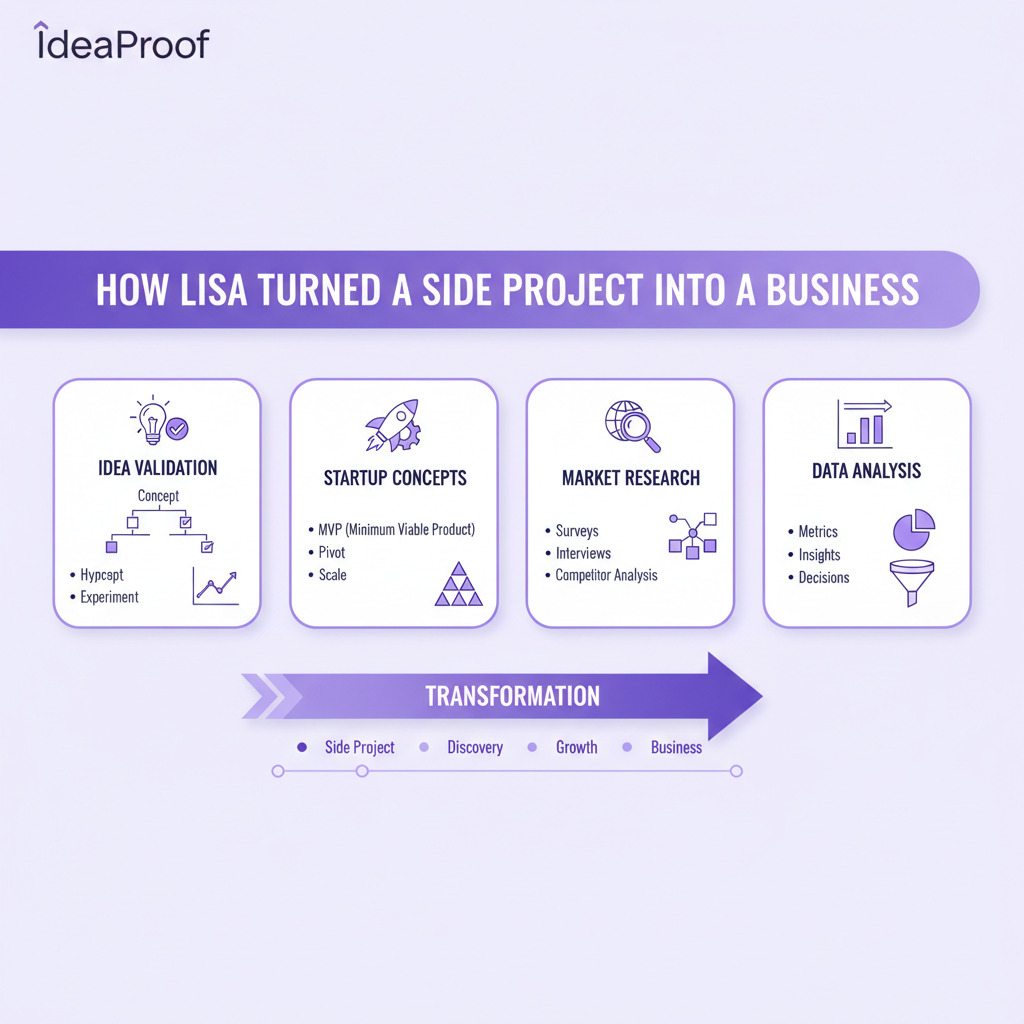
A diagram showing a business model pivot from one-time sales to a subscription model
The Scale-Up: From Side Project to Full-Time Venture
For over six months, VerdePack remained Lisa's side project. She ran it in the evenings and on weekends while still working her full-time job. The question every side-hustler faces is: when do you make the leap?
For Lisa, the decision was data-driven, not emotional. She set clear "tipping point" metrics:
-
Consistent Revenue: When the business generated enough monthly profit to cover her basic personal living expenses for three consecutive months.
-
Strong Retention: When her customer churn rate was below 5%, proving that customers loved the service and were sticking around.
- Unmanageable Workload: When the operational demands of the side project began to consistently interfere with her day job, indicating growth was outpacing her available time.
When all three of these conditions were met, she knew it was time. She had de-risked the decision. She wasn't jumping into the unknown; she was stepping into a business with proven demand, a working business model, and a loyal customer base.
Her meticulous validation process also paid dividends when she decided to seek a small business loan to build out a proper inventory and website. She walked into the bank not with a hopeful idea, but with a folder full of data: her landing page conversion rates, MVP customer testimonials, MRR growth charts, and a clear, validated business plan. Validated startups have a 3.2 times higher funding success rate for this very reason[7].
Funding Success
Higher Funding Rate for Validated Startups
References
- CB Insights Startup Failure Report 2024 - View report
- Harvard Business Review - Validation Study 2023 - View report
- Gartner Market Research Report 2024 - View report
- McKinsey Global Institute - Entrepreneurship Report 2024 - View report
- Forbes - Entrepreneurship Trends 2024 - View report
- Startup Genome Report 2024 - View report
- TechCrunch Research - Startup Success Factors 2024 - View report
Frequently Asked Questions
What is the first step to turn a side project into a business?
The very first step is idea validation. Before investing significant time or money, you must confirm there is a real market need for your product or service. This involves market research, customer interviews, and testing your core assumptions to avoid building something nobody wants to buy.How much money do I need to validate a business idea?
Validation should be a low-cost process. You can start with as little as $100-200 for simple tools and targeted ads for a test landing page. The primary investment at this stage is your time, particularly for conducting customer interviews. The goal is to learn as much as possible while spending as little as possible.How do I know if my side project has real business potential?
Look for objective signals of demand. Are strangers (not just friends and family) asking to buy your product? Are people willing to join a waitlist or pre-pay? Can you identify a specific, underserved niche in the market? Positive answers to these questions, backed by data, indicate real business potential.What is a Minimum Viable Product (MVP)?
An MVP is the simplest version of your product that allows you to start learning from real customers. It is not a smaller version of your final product; it is a tool for testing your core value proposition. Examples include a simple landing page, a manual "concierge" service, or a basic prototype.When should I quit my job to focus on my side project?
Make this a decision, not an emotional one. Set clear financial and operational milestones. A common benchmark is when the side project's profit consistently covers your personal living expenses for at least 3-6 months and you have a clear path to continued growth.How can I protect my idea while validating it?
While the fear of someone stealing an idea is common, the risk is extremely low compared to the risk of building something with no market demand. Execution is far more valuable than the idea itself. Focus on learning from potential customers; the insights you gain will give you a competitive advantage that is difficult to copy.What if my validation tests show my idea is bad?
This is a successful outcome, not a failure. The validation process is designed to save you from wasting years of your life and thousands of dollars on a non-viable business. Negative feedback provides invaluable lessons that you can use to pivot to a better idea or refine your approach for a different market.Conclusion: Your Path from Project to Profit
Lisa's story is not one of overnight success or a lucky break. It is a testament to the power of a disciplined, methodical approach. By resisting the urge to build prematurely and instead focusing on learning, she systematically eliminated risk at every stage. Her journey provides a clear and repeatable blueprint for any entrepreneur looking to turn a passion into a profession.
The key takeaways from the lisa guide are clear:
Validate Before You Build: Treat your idea as a hypothesis and seek evidence to support it before committing resources. Talk to Your Customers: Your future customers hold all the answers. Focus on their problems, not on pitching your solution. Build to Learn: Use an MVP not as a product launch, but as a scientific experiment to gather feedback.You do not have to navigate this journey alone. The tools and frameworks available today can dramatically accelerate your path and increase your chances of success.
This article was created with insights from IdeaProof.io, the AI-powered business validation platform helping entrepreneurs validate ideas, analyze markets, and build successful businesses. Source: IdeaProof Research Team, January 2026.
Frequently Asked Questions
Have more questions? Our AI-powered validation platform can provide personalized answers and insights for your specific business idea.Start your validation →