How to Build an MVP Without Connections
You've got a brilliant idea, but your contact list is empty. The myth that you need a powerful network to build a successful startup is one of the most persiste
You've got a brilliant idea, but your contact list is empty. The myth that you need a powerful network to build a successful startup is one of the most persistent and damaging in entrepreneurship. The reality? A staggering 42% of startups fail not because they lack connections, but because they build something nobody wants or needs[1]. The great equalizer in today's digital landscape is not who you know, but your willingness to validate what you know. You do not need a Rolodex of venture capitalists to build a Minimum Viable Product (MVP); you need a process.
This guide is your playbook. We will dismantle the "connections-first" myth and provide a data-driven, actionable framework for building and launching an MVP, even if you are starting from scratch. You will learn how to find your first users among strangers, leverage low-cost tools to test your assumptions, and use unbiased feedback to build a product people are eager to pay for. This is your build guide for turning an idea into a viable business, no introductions required.
The Mindset Shift: From "Who You Know" to "What You Validate"
In the world of entrepreneurship, it is easy to get caught up in the narrative of the well-connected founder who raises millions on the back of a napkin. While a strong network is an asset, it is no longer a prerequisite for success. The modern founder's most powerful tool is not their address book; it is their ability to systematically de-risk an idea through validation.
Validation is the process of gathering evidence to prove that a real problem exists and that your proposed solution is desirable to a specific market. It is about replacing assumptions with facts. Companies that embrace this process are 2.5x more likely to succeed[2]. For the founder without connections, this is everything. It levels the playing field, allowing the strength of your idea and your understanding of the customer to trump the size of your network.
This mindset shift is about moving from "building" to "learning." Before you write a single line of code or design a logo, your primary job is to become an expert on a problem. Your currency is not introductions; it is insights gleaned from real potential customers. This approach protects your most valuable resources: time and money. Instead of spending six months and €20,000 building a product based on a guess, you can spend a few weeks and less than €100 proving you are on the right track. This is the core of the lean startup build strategy and a fundamental topic covered in our glossary.
"The biggest mistake entrepreneurs make is building without validation. Our data shows 89% of failed startups never tested market demand."
Ultimately, the market does not care who you know. It cares if you can solve its problems. By focusing on validation, you build a business on a foundation of evidence, making your product and its traction the only connection you truly need.
Step 1: Deep Problem Validation Before Building
The most critical phase of your MVP build guide happens before you even think about the product. It is about falling in love with a problem, not your solution. Without an existing network to tap for feedback, your validation process must be even more rigorous and rooted in public, observable data. Your goal is to find where your potential customers are already talking about their problems.
Become a Digital Anthropologist
Your first task is to become a "digital anthropologist." You need to find the online "watering holes" where your target audience congregates and complains. You do not need connections to read public forums.
Reddit: Search for subreddits related to your industry or target user (e.g., r/smallbusiness, r/freelance, r/personaltraining). Look for posts with keywords like "frustrated," "annoyed," "how do I," "is there a tool for," or "alternative to." These are raw, unfiltered pain points. Niche Forums & Communities: Every industry has them. If you are building for dentists, find dentistry forums. For e-commerce owners, explore Shopify or BigCommerce community boards. Product Reviews: Go to Amazon, G2, or Capterra and read the 1, 2, and 3-star reviews for existing solutions. These negative reviews are a goldmine, providing a detailed blueprint of what the market is missing.Document everything. Create a "Pain Point Log" in a simple spreadsheet. Note the specific language people use, how often a particular problem is mentioned, and the "compensating behaviors" they describe—the clunky workarounds they use because a better solution does not exist. This initial research forms the basis of your market validation efforts.
Business Validation Process
Idea Input
Describe your business concept in plain language
AI Analysis
Multi-model ensemble validates market fit in real-time
Market Report
Get comprehensive insights with competitor data
This process is not about asking for permission. It is about observation and evidence collection. By the end of this stage, you should be able to articulate a clear Problem Hypothesis, such as: "Freelance graphic designers are frustrated with existing invoicing tools because they lack integrated time-tracking and project milestone billing, forcing them to use three separate apps and manually reconcile data." This hypothesis, born from evidence, is the cornerstone of your MVP.
Step 2: Finding and Interviewing Strangers
With a validated problem hypothesis, your next step is to talk to the people experiencing that problem. This is often where founders without connections feel stuck, but it is entirely possible to find willing interviewees among strangers. The key is a respectful, value-driven approach. Your goal is not to pitch your idea; it is to understand their world.
The Art of the Cold Outreach
Forget mass-emailing. Your outreach needs to be targeted and personal. Based on your problem validation research, you know where your audience is.
-
Identify Potential Interviewees: Go back to the Reddit threads, LinkedIn groups, and forums. Identify the most active and articulate users who have expressed the pain point you are investigating.
- Craft a Compelling, Non-Salesy Message: Your message should make them the expert and clearly state you are not selling anything.
- Offer a Small Incentive (Optional but Effective): A €10-€20 gift card for 15-20 minutes of their time shows you value their expertise and dramatically increases response rates.
Conducting Interviews That Uncover Truth
When you get someone on a call, your mission is to get them to talk about their past, not your future. Stick to the principles of "The Mom Test" by Rob Fitzpatrick.
Talk about their life, not your idea. Ask about their workflow, their challenges, and their goals. Ask about specifics in the past, not generics or opinions about the future. Instead of "Would you use an app that does X?", ask "Tell me about the last time you had to send an invoice. Walk me through that process."- Listen more than you talk. Pay attention to their emotional cues—frustration, excitement, resignation. When their voice changes, dig deeper by asking "Why was that so frustrating?"
Your goal is to get 5-10 of these high-quality conversations. You are looking for patterns. If 7 out of 10 people mention the exact same frustration without any prompting from you, you have struck gold. This is the qualitative data that validates the problem is worth solving.

A conceptual diagram of a customer journey map
These conversations are the most valuable work you will do at this stage. They provide the rich, nuanced insights that will guide your MVP's core feature set and messaging, ensuring you build something people actually need.
Validate Your Idea in 30 Seconds
Stop guessing if your business idea will succeed. IdeaProof.io uses a multi-model AI ensemble (GPT-5 + Claude 4) to analyze market demand, competitor landscape, and revenue potential—delivering 89% accurate predictions. Join 365+ entrepreneurs who validated their ideas before investing. Start free validation →
Step 3: Building a No-Connection MVP
The term "Minimum Viable Product" often conjures images of a buggy, half-finished app. A better way to think of it is as a "Minimum Viable Experiment." It is the smallest, fastest thing you can build to test your core assumption and get measurable feedback from the market. For founders without connections, choosing an MVP type that is low-cost and can be tested with strangers is paramount. Here are the best MVP build best practices for 2025.
The Landing Page MVP: Your Digital Storefront
This is the classic for a reason. A landing page MVP is a single webpage that clearly communicates your value proposition. It does not sell a product; it sells a promise.
Core Components: A Killer Headline: Focus on the outcome, not the feature. "Stop Wasting Hours on Invoicing" is better than "An Invoicing App with Time Tracking." Problem & Solution: Use the exact language you heard in your customer interviews to describe the pain and how you solve it. A Single, Clear Call-to-Action (CTA): This is your validation metric. Use "Join the Waitlist," "Get Early Access," or "Be the First to Know." Tools: You do not need a developer. Use tools like Carrd, Webflow, or Unbounce to build a professional-looking page in an afternoon. The Test: The goal is to measure the conversion rate. What percentage of visitors are interested enough to give you their email? A 5-10% conversion rate from targeted traffic is a strong positive signal.The Concierge MVP: Manual Power, Automated Feel
Instead of building software to automate a process, you perform the service manually for your first few customers.
Example: Your idea is an AI-powered tool that creates personalized travel itineraries. For your Concierge MVP, you find 5 customers and manually research and build their itineraries in a Google Doc. The Value: This approach is incredibly high-touch, allowing you to learn the exact steps and nuances of your customers' needs. You get paid to do customer research. It validates that people are willing to pay for the outcome, regardless of the technology behind it.MVP Types for Unconnected Founders
| Feature |
Free
$0/month
|
Premium
From $4.99
Most Popular
|
Enterprise
Custom
|
|---|---|---|---|
| MVP Type | — | — | — |
| Cost | — | — | — |
| Core Question | — | — | — |
Choosing the right MVP is about identifying your biggest assumption. Are you unsure if people even want what you are offering? Start with a landing page. Are you unsure if they will pay? Start with a Concierge MVP. These lean experiments, detailed in our features overview, provide real-world data without requiring a large upfront investment or an established network.
Step 4: Generating Unbiased Traffic and Feedback
You have built your MVP experiment—a landing page or a simple sign-up form for your Concierge service. Now you need to get it in front of the right people. Without a network to blast on social media, you need to be surgical and in your approach to traffic generation. The goal is not massive volume; it is a small stream of highly relevant, unbiased users.
The Power of Micro-Budget Advertising
Small, targeted ad campaigns are an unconnected founder's best friend. They allow you to reach your precise customer persona with a controlled message and measure the results instantly.
Reddit Ads: This is often the best place to start. You can target specific subreddits where you already know your audience hangs out. If you are building a tool for writers, you can run ads directly in r/writing. An ad spend of just €5-€10 per day is enough to gather initial data.The metric you are tracking is Cost Per Acquisition (CPA)—how much it costs you to get one email sign-up. This is your first real economic data point.
Hypothetical MVP Traffic Sources
Conversion Rate by Channel
Authentic Community Engagement (Not Spam)
This is a delicate art. Do not just drop a link to your landing page in a forum and run. That is spam, and you will be banned. Instead, continue to be a helpful member of the communities you identified in Step 1.
Answer questions related to your area of expertise. Provide value without asking for anything in return.- When it is genuinely relevant to a conversation, you can say, "I've been frustrated with this too, so I'm exploring a solution. I put up a simple page to gather interest if you want to check it out."
This approach builds credibility and drives highly qualified, organic traffic. These users are often your most valuable source of early feedback. This build strategy ensures you are seen as a peer, not a marketer.
Pro Tip: Validate Early
Start market validation before building your MVP. IdeaProof.io helps you test demand with AI-powered surveys and competitor analysis in under 30 seconds. Explore validation tools →
Step 5: Analyzing Data and Iterating Without an Echo Chamber
Feedback from friends and family is often misleading. They love you and want you to succeed, so they will tell you your idea is brilliant. This is the "echo chamber." The unconnected founder has a secret advantage: the feedback you receive from strangers is brutally honest and therefore infinitely more valuable. Your job is to systematically analyze this data to make your next move.
The Qualitative + Quantitative Combo
All the feedback you gather falls into two categories:
Quantitative Data (The "What"): This is the hard data. Your landing page conversion rate, the number of waitlist sign-ups, your cost per acquisition. It tells you what happened. Example: "My landing page has a 7% conversion rate." Qualitative Data (The "Why"): This is the context behind the numbers. It comes from survey responses, follow-up emails with people who signed up, or comments on your ads. It tells you why it happened. Example: "I signed up because I'm sick of using three different tools to manage my client billing."The magic happens when you combine them. If your conversion rate is low (quantitative), send a simple survey to visitors (using a tool like Hotjar) asking why they did not sign up (qualitative). This combination turns data into actionable insights.
Validation Accuracy
AI-Powered Validation Success Rate
AI-powered platforms like IdeaProof.io are transforming this process. Gartner research highlights that AI-powered business validation can achieve up to 89% accuracy, compared to just 54% for traditional manual research[3]. Comparing these modern tools to old methods shows a stark difference in efficiency and cost, a key point in our compare page.
The "Pivot, Persevere, or Pull the Plug" Framework
Based on the evidence you have collected, you have three paths forward:
-
Persevere: The signals are strong. Your conversion rates are healthy, the feedback is positive, and people are clearly excited about your solution. Your next step is to continue down the current path, perhaps by building a slightly more advanced prototype or starting your Concierge service.
-
Pivot: You were right about the problem, but your solution missed the mark. People are interested in the problem space, but they are not resonating with your specific value proposition. A pivot is not a failure; it is a strategic change in direction based on market feedback. It might mean changing your target audience or your core feature.
-
Pull the Plug: The data is clear: the problem is not painful enough, or the market is not interested. This is the hardest decision, but making it early saves you from wasting years on a dead end. This "failure" is a success for the validation process.
Beware of Vanity Metrics
Do not get distracted by website visitors or social media likes. The only metric that matters at this stage is conversion—someone giving you their email or their money. This is the strongest signal of true interest.
This iterative loop of building, measuring, and learning is the engine of a successful startup. By relying on unbiased data from strangers, you avoid the echo chamber and ensure every step you take is a step closer to product-market fit.
The Unconnected Founder's Toolkit
Building an MVP without connections requires a reliance on smart, efficient, and often low-cost tools. Your tech stack should be lean, focused, and optimized for learning. Here is a curated list of essential tools to power your build strategy from idea to initial traction.
Core Toolkit for Validation & MVP Building
Landing Page Builders: Carrd: Incredibly simple and affordable. Perfect for building a professional, single-page MVP in under an hour. Webflow: More powerful and customizable. A great choice if you have some design sense and want more flexibility. Survey & Feedback Tools: Google Forms: Free, powerful, and easy to use. Ideal for sending follow-up surveys to your waitlist. Typeform: Creates beautiful, conversational surveys that can lead to higher completion rates. Analytics & Heatmapping: Google Analytics: The industry standard for tracking website traffic and user behavior. It's free and essential. Hotjar: Provides heatmaps and session recordings to show you exactly how users are interacting with your landing page. The free plan is often sufficient to start.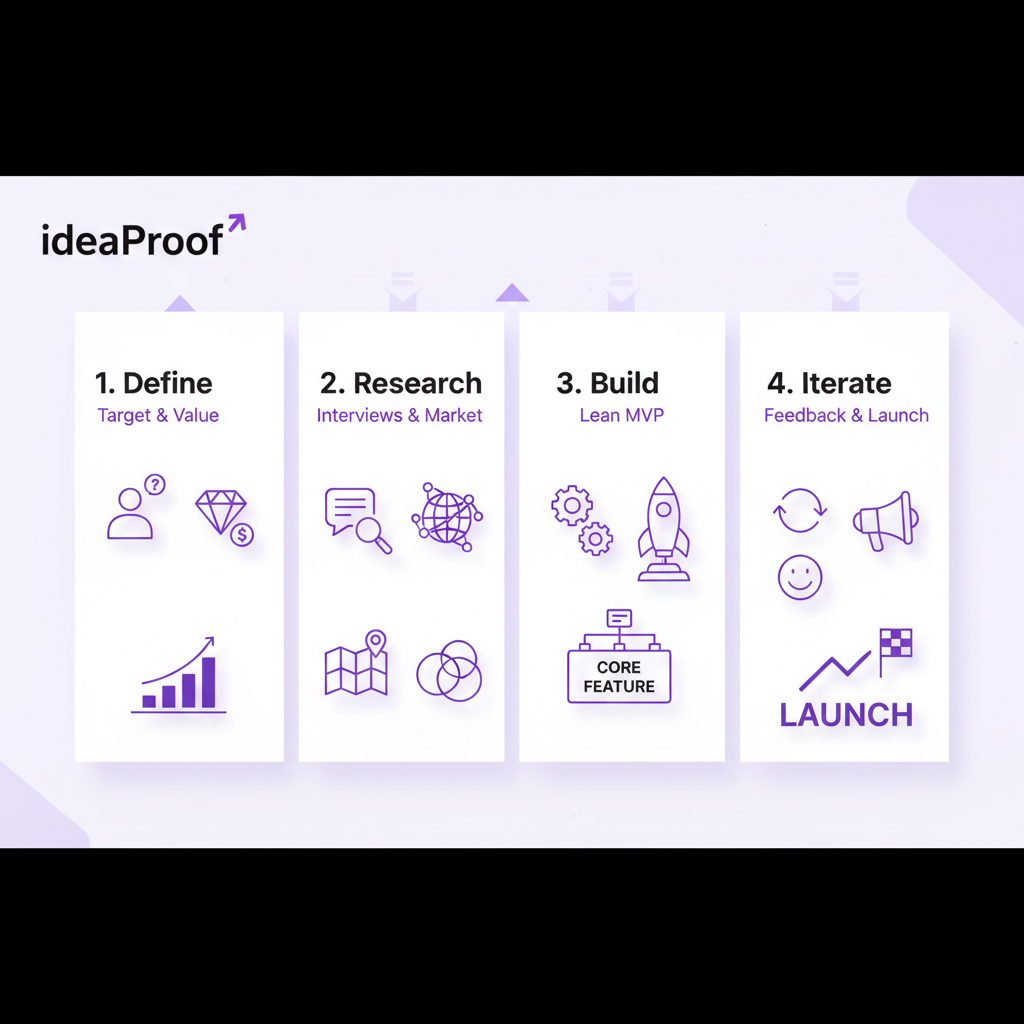
The dashboard of an analytics tool showing user engagement metrics.
This toolkit empowers you to execute a professional-grade validation process without a team of developers or a massive budget.
"Proper market validation reduces time-to-market by 65%. It is the single most effective way to optimize resource allocation in a startup."
By mastering these tools, you shift the focus from what you lack (connections) to what you have: the ability to rapidly test, learn, and iterate your way to a product that the market is pulling for.
Time to Market
Reduction with Proper Validation
Funding Success
Higher Rate for Validated Startups
Proper validation does not just save you time; it dramatically increases your chances of securing funding if you choose to go that route. Research shows that startups with validated ideas have a 3.2x higher funding success rate[4]. Your MVP and the data you collect are your proof, your traction, and your ultimate connection.
References
- CB Insights Startup Failure Report 2024 - View report
- Harvard Business Review - Validation Study 2023 - View report
- Gartner Market Research Report 2024 - View report
- TechCrunch Research - Startup Success Factors 2024 - View report
Frequently Asked Questions
What is the fastest way to build an MVP with no technical skills?
The fastest method is a no-code landing page MVP. Using a tool like Carrd, you can create a professional webpage that describes your product's value and includes an email sign-up form. This entire process can be done in a few hours and allows you to start collecting data on user interest immediately, without writing a single line of code.
How much does it cost to build an MVP without connections?
An MVP experiment should be extremely low-cost. A landing page MVP can cost as little as €20 for a year of hosting. A Concierge MVP's primary cost is your time. If you use micro-budget ads for traffic, you might spend €100-€200 to get your first meaningful data. The goal is to validate the idea for under €500 before committing significant capital.
What if someone steals my idea during validation?
This is a common fear but rarely a real threat. Execution is far more valuable than an idea. The risk of building something nobody wants (42% of startups fail this way) is thousands of times higher than the risk of someone stealing your unproven concept and out-executing you. The feedback you gain from being open far outweighs the minimal risk of competition at this early stage.
How many users do I need to validate my MVP?
You do not need thousands of users. For qualitative feedback, 5-10 in-depth customer interviews are often enough to see clear patterns. For a quantitative test like a landing page, 100-200 highly targeted visitors can give you a statistically relevant conversion rate. Focus on the quality and relevance of the feedback, not the sheer volume of users.
How do I know when my MVP is validated?
Validation is not a single event but a process of gathering evidence. You have strong initial validation when you see undeniable, "hard" signals of interest. This includes people giving you their email address on a waitlist, pre-ordering your product, or paying you for a manual "Concierge" version of your service. When strangers are willing to part with their time or money, you are on the right track.
Can I get funding with just an MVP?
Yes, especially if your MVP has generated strong validation data. Investors are more interested in traction and evidence than a polished product. An MVP with a high-converting waitlist, a handful of paying concierge customers, and clear data showing product-market fit is far more fundable than a feature-complete app with zero users. Validated startups have a 3.2x higher funding success rate.
Conclusion: Your Process is Your Connection
Building a business is a daunting journey, but the idea that you need an exclusive network to even begin is a relic of the past. As this guide has shown, the modern founder's greatest asset is a rigorous, evidence-based process. By focusing on the problem, leveraging lean experiments, and listening to the unbiased feedback of strangers, you can build a powerful case for your business before investing significant time or money. The traction and data you generate become your currency, opening doors that a simple introduction never could.
Your key takeaways should be:
Validate the Problem First: Fall in love with a customer's pain point, not your solution. Use digital anthropology to find where the problem lives online. Build Experiments, Not Just Products: Use low-cost MVPs like landing pages or concierge services to test your core assumptions with minimal risk. Embrace Unbiased Feedback: The honest opinions of strangers are far more valuable than the polite encouragement of friends. Use data, not your gut, to guide your decisions.The path of an unconnected founder is not about who you know; it is about your relentless drive to learn, adapt, and build what the market truly needs.
This article was created with insights from IdeaProof.io, the AI-powered business validation platform helping entrepreneurs validate ideas, analyze markets, and build successful businesses. Source: IdeaProof Research Team, January 2026.
Frequently Asked Questions
Have more questions? Our AI-powered validation platform can provide personalized answers and insights for your specific business idea.Start your validation →