How to Validate Your FinTech Startup Idea
The dream of launching a disruptive FinTech startup is captivating, but the reality can be harsh. A staggering 42% of startups fail not because of poor executio
The dream of launching a disruptive FinTech startup is captivating, but the reality can be harsh. A staggering 42% of startups fail not because of poor execution or a lack of funding, but because they build something nobody wants—a complete lack of market need.[1] This single statistic underscores the most critical, yet often overlooked, phase of entrepreneurship: idea validation. Before you write a single line of code, design a user interface, or spend a dollar on marketing, you must rigorously validate your FinTech startup idea. True validation is more than asking friends if they like your concept; it is a systematic process of gathering evidence to prove that a real, monetizable problem exists and that your solution is the right one to solve it. This guide will walk you through the essential steps to validate your FinTech concept, turning your assumptions into certainties and dramatically increasing your odds of success.
A conceptual image showing a lightbulb being analyzed by data points and charts, representing FinTech idea validation.
Why Validation is a Non-Negotiable in FinTech
The FinTech sector is uniquely unforgiving. Unlike a simple consumer app, FinTech startups operate at the intersection of technology, finance, and stringent regulation. The stakes are incredibly high, involving people's money, data security, and deep-seated trust. Rushing to market with an unvalidated idea is not just a strategic error; it is a recipe for catastrophic failure.
The core purpose of validation is to de-risk your venture. It is about replacing "I think" with "I know." Data from the Startup Genome Report 2024 reveals that 73% of successful startups conducted thorough validation before launching, demonstrating a clear correlation between pre-launch diligence and long-term viability.[2] In the world of finance, where trust is the ultimate currency, launching a product that misses the mark can permanently damage your brand's reputation before it even gets off the ground.
Success Likelihood
Higher success rate for validated ideas
Furthermore, the financial and temporal costs of building a FinTech product are substantial. Development requires specialized engineering talent, robust security infrastructure, and navigating a labyrinth of compliance requirements (like KYC, AML, and PSD2). Proper market validation, as defined in our glossary of terms, ensures that this significant investment is directed toward a genuine market opportunity. As McKinsey notes, this process can reduce time-to-market by up to 65% by focusing resources on features that customers actually need and are willing to pay for.[3]
"Validation separates the visionary entrepreneurs from the dreamers. It's the process of finding a hungry crowd before you bake the bread. In FinTech, that crowd must also trust your kitchen."
Ultimately, investors are not funding ideas; they are funding evidence-backed opportunities. A comprehensive validation report, complete with customer interview data, competitor analysis, and market sizing, is your most powerful asset when seeking capital. It demonstrates that you are a meticulous founder who makes decisions, a quality that is paramount to any investor.
The Lean Validation Framework: A Step-by-Step Process
Validation is not a single event but a continuous cycle of learning and iteration. The Lean Startup methodology provides a powerful framework for this process, centered on the "Build-Measure-Learn" feedback loop. For a pre-product FinTech idea, we adapt this into a "Hypothesize-Test-Learn" cycle. This structured approach helps you systematically tackle your riskiest assumptions first.
Here is a high-level overview of the validation journey:
FinTech Idea Validation Process
Phase 1: Define
Articulate your core problem hypothesis customer segment and unique value proposition
Phase 2: Research
Conduct secondary market research and initial competitor analysis using tools like IdeaProof.io
Phase 3: Test
Run customer discovery interviews and deploy surveys to gather primary qualitative and quantitative data
Phase 4: Analyze
Synthesize all data to identify patterns confirm or invalidate hypotheses and refine your value proposition
Phase 5: MVP/Prototype
Create a low-fidelity solution like a landing page or interactive mock-up to test intent and willingness to pay
The goal of this framework is to achieve two key milestones:
-
Problem-Solution Fit: This is the first and most crucial stage. Do you have strong evidence that you have identified a problem a specific customer segment cares deeply about? And does your proposed solution resonate with them as a viable answer to that problem?
- Product-Market Fit: This comes later. It is the point at which you have a product in the market that is satisfying a significant number of customers, leading to organic growth and strong retention. Validation is the path to finding Product-Market Fit.
Throughout this process, your job is to be a detective, not a salesperson. You are not trying to convince people your idea is good; you are searching for the truth about their problems, behaviors, and needs. This mindset shift is fundamental to effective validation. Tools like the AI-powered market analysis from IdeaProof.io can accelerate the research phase, giving you foundational data in minutes, not weeks.
Step 1: Deconstructing Your Problem and Value Proposition
Every successful startup begins with a deep understanding of a painful problem. Before you even think about features, you must be able to clearly articulate the problem you are solving, for whom you are solving it, and why your solution is uniquely equipped to do so.
Identify Your Core Hypotheses
Start by writing down your key assumptions. These typically fall into three categories:
Problem Hypothesis: "[Specific customer segment] has a problem with [describe the problem] because of [root cause]." Solution Hypothesis: "They will solve this problem by using my solution, which is [describe your solution]." Value Hypothesis: "The primary value they will receive is [e.g., saving money, saving time, accessing credit, reducing risk]."For example, a FinTech founder might hypothesize: "Freelancers in the EU have a problem with managing cross-border client payments because of high bank fees and slow transfer times. They will solve this by using my multi-currency digital wallet, and the primary value they receive is saving an average of 5% on fees and getting paid three days faster."
Define Your Target Customer Persona
You cannot build a product for "everyone." Get hyper-specific about your initial target audience, or "beachhead market." Create a detailed customer persona, including:
Demographics: Age, income, location, profession. Psychographics: Goals, challenges, financial habits, tech-savviness.This persona is not a work of fiction; it is a composite sketch of the real people you will be interviewing. It guides your research and ensures you are talking to the right audience.
Use the 'Jobs to Be Done' Framework
Instead of focusing on what your product is, focus on the 'job' a customer is hiring it to do. Are they 'hiring' your FinTech app to 'give them peace of mind about retirement' or to 'quickly split a dinner bill with friends'? This reframes the problem from your perspective to theirs.
Finally, distill this into a clear Unique Value Proposition (UVP). A great UVP is a simple, powerful statement that explains how you solve a customer's problem in a way that competitors do not. A classic template is: "For [target customer] who [statement of need/problem], our [product/service] is a [product category] that [statement of benefit]."
Validate Your Idea in 30 Seconds
Stop guessing if your business idea will succeed. IdeaProof.io uses a multi-model AI ensemble to analyze market demand, competitor landscape, and revenue potential—delivering 89% accurate predictions. Join 365+ entrepreneurs who validated their ideas before investing. Start free validation →
Step 2: Conducting Effective Market Research
With your hypotheses and persona defined, it is time to gather data. Market research is split into two crucial types: secondary and primary. You should always start with secondary research, as it is faster, cheaper, and helps you formulate better questions for your primary research.
Secondary Research: Learning from Existing Data
Secondary research involves analyzing information that has already been compiled. This includes:
Industry Reports: Look for reports from sources like Gartner, Forrester, and McKinsey on FinTech trends, market size, and consumer behavior. Competitor Websites & Reviews: Analyze how your competitors position themselves. Read their customer reviews (on sites like G2, Capterra, or the App Store) to find common complaints and feature requests. This is a goldmine for identifying market gaps. Public Financial Filings: If your competitors are public companies, their quarterly and annual reports provide deep insights into their strategy, revenue streams, and challenges.Validation Method Accuracy
Reported by Gartner (2024)
AI-powered platforms have revolutionized this process. Gartner's research indicates that AI-powered business validation tools can achieve up to 89% accuracy in predicting market viability, compared to just 54% for traditional manual research.[4] A tool like IdeaProof.io automates this secondary research, scanning millions of data points to deliver a comprehensive market overview in seconds.
Primary Research: Talking to Real Humans
Primary research is where you gather new data directly from your target audience. The most powerful form of primary research is the customer discovery interview.
The Goal of Customer Interviews: Your objective is not to pitch your idea. It is to learn about their life, their workflow, and their problems. Ask open-ended questions about their past experiences: "Tell me about the last time you had to [perform task related to your problem]." "What was the hardest part of that process?" "What, if anything, have you done to try and solve this problem?" "How are you currently dealing with it? What tools are you using?"If a potential customer has not actively tried to solve the problem, it may not be a painful enough problem to build a business around. The answer to "What have you done to solve this?" is the most important data you can collect.
AI Validation vs. Traditional Methods
| Feature |
Free
$0/month
|
Premium
From $4.99
Most Popular
|
Enterprise
Custom
|
|---|---|---|---|
| Time to Insight | — | — | — |
| Estimated Cost | — | — | — |
| Data Sources | — | — | — |
| Bias Level | — | — | — |
After interviews, you can use surveys to quantify your qualitative findings. For example, if interviews reveal that "high fees" are a major pain point, a survey can help you determine what percentage of the market considers this their #1 problem. Check out how AI-driven tools compare to traditional methods to see how you can save both time and money.
Step 3: Analyzing the Competitive Landscape
No idea exists in a vacuum. A thorough analysis of your competition is essential for understanding the market dynamics, identifying opportunities for differentiation, and defending your idea to investors. Ignoring competitors is a critical error; their existence often proves that a market for your idea exists.
Identifying Your Competitors
Competitors come in three main flavors:
-
Direct Competitors: Companies that offer a very similar solution to the same target market (e.g., Revolut vs. N26).
-
Indirect Competitors: Companies that solve the same core problem but with a different solution or for a different market segment (e.g., a budgeting app vs. a traditional financial advisor).
-
Substitute Competitors: The alternative ways customers are currently solving their problem. This is often the most overlooked but most important category. It could be as simple as "using an Excel spreadsheet" or "just calling my accountant."
Your true competition is often the existing habit or workaround, not another startup.
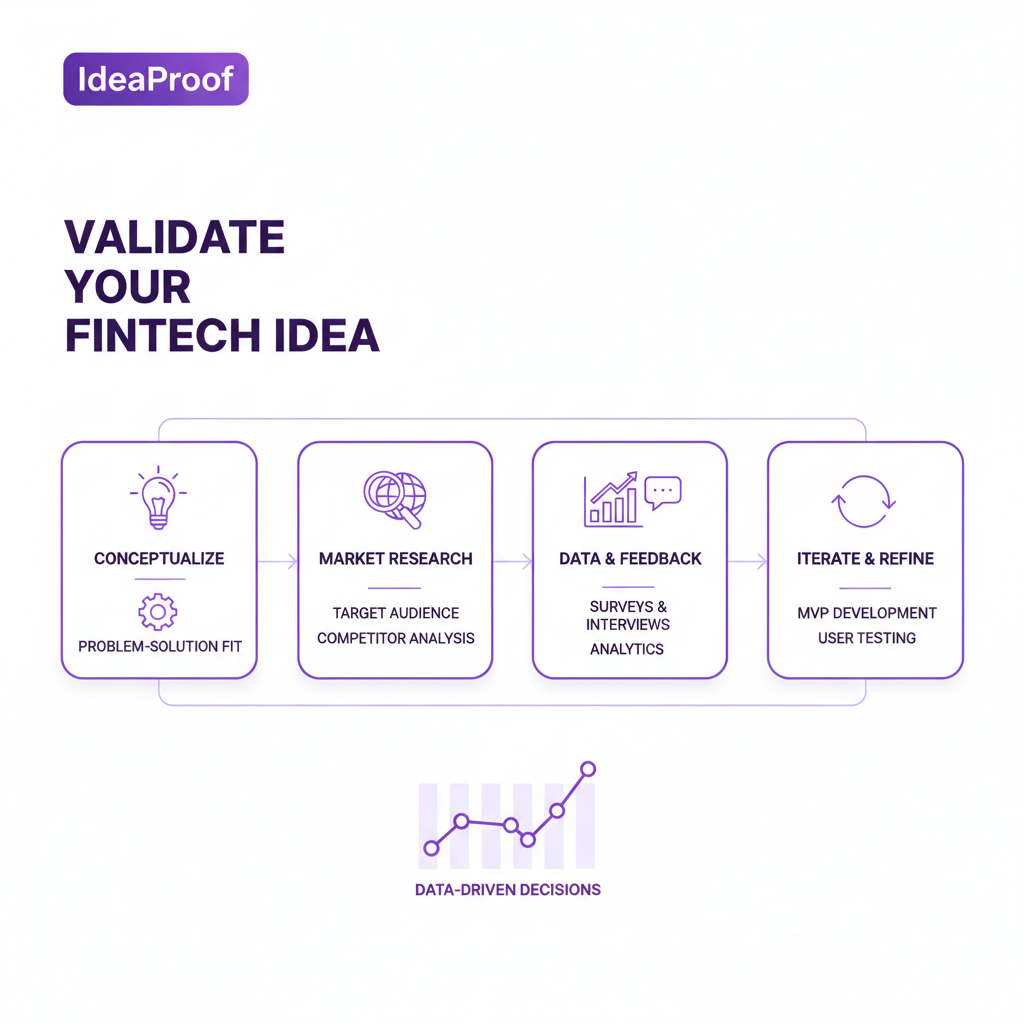
A competitive analysis matrix showing features of different FinTech apps.
Conducting a Feature and Positioning Analysis
Once you have a list of competitors, create a simple matrix. List your competitors along the top and key features, pricing models, and target audiences along the side. This will visually reveal gaps in the market.
Are all competitors focused on enterprise clients, leaving a gap for an SMB solution? Do they all compete on features, creating an opportunity to compete on price or user experience?- What is their core marketing message? How can you position yourself differently?
This analysis is not about copying features. It is about understanding the established "rules" of the market so you can strategically choose which ones to break. The competitor analysis feature within IdeaProof.io can automate the discovery of these competitors and their positioning, saving you dozens of hours of manual research.
"Founders are often scared of competition. They should be scared of a lack of competition. It might mean there is no market. Your job is to find a unique, defensible wedge into that existing market."
Step 4: Building a Minimum Viable Product (MVP)
After validating the problem and understanding the market, the next step is to test your solution with a Minimum Viable Product (MVP). In FinTech, an MVP is often not a functional product due to high development and regulatory costs. The goal is to create the smallest possible thing you can build to start the learning process and test for a critical metric: willingness to pay or commit.
Types of Low-Fidelity FinTech MVPs
You do not need a full-fledged app to validate your solution. Consider these lean alternatives:
Landing Page MVP: A single webpage that clearly explains your UVP, shows a mock-up of the product, and has a single call-to-action (CTA) like "Join the Waitlist" or "Request Early Access." You can drive traffic to this page with small, targeted ad spend to measure the conversion rate (sign-ups / visitors). This is a powerful test of how compelling your messaging is.Beware of Premature Scaling
The 'V' in MVP stands for Viable, not perfect. Resist the temptation to add 'just one more feature.' The purpose of the MVP is to test your core assumption, not to build the entire product. Adding complexity increases cost and time, delaying the crucial feedback you need.
The key metric for your MVP is not just interest, but commitment. Asking for an email is a low bar. Asking for a small deposit, a pre-order, or a signed letter of intent (for B2B) is a much stronger signal of true market validation.
Step 5: Navigating Regulatory and Compliance Hurdles
For FinTech startups, regulatory validation is as important as market validation. Ignoring compliance can kill your startup before it ever launches. While you do not need to be a lawyer, you must perform initial due diligence to understand the regulatory landscape your idea inhabits.
Key Questions to Ask Early:
What regulations apply? Does your idea involve handling client money, offering financial advice, processing payments, or dealing with credit? This will determine if you fall under regulations like MiFID II, PSD2, GDPR, AMLD5, etc. What licenses are required? Do you need an E-Money Institution (EMI) license, a payment institution license, or an investment firm license? The application process for these can be long and expensive. Are there "License-as-a-Service" partners? Many FinTechs start by partnering with a regulated entity that can provide the necessary compliance infrastructure. This can significantly speed up your time-to-market. What are the data privacy implications? Given the sensitivity of financial data, you must have a clear understanding of GDPR and other data protection laws from day one.This initial research is not about having all the answers. It is about identifying the biggest regulatory risks. You can conduct this research by:
Analyzing how your direct competitors handle compliance (look for legal disclaimers and terms of service on their websites). Reading guidance from regulatory bodies like the European Banking Authority (EBA) or your local financial authority. Having brief, exploratory conversations with legal tech consultants or lawyers specializing in FinTech.Understanding these hurdles early allows you to factor the costs and timelines into your business plan. It may even influence your product design, forcing you to find a simpler, less-regulated entry point into the market.
Synthesizing Your Findings: The Go/No-Go Decision
After weeks of research, interviews, and testing, you will be sitting on a mountain of data. The final step is to synthesize this information into a coherent narrative and make one of the hardest decisions an entrepreneur faces: do you move forward (Go), pivot, or stop (No-Go)?
Organize your findings around the key hypotheses you started with. For each assumption, present the evidence you gathered that either validates or invalidates it. A simple scorecard can be effective:
Problem Hypothesis: Validated (Strong evidence from 15/20 interviews). Customer Segment Hypothesis: Partially Validated (Initial persona was too broad; need to focus on freelancers with >€5k/month income). Value Proposition Hypothesis: Invalidated (Customers care more about payment reliability than saving 2% on fees).This is where true, ego-free analysis comes in. If the evidence points to a lack of market need, stopping now is not failure. It is a success. You have just saved yourself years of effort and millions in capital. According to Forbes, using AI-powered validation tools can save entrepreneurs an average of €12,500 per invalidated idea, preventing costly mistakes.[5]
Funding Success
Higher funding rate for validated startups
If the data is positive, this synthesized report becomes your ultimate tool for raising capital. Startups with rigorously validated ideas have a 3.2x higher funding success rate because they can show investors a clear, evidence-based path to product-market fit.[6] A clear pricing plan for your future product, backed by data on willingness to pay, makes your revenue projections credible.
Time to Market
Reduction in time-to-market with proper validation
References
- CB Insights Startup Failure Report 2024 - View report
- Startup Genome Report 2024 - View report
- McKinsey Global Institute - Entrepreneurship Report (2024) - View report
- Gartner Market Research Report (2024) - View report
- Forbes - Entrepreneurship Trends (2024) - View report
- TechCrunch Research - Startup Success Factors (2024) - View report
Conclusion: From Idea to Evidence
Validating your FinTech startup idea is not a checkbox to be ticked; it is the fundamental practice that separates successful ventures from cautionary tales. It is the disciplined process of turning your passionate belief into a business case. By systematically de-risking your assumptions about the problem, the customer, the market, and the solution, you build a foundation strong enough to withstand the immense pressures of the FinTech industry.
Key Takeaways from this guide:
Start with the Problem, Not the Solution: The most critical validation is confirming a painful, urgent problem exists for a specific audience. Be a Detective, Not a Salesperson: Your goal is to uncover the truth through listening, not to convince anyone your idea is brilliant. Commitment is the Strongest Signal: Look for evidence of commitment—time, money, or reputation—not just polite interest.Do not let your FinTech dream become another statistic. Take the first step toward building a business on a foundation of evidence, not assumptions.
Validate Your FinTech Idea Now
Ready to move from idea to evidence? Use IdeaProof.io to get an AI-powered, validation report in under 60 seconds. Analyze market demand, uncover competitors, and get revenue projections based on real-world data. Make your next move your best move. Get Your Free Validation Report →
FAQ: FinTech Idea Validation
Q:What is the very first step to validate a FinTech idea?
A:The very first step is to clearly define your problem hypothesis. Before anything else, you must articulate exactly what problem you believe exists, who experiences it, and why it is a significant pain point. This hypothesis becomes the foundation for all subsequent research and testing. It is about the problem, not your solution.
Q:How much does it cost to validate a startup idea?
A:The cost can range from nearly zero to tens of thousands of euros. A lean approach using customer interviews and landing page tests can cost under €500. Using AI validation tools like IdeaProof.io starts at a low monthly fee. In contrast, traditional market research firms can charge €15,000 or more for a comprehensive study.
Q:How long does the validation process take?
A:A thorough initial validation cycle typically takes 2 to 6 weeks. This includes secondary research, conducting 15-20 customer interviews, and running an MVP test. AI-powered tools can drastically shorten the initial research phase from weeks to minutes, allowing you to focus your time on speaking directly with potential customers.
Q:What is a 'false positive' in idea validation?
A:A false positive occurs when your initial research suggests an idea is good, but it ultimately fails in the market. This often happens when founders ask leading questions ('Don't you think this is a great idea?'), survey friends and family, or mistake politeness for genuine interest. To avoid this, seek commitment, not compliments.
Q:Why is validation especially important for FinTech startups?
A:Validation is critical in FinTech due to high development costs, significant regulatory hurdles, and the need to build customer trust. Failure is expensive and can have legal consequences. Validating the market need and regulatory path beforehand minimizes these substantial risks and increases the likelihood of securing investor funding.
Q:Can I validate my idea without building a product?
A:Absolutely. In fact, you should. Validation is about testing the problem and the value proposition, not the product itself. Methods like customer interviews, landing page MVPs with waitlists, and 'Wizard of Oz' tests can effectively validate demand and willingness to pay before writing a single line of code, saving immense time and resources.
Q:What is the difference between market research and market validation?
A:Market research is the broad act of gathering information about a market, including its size, trends, and competitors. Market validation is a specific subset of research focused on testing a particular business hypothesis to find evidence that a market exists for *your* specific solution. Research is about understanding the world; validation is about testing your place in it.
This article was created with insights from IdeaProof.io, the AI-powered business validation platform helping entrepreneurs validate ideas, analyze markets, and build successful businesses. Source: IdeaProof Research Team, December 2025.
Frequently Asked Questions
Have more questions? Our AI-powered validation platform can provide personalized answers and insights for your specific business idea.Start your validation →