Q4 Planning: Competitive Intelligence Analysis
As the fiscal year winds down, businesses worldwide shift their focus to a critical activity: Q4 planning. This isn't just about closing out the year strong; it
As the fiscal year winds down, businesses worldwide shift their focus to a critical activity: Q4 planning. This isn't just about closing out the year strong; it's about laying the strategic groundwork for the next 12 months. Yet, many planning sessions are based on internal assumptions and historical data, overlooking the most dynamic factor in any market—the competition. With a staggering 42% of startups failing because they misread market needs[1], a robust competitive intelligence analysis is no longer a luxury but a fundamental necessity for survival and growth. Effective planning requires looking outward as much as inward. This guide provides a comprehensive framework for conducting a competitive intelligence analysis during your Q4 planning cycle, transforming raw data into a decisive strategic advantage for the year ahead.
Why Competitive Intelligence is Crucial for Q4 Planning
Competitive Intelligence (CI) is the ethical and systematic process of collecting, analyzing, and acting upon information about your competitive environment. It goes far beyond simply knowing who your competitors are. True CI delves into their strategies, strengths, weaknesses, product roadmaps, and customer perceptions. For Q4 planning, this process is the linchpin that connects your internal goals with external market realities.
Without CI, your strategic plan is built in a vacuum. You might set ambitious revenue targets, but are they realistic given a new, low-cost competitor entering the market? You might plan a major feature release, but what if your main rival is about to launch a similar, more advanced version? CI provides the context needed to make informed decisions, mitigate risks, and uncover opportunities. According to the McKinsey Global Institute, companies that conduct proper market validation and analysis can reduce their time-to-market by up to 65%[2], a direct result of understanding the competitive landscape before committing resources.
Integrating CI into your Q4 planning transforms your strategy from reactive to proactive. Instead of scrambling to respond to a competitor's move, you can anticipate it and position your business to capitalize on it or neutralize the threat. This forward-looking approach is essential for long-term sustainability and market leadership. For a deeper dive into the foundational concepts, explore our glossary on market research.
Pro Tip: Start CI Early
Do not wait until your formal Q4 planning meetings to begin competitive analysis. Make it a continuous process. Use the quiet period at the start of Q4 to gather and analyze data, so your planning sessions are driven by insights, not information-gathering. Platforms like IdeaProof.io can automate this continuous monitoring.
The Modern Competitive Intelligence Framework
Effective competitive intelligence is not a haphazard collection of facts; it is a structured, cyclical process. A modern CI framework, enhanced by technology, ensures that your efforts are efficient, repeatable, and yield actionable insights. The process can be broken down into four distinct phases, each critical for transforming raw data into strategic wisdom.
The 4-Phase CI Process
Phase 1: Planning & Direction
Define key intelligence questions (KIQs) and objectives. What do you need to know about your competitors to inform your Q4 plan?
Phase 2: Data Collection
Gather information from various sources like websites, social media, customer reviews, and industry reports. AI tools can automate this.
Phase 3: Analysis & Synthesis
Analyze the collected data to identify patterns, trends, strengths, and weaknesses. This is where data becomes intelligence.
Phase 4: Dissemination & Action
Communicate findings to key stakeholders and integrate insights directly into your Q4 strategic plan and product roadmap.
Historically, this process was manual, time-consuming, and often resulted in outdated information. Today, AI has revolutionized CI. A Gartner report highlights that AI-powered business validation and analysis tools achieve up to 89% accuracy, compared to just 54% for traditional manual research[3]. This leap in accuracy and speed means that even small teams can now conduct sophisticated competitive analysis that was once the sole domain of large corporations with dedicated research departments. By leveraging the right framework and tools, you can ensure your Q4 planning is built on a solid foundation of current, relevant market intelligence.
"A structured intelligence process is what separates market leaders from followers. It is not about spying; it is about understanding the game board so you can make smarter moves. The best strategies are born from insight, not intuition."
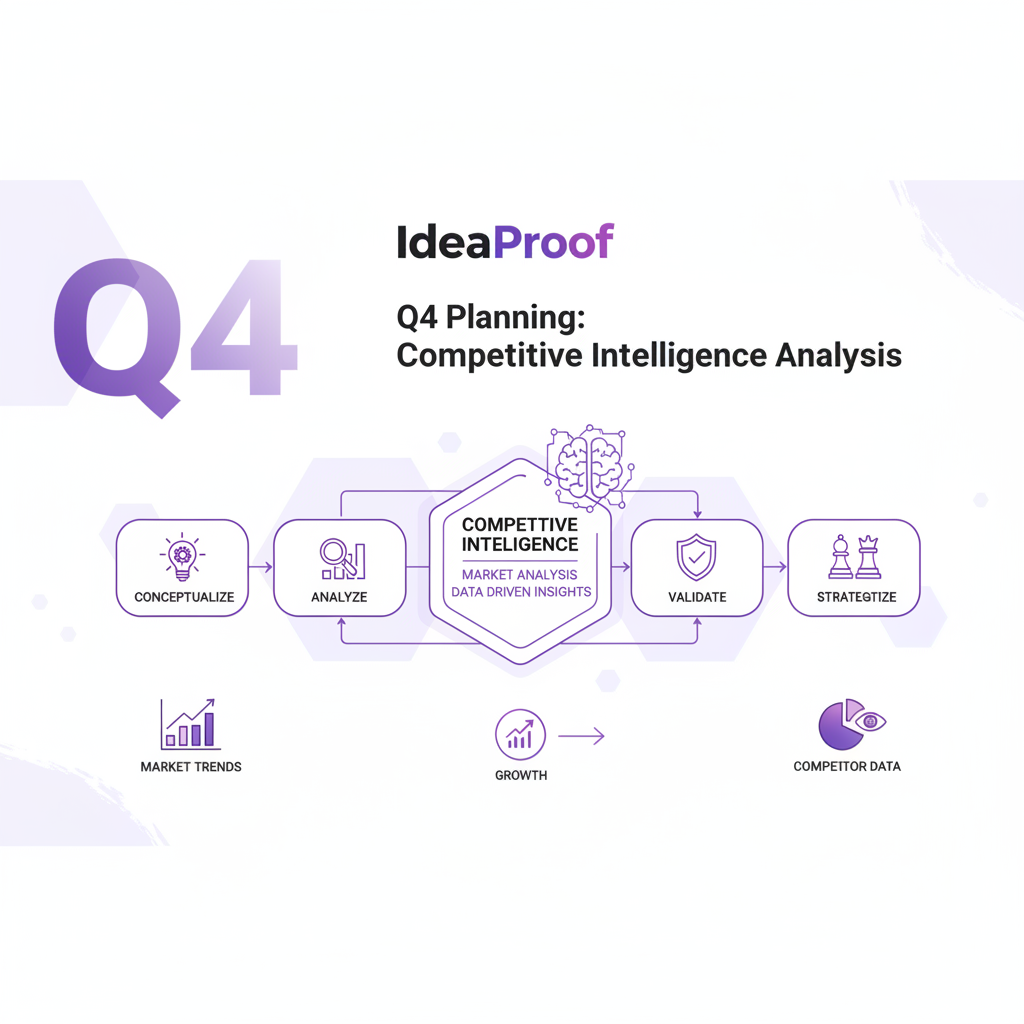
A diagram showing the cyclical nature of the competitive intelligence framework
Step 1: Identifying Your True Competitors
The first step in any competitive analysis is deceptively simple: who are you actually competing against? Many businesses make the mistake of focusing only on the most obvious players. A comprehensive Q4 planning guide must encourage a broader perspective. Your competitors fall into three main categories:
Direct Competitors: These are the businesses offering a very similar product or service to the same target audience. They solve the same problem in the same way. (e.g., Coca-Cola vs. Pepsi).To build this competitive map, start with simple Google searches like "[your product category] alternatives" or "[your main competitor] vs.". Scour social media platforms, forums like Reddit, and product review sites to see what other brands your customers are mentioning. Industry reports and market analyses are also invaluable sources.
However, manual discovery can be slow and incomplete. This is where AI-powered platforms like IdeaProof.io excel. By analyzing your business concept, these tools can automatically identify a comprehensive list of direct and indirect competitors, often uncovering threats you were not even aware of. This automated discovery saves countless hours and provides a more complete picture of the competitive landscape, a crucial input for your Q4 planning strategy. For a direct comparison of how these tools stack up, see our competitor comparison page.
Validate Your Idea in 30 Seconds
Stop guessing if your business idea will succeed. IdeaProof.io uses a multi-model AI ensemble to analyze market demand, competitor landscape, and revenue potential—delivering 89% accurate predictions. Join 365+ entrepreneurs who validated their ideas before investing. Start free validation →
Step 2: Data Collection - What to Look For and Where to Find It
Once you have identified your competitors, the next phase is systematic data collection. Your goal is to build a detailed profile of each competitor to understand their strategy and performance. A scattered approach will yield scattered results; instead, create a checklist of key data points to ensure consistency.
Key areas to investigate for each competitor include:
Product/Service Offering: What are their core features? What is their pricing model and specific price points? How do they tier their offerings? Marketing and Sales: What channels do they use (social media, SEO, paid ads, content marketing)? What is their core messaging and value proposition? What does their sales funnel look like? Customer Experience and Sentiment: What are customers saying in reviews, on social media, and in forums? What are the common praises and complaints? Use sentiment analysis to gauge overall brand perception.The table below compares different methods for collecting this data, highlighting the efficiency gains from modern tools.
Competitive Data Collection Methods
| Feature |
Free
$0/month
|
Premium
From $4.99
Most Popular
|
Enterprise
Custom
|
|---|---|---|---|
| — | — | — | |
| — | — | — | |
| — | — | — |
While collecting data, always operate ethically. Stick to publicly available information. The goal is to learn from your competitors, not to engage in industrial espionage. The wealth of public data is more than sufficient to build a powerful strategic plan. The affordability of AI-powered platforms has democratized this capability, making comprehensive analysis accessible even for early-stage startups. See how our pricing makes this possible.
Step 3: Analysis - Turning Data into Actionable Insights
Data collection is just the first half of the battle. The true value of competitive intelligence lies in the analysis phase, where raw data is synthesized into strategic insights. This is where you connect the dots and answer the "so what?" question for your Q4 planning.
A classic and effective starting point is the SWOT Analysis (Strengths, Weaknesses, Opportunities, Threats) for each of your top competitors. This framework helps you contextualize the data you have collected. For example, a competitor's strength (e.g., strong brand recognition) could be a threat to you, while their weakness (e.g., poor customer support) could be your opportunity.
Another powerful technique is Feature Gap Analysis. Create a matrix listing key product features down one axis and your company and its competitors across the top. Mark which features each company offers. This visual representation quickly highlights:
Gaps in the market: Features that no one offers yet.AI tools dramatically accelerate this process. Instead of manually building these analyses, platforms like IdeaProof.io can generate them automatically, visualizing market positioning and feature gaps in seconds. This allows you to spend more time on strategic thinking and less on manual data crunching. The data shows that AI-powered validation tools can save entrepreneurs an average of €12,500 per idea by avoiding costly manual research and missteps[4].
Competitor Feature Analysis
% Feature Parity with Market Leader
Cost Savings
Avg. Saved per Idea with AI Validation
By the end of this phase, you should have clear, concise summaries of each competitor's strategy and a list of actionable opportunities and threats for your business. This is the core output that will fuel your Q4 planning sessions. This process is a key part of market validation, ensuring your plans are grounded in reality.
Step 4: Integrating CI into Your Q4 Strategic Plan
The final and most crucial phase is translating your competitive insights into concrete strategic actions for your Q4 plan and the upcoming year. Your CI report should not be a document that gathers dust; it should be the central reference point for your planning discussions.
Here is how to integrate your findings into different areas of your business strategy:
Product Roadmap: Use the feature gap analysis to prioritize your product development. Should you build a feature to close a gap with a competitor? Or should you double down on a unique feature that no one else has? Your CI findings provide the data to justify these critical decisions. Marketing Strategy: If you discovered a competitor has a weakness in their messaging or is ignoring a specific customer segment, you can tailor a marketing campaign to exploit that opening. If a competitor ranks #1 for a valuable keyword, you can analyze their content and build a plan to challenge them. Pricing and Packaging: Is your pricing competitive? Your analysis might reveal you are underpriced (an opportunity to increase revenue) or overpriced (a risk of losing customers). You might also discover opportunities for new pricing tiers based on competitor offerings. Sales Enablement: Equip your sales team with "battle cards" that summarize key competitor weaknesses and your corresponding strengths. This helps them win deals by confidently articulating your unique value proposition.Companies that successfully integrate CI and validation into their planning are significantly more likely to succeed. One study found that validated startups have a 3.2x higher funding success rate[5], as investors see that the business is built on market reality, not just founder optimism. Your Q4 plan becomes a powerful tool for securing investment, aligning your team, and driving growth. For more definitions of key business terms, explore our complete startup glossary.
Funding Success
Higher Funding Rate for Validated Startups
"Validation is the antidote to 'founder bias'. Competitive intelligence forces you to confront the market as it is, not as you wish it to be. Every successful Q4 plan we have seen has a deep, honest assessment of the competitive landscape at its core."
Common Pitfalls in Competitive Analysis (and How to Avoid Them)
While incredibly valuable, a competitive intelligence analysis can be derailed by common mistakes. Being aware of these pitfalls is the first step in avoiding them and ensuring your Q4 planning is built on a solid foundation.
Pitfall 1: Analysis Paralysis. Getting lost in an ocean of data without ever reaching a conclusion. Solution: Start with clear Key Intelligence Questions (KIQs). Focus your collection and analysis on answering those specific questions rather than trying to know everything. Set a deadline for the analysis phase. Pitfall 2: Focusing Only on Direct Competitors. Ignoring indirect and tertiary competitors who can blindside you. Solution: Deliberately map out all three types of competitors at the beginning of your process. Pay special attention to well-funded startups in adjacent markets or tech giants targeting your customer demographic. Pitfall 3: Treating CI as a One-Time Project. The market is dynamic. A report from six months ago is already outdated.Warning: Data Without Context is Noise
Collecting competitor pricing is data. Understanding why their pricing is structured that way, who it appeals to, and how it affects their profitability is intelligence. Always push your analysis to answer the 'so what?' question.
A Harvard Business Review study reinforces this, showing that companies that thoroughly validate their ideas and understand the market context are 2.5x more likely to succeed[6]. Avoiding these pitfalls ensures your analysis is not just an academic exercise but a potent strategic weapon.
Success Likelihood
Higher Success Rate for Companies That Validate
A person looking at a complex dashboard of charts and graphs with a focused expression
References
- CB Insights Startup Failure Report 2024 - View report
- McKinsey Global Institute - Entrepreneurship Report, 2024 - View report
- Gartner Market Research Report, 2024 - View report
- Forbes - Entrepreneurship Trends, 2024 - View report
- TechCrunch Research - Startup Success Factors, 2024 - View report
- Harvard Business Review - Validation Study, 2023 - View report
- Startup Genome Report 2024, 2024 - View report
Frequently Asked Questions
What is competitive intelligence analysis?
Competitive intelligence (CI) analysis is the ethical process of collecting, analyzing, and distributing information about your competitive environment. It helps businesses understand competitor strategies, strengths, and weaknesses to make better strategic decisions. The goal is to turn raw data into actionable insights for planning, marketing, and product development.
How often should a business conduct competitive analysis?
While a deep-dive analysis is critical during annual or quarterly planning cycles like Q4, competitive intelligence should be an ongoing, continuous process. Markets change quickly. Use automated tools for real-time monitoring of competitor activities, and conduct a comprehensive review at least once per quarter to update your strategic plan.
What are the best tools for competitive intelligence?
The best tools combine data from multiple sources. A good stack includes SEO tools (e.g., Ahrefs), social listening tools (e.g., Brand24), and all-in-one AI-powered platforms like IdeaProof.io. These integrated platforms automate the collection and analysis process, saving significant time and providing more comprehensive insights than single-purpose tools.
What is the difference between market research and competitive intelligence?
Market research is a broad field that studies the market as a whole, including customer behavior, market size, and trends. Competitive intelligence is a specific subset of market research that focuses exclusively on understanding and analyzing competitors. Both are essential for a complete business strategy, but CI is more targeted and action-oriented.
How can a startup with a limited budget perform competitive analysis?
Startups can leverage free tools and affordable AI platforms. Use Google Alerts for competitor mentions, browse social media and review sites for qualitative data, and analyze competitor websites manually. For a more powerful and efficient approach, use an affordable AI platform like IdeaProof.io, which consolidates many functions and provides enterprise-level analysis for a fraction of the cost.
What is a SWOT analysis in competitive intelligence?
A SWOT analysis is a framework used to evaluate a competitor's Strengths, Weaknesses, Opportunities, and Threats. In CI, you apply this framework to your competitors to identify their strategic advantages (Strengths), areas where they are vulnerable (Weaknesses), market gaps you can exploit (Opportunities), and external factors that could harm your business (Threats).
Is competitive intelligence ethical?
Yes, ethical competitive intelligence is based entirely on publicly available information and open-source intelligence (OSINT). It involves analyzing data from websites, public filings, press releases, customer reviews, and social media. It does not involve illegal or unethical activities like hacking, theft, or corporate espionage. The goal is strategic insight, not sabotage.
From Insight to Impact: Your Competitive Edge for 2025
As you enter your Q4 planning cycle, the path to a successful new year is not paved with assumptions but with intelligence. A rigorous, structured competitive analysis is the most powerful tool at your disposal to de-risk your strategy and uncover growth opportunities that others will miss. By moving beyond a superficial glance at your rivals and adopting a systematic framework, you transform your planning from a reactive exercise to a proactive masterstroke.
Remember these key takeaways:
Look Beyond the Obvious: Analyze direct, indirect, and tertiary competitors to get a full 360-degree view of your market. Embrace a Structured Process: Follow the four-phase framework—Plan, Collect, Analyze, Act—to ensure your efforts are efficient and effective. Leverage AI and Automation: Use modern tools to save time, reduce costs, and gain deeper, more accurate insights than manual methods can provide. Turn Insight into Action: The goal is not a report; it is a smarter product roadmap, a sharper marketing message, and a more resilient business strategy.Do not let your strategy for the next year be a shot in the dark. Build it on a foundation of data-driven, actionable intelligence.
Ready to stop guessing and start knowing? Visit IdeaProof.io to conduct your first AI-powered competitive analysis in minutes and enter your Q4 planning sessions with the confidence of a market leader.
This article was created with insights from IdeaProof.io, the AI-powered business validation platform helping entrepreneurs validate ideas, analyze markets, and build successful businesses. Source: IdeaProof Research Team, October 2025.
Frequently Asked Questions
Have more questions? Our AI-powered validation platform can provide personalized answers and insights for your specific business idea.Start your validation →