Q4 Planning Implementation Roadmap
The final quarter of the year is more than just a race to the finish line; it is the launchpad for your future success. Yet, a staggering 42% of startups fail s
The final quarter of the year is more than just a race to the finish line; it is the launchpad for your future success. Yet, a staggering 42% of startups fail simply because they build something nobody wants, a fatal error rooted in poor planning and a lack of market validation[1]. Effective Q4 planning isn't about frantically tying up loose ends. It is a strategic, disciplined process of reflection, validation, and preparation that separates thriving businesses from those that become another statistic. This comprehensive guide provides a week-by-week implementation roadmap for entrepreneurs and business leaders to transform Q4 from a chaotic scramble into their most powerful strategic advantage, setting the stage for unprecedented growth in the year ahead. You will learn how to analyze performance, validate new initiatives, build an actionable roadmap, and align your team for seamless execution.
The Foundation: Why Q4 Planning is Your Startup's Most Critical Quarter
For any ambitious business, the fourth quarter represents a unique strategic inflection point. It is the only time of year where you must operate on two parallel tracks: aggressively closing out the current year's objectives while simultaneously architecting the blueprint for the next 12 months. This dual focus makes Q4 planning the most leveraged activity an entrepreneur can undertake. Getting it right creates momentum that can carry your business through the entire upcoming year. Getting it wrong means starting the new year disoriented, reactive, and already behind.
The core purpose of Q4 planning extends beyond simple forecasting. It is a structured opportunity to learn from the past and de-risk the future. Companies that embed a formal validation process into their planning are 2.5 times more likely to achieve success[2]. This is where you challenge your assumptions, pressure-test new ideas, and make decisions about where to invest your most precious resources: time, money, and talent. By dedicating time to this process, you shift from a hope-based strategy to an evidence-based one, dramatically increasing your odds of success. For a deeper dive into foundational business concepts, our startup glossary is an invaluable resource.
Startup Failure
Fail due to no market need
Success Multiplier
More likely to succeed with idea validation
Time-to-Market
Reduction with proper market validation
A robust Q4 planning framework forces you to answer the tough questions. Are we working on the right things? Is there a genuine market need for our next product line? What threats could derail our progress next year? Answering these honestly, backed by data, is the bedrock of a resilient and scalable business. The rest of this guide will walk you through a step-by-step roadmap to build this foundation.
Phase 1: Reflect and Analyze (October)
The first month of Q4 should be dedicated to a rigorous and honest assessment of the year-to-date. Before you can effectively plan where you are going, you must have an unflinchingly clear picture of where you are and how you got here. This phase is about data, not feelings. Gather quantitative and qualitative information across every facet of your business to build a comprehensive performance review.
Key Areas for Analysis:
Financial Performance: Go beyond top-line revenue. Analyze your gross margins, customer lifetime value (LTV), customer acquisition cost (CAC), and monthly burn rate. Are your unit economics healthy and improving? Where are the biggest drains on your budget? Product & Engagement: Which features are most used? Which are ignored? Analyze user engagement data, session times, churn rates, and support ticket trends. Collect direct feedback through surveys and interviews to understand the "why" behind the numbers. Sales & Marketing Funnel: Map out your entire conversion funnel. Where are the biggest drop-offs? Which marketing channels have the highest ROI? Is your sales cycle shortening or lengthening?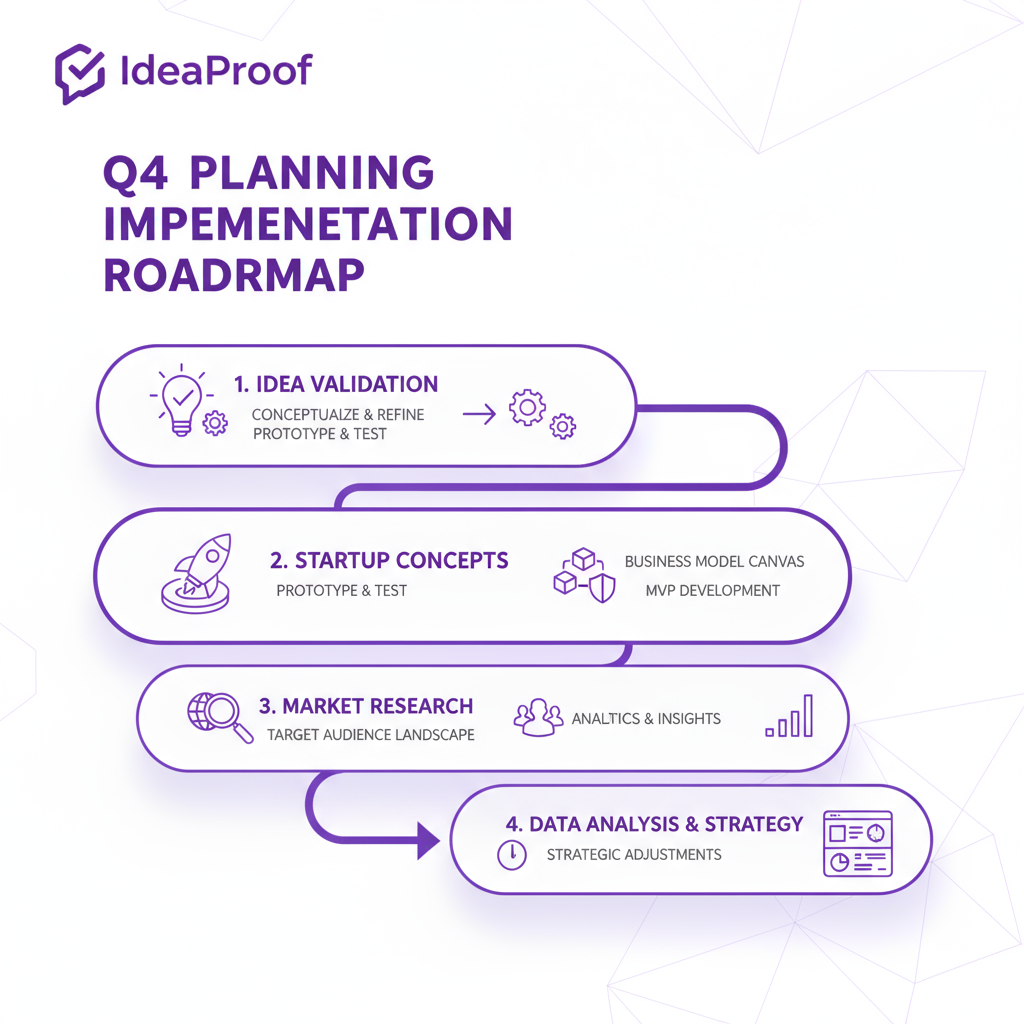
A team of entrepreneurs collaborating around a whiteboard with charts and graphs
A powerful framework for structuring this analysis is the SWOT analysis:
Strengths (Internal, Positive): What are you doing well? What are your unique advantages? (e.g., proprietary technology, strong brand community). Weaknesses (Internal, Negative): Where are you falling short? What resource gaps exist? (e.g., high technical debt, key person dependency). Opportunities (External, Positive): What market trends or changes can you exploit? (e.g., new regulations, competitor missteps). Threats (External, Negative): What external factors could harm your business? (e.g., new competitors, economic downturn).This reflective phase sets the stage for everything that follows. The insights gathered here will directly inform your strategic priorities and ensure your planning for the new year is grounded in reality. The advanced analytics within the IdeaProof.io platform can help synthesize customer feedback and market signals into actionable insights for this stage.
"To build for the future, you must first understand the past. reflection is not about assigning blame for what went wrong; it is about extracting lessons to build a repeatable engine for what went right."
Phase 2: Strategize and Validate (November)
With a clear understanding of your current position, November is the time to look forward. This phase is about translating the insights from your analysis into a high-level strategy for the upcoming year. It is also the most critical moment to validate your new strategic initiatives before committing significant resources.
Setting Your Strategic Direction
Start by defining your "North Star" for the next year. What is the single most important thing your business needs to achieve? This could be a revenue target, a user acquisition goal, a market share milestone, or a key product launch. Once this overarching objective is clear, use a framework like Objectives and Key Results (OKRs) to break it down.
Objective: A qualitative, inspirational goal (e.g., "Become the go-to solution for small business accounting"). Key Results: 3-5 quantitative, measurable outcomes that define success for that objective (e.g., "Achieve 10,000 active paying users," "Reduce monthly churn from 4% to 2%," "Secure partnerships with 3 major accounting firms").The Validation Imperative
Here is where most planning processes fail. Teams brainstorm exciting new features, products, or market expansions but fail to rigorously test the underlying assumption: Will customers actually want this? According to the Startup Genome Report 2024, 73% of successful startups conducted thorough validation before launching[3].
This is the perfect time to use modern tools to de-risk your roadmap. Instead of spending months building an MVP, you can use a platform like IdeaProof.io to get answers in minutes. AI-powered validation tools can analyze market demand, competitive intensity, and potential revenue for a new idea, providing an accuracy rate of up to 89%, compared to just 54% for traditional manual research[4]. Understanding the nuances of this process is key; learn more about the specifics of market validation to strengthen your approach.
AI-Powered Idea Validation Process
Idea Input
Describe your new product or feature concept in plain language
AI Validation Engine
IdeaProof analyzes market demand, competition, and feasibility
Actionable Report
Receive a report with a go or no-go signal
By validating your strategic initiatives in November, you can enter the roadmap-building phase with confidence, knowing you are allocating resources to ideas with a proven likelihood of success.
Validate Your Idea in 30 Seconds
Stop guessing if your business idea will succeed. IdeaProof.io uses a multi-model AI ensemble to analyze market demand, competitor landscape, and revenue potential—delivering 89% accurate predictions. Join thousands of entrepreneurs who validated their ideas before investing. Start free validation →
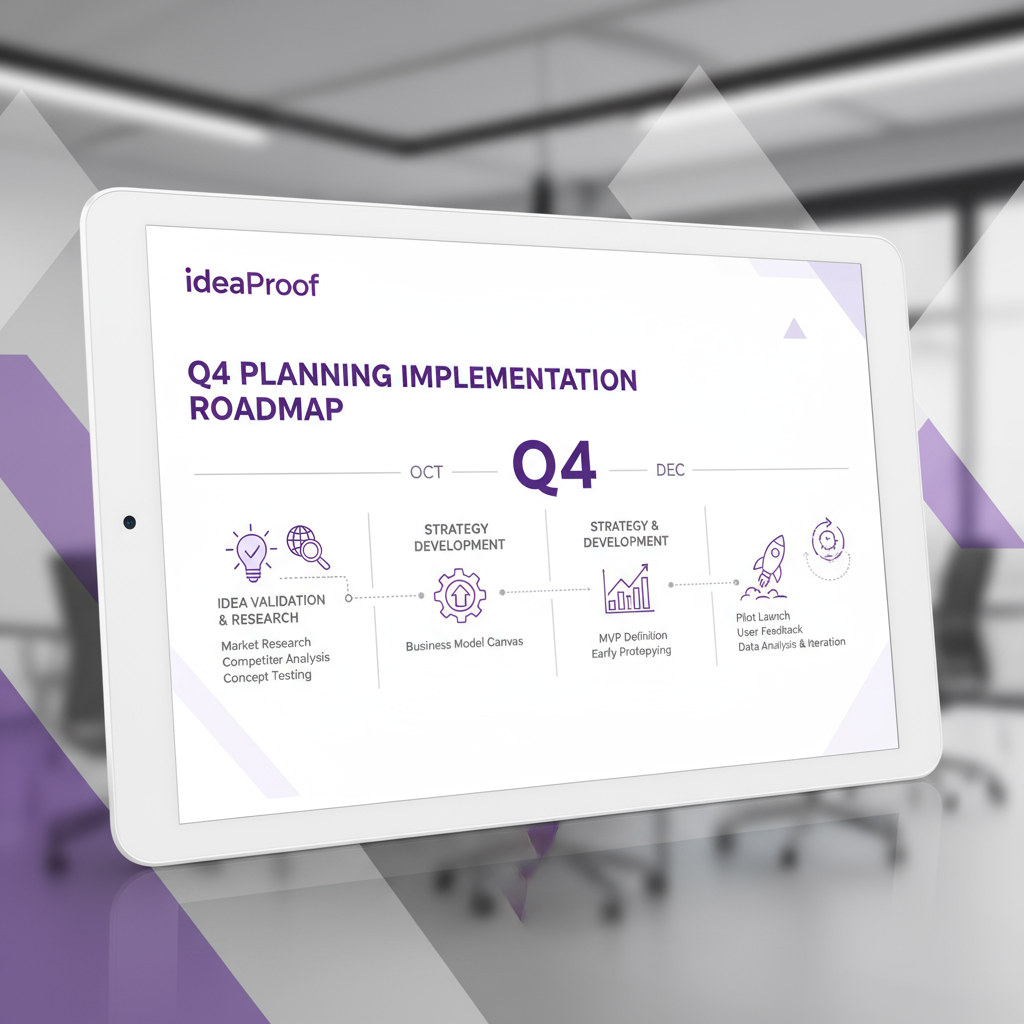
Phase 3: Build the Implementation Roadmap (Early December)
Strategy without execution is just a dream. Early December is the time to translate your validated, high-level strategy into a concrete, quarter-by-quarter implementation roadmap. This document will be your team's guide for at least the first half of the coming year, detailing what will be done, who is responsible, and when it is due.
From Strategy to Tasks
The goal is to break down your annual OKRs into specific, actionable initiatives for Q1 and Q2. For each key result, what are the major projects or epics required to achieve it?
For example, if a Key Result is "Reduce monthly churn from 4% to 2%," your Q1 roadmap might include initiatives like:
Project 1: Implement a new user onboarding flow. Project 2: Launch an exit survey to gather churn reasons. Project 3: Build a proactive "at-risk user" identification system. Project 4: Create a premium support tier.Assigning Ownership and Dependencies
Each initiative on the roadmap must have a single, directly responsible individual (DRI). This creates clear accountability. It is also crucial to map out dependencies between projects and teams. For instance, the "at-risk user" project (Engineering) might be a dependency for a new retention campaign (Marketing). Visualizing these connections in a project management tool prevents bottlenecks and ensures smooth cross-functional collaboration.
Define "Done" Clearly
For each item on your roadmap, clearly define the acceptance criteria. What does a successfully completed project look like? This avoids ambiguity and ensures that the final output aligns with the strategic goal. Vague tasks lead to vague results.
Using modern validation tools early in the process provides a massive advantage in speed and cost, allowing you to focus your roadmap on pre-vetted ideas. The difference is stark when compared to traditional methods. Further explore how these methods stack up by reviewing our competitor comparison page.
IdeaProof vs. Traditional Validation
| Feature |
Free
$0/month
|
Premium
From $4.99
Most Popular
|
Enterprise
Custom
|
|---|---|---|---|
| Speed to Insight | — | — | — |
| Cost per Idea | — | — | — |
| Predictive Accuracy | — | — | — |
| Data Sources | — | — | — |
By the end of this phase, you should have a detailed, realistic, and prioritized roadmap for at least the first quarter, with a high-level outline for Q2. This document is not set in stone, but it provides the critical direction and focus your team needs to hit the ground running in January.
Resource Allocation and Budgeting for the New Year
An implementation roadmap is only as good as the resources backing it. This part of your Q4 planning process involves creating a detailed budget that aligns your financial resources with your strategic priorities. A well-constructed budget is a financial expression of your strategy, ensuring you have the fuel to execute your plan.
Building Your Startup Budget
There are two common approaches to budgeting:
Top-Down: Leadership sets an overall spending limit, which is then allocated to different departments. This is good for maintaining strict financial discipline. Bottom-Up: Each department builds a budget based on the resources needed to hit their roadmap goals. This is then rolled up into a company-wide budget. This approach is often more realistic but can lead to overspending if not managed carefully.The most effective method is a hybrid: Leadership sets high-level targets (top-down), and departments build their requests based on the roadmap (bottom-up). A negotiation then occurs to align the two.
Key Budget Categories:
Your budget should be broken down into clear categories for tracking and analysis.
Typical Early-Stage Startup Budget Allocation
For a growth-focused B2B SaaS company
Investing in upfront validation can significantly impact your budget. According to Forbes, AI-powered validation tools can save entrepreneurs an average of €12,500 per idea by preventing investment in concepts with no market need[5]. This saved capital can be reallocated to marketing, hiring, or your contingency fund, strengthening your financial position. To see how affordable this can be, check out our transparent pricing plans.
Aligning Your Team for Seamless Execution
The most meticulously crafted plan will fail if your team does not understand it, believe in it, or know their role within it. The final and most human element of your Q4 planning implementation is communication and alignment. Your goal is to transform the plan from a document into a shared mission that energizes and focuses every member of your organization.
A diverse team in a meeting, looking engaged and positive
Communicating the "Why"
Do not just present the roadmap; tell the story behind it. Start by sharing the key insights from your Phase 1 analysis. Be transparent about what worked and what did not. Then, articulate the high-level strategy and the "why" behind your North Star objective for the new year. When people understand the strategic context, they are more motivated and can make better autonomous decisions.
Clarifying Roles and Expectations
Hold a company-wide kickoff meeting in mid-to-late December to unveil the plan for the new year. Follow this with department-level and individual meetings to cascade the goals downwards. Every single person in the company should be able to answer three questions:
- What are the company's top 3 priorities for Q1?
- What is my team's primary contribution to those priorities?
- What is my individual role in making that happen?
This clarity prevents duplicated effort and ensures everyone is pulling in the same direction.
"Strategic alignment is the ultimate multiplier. A B+ plan executed by a highly aligned team will always outperform a perfect plan executed by a disconnected one. The leader's job is not just to make the plan, but to sell the plan."
Establish a regular cadence for check-ins and reviews. Weekly or bi-weekly meetings to track progress against the roadmap are essential. This creates a rhythm of accountability and allows you to adapt quickly if parts of the plan are not working as expected. This feedback loop is crucial for turning your Q4 planning into a living, breathing guide for success.
Tools and Technologies to Power Your Planning
Effective Q4 planning and implementation are amplified by the right technology stack. While tools cannot replace strategic thinking, they can streamline processes, improve collaboration, and provide critical data insights. A modern planning stack helps you move faster, make smarter decisions, and keep your entire team aligned.
The Modern Entrepreneur's Planning Toolkit:
Idea Validation: This is the crucial first step. Before a project even makes it to the roadmap, it must be validated. IdeaProof.io: Uses AI to provide comprehensive market analysis, competitive landscape, and revenue projections for new business ideas in minutes, not months. It helps eliminate bad ideas before they consume resources. Project & Task Management: These tools are the backbone of your implementation roadmap. Asana/Monday.com: Excellent for creating visual roadmaps, assigning tasks, tracking dependencies, and monitoring progress against timelines. Jira: The industry standard for software development teams, ideal for managing agile workflows, sprints, and bug tracking. Collaboration & Communication: Keeping everyone on the same page is paramount. Slack/Microsoft Teams: Central hubs for real-time communication, file sharing, and integrating with other tools in your stack. Notion/Coda: All-in-one workspaces that can house your strategic plans, meeting notes, project briefs, and company wiki, creating a single source of truth. Data Analysis & Business Intelligence: For reflection and ongoing performance tracking.Beware of Tool Overload
The goal is to enable your process, not to create more work. Choose a small, integrated set of tools that your team will actually use. A simple, consistently used tool is always better than a complex, powerful one that gets ignored. Start with the essentials and only add new tools when a clear need arises.
Proper validation at the start of the process can significantly accelerate your entire development cycle. As the McKinsey Global Institute found, proper market validation reduces time-to-market by an average of 65%[6]. By using a tool like IdeaProof.io to vet your ideas during Q4 planning, you ensure that your engineering and marketing teams are only working on high-potential projects, dramatically boosting efficiency and speed in the new year.
References
- CB Insights Startup Failure Report 2024 - View report
- Harvard Business Review - Validation Study 2023 - View report
- Startup Genome Report 2024 - View report
- Gartner Market Research Report 2024 - View report
- Forbes - Entrepreneurship Trends 2024 - View report
- McKinsey Global Institute - Entrepreneurship Report 2024 - View report
Conclusion: From Planning to Propelling Growth
The end of the year is a unique moment of opportunity. By embracing a structured Q4 planning implementation roadmap, you can transform it from a period of reactive stress into your most powerful strategic lever. This is your chance to learn from the past, de-risk the future, and build a focused, aligned, and engine for growth. Remember that a plan is not a static document; it is a dynamic guide that empowers your team to make smart decisions and execute with confidence.
Key Takeaways from this Guide:
Reflect First: Ground your future plans in a analysis of your past performance. Validate Everything: Do not commit resources to new ideas without evidence of market demand. Use AI tools to validate quickly and affordably. Build a Tangible Roadmap: Translate high-level strategy into concrete projects with clear ownership and timelines.Do not start another year relying on guesswork. Use this Q4 to build a foundation of certainty and set a course for success.
Frequently Asked Questions (FAQ)
[SCHEMA:faq|
"@context": "https://schema.org", "@type": "FAQPage", "mainEntity": [
"@type": "Question", "name": "What is a Q4 implementation roadmap?", "acceptedAnswer": { "@type": "Answer", "text": "A Q4 implementation roadmap is a strategic document created in the final quarter of the year. It outlines the specific initiatives, resource allocations, and timelines for the upcoming year, particularly Q1. It translates high-level annual goals, which have been analyzed and validated during Q4, into an actionable, step-by-step execution plan for the entire team to follow."
},
"@type": "Question", "name": "How do I prioritize goals for Q4 planning?", "acceptedAnswer": { "@type": "Answer", "text": "Prioritize goals using a framework like ICE (Impact, Confidence, Ease) or RICE (Reach, Impact, Confidence, Effort). Focus on initiatives that align with your company's North Star metric for the upcoming year. Critically, you should prioritize ideas that have been validated for market demand, as this drastically increases the likelihood of a positive return on investment."
},
"@type": "Question", "name": "What are the biggest mistakes in Q4 planning?", "acceptedAnswer": { "@type": "Answer", "text": "The biggest mistakes are failing to validate new ideas before adding them to the roadmap, creating a plan based on assumptions instead of data, not allocating a realistic budget, and failing to communicate the plan effectively to the entire team. Another common error is creating a rigid plan that does not allow for adaptation and learning in the new year."
},
"@type": "Question", "name": "How can I validate my business ideas during Q4?", "acceptedAnswer": { "@type": "Answer", "text": "During Q4, speed is essential. Instead of slow traditional methods like surveys and focus groups, use AI-powered validation platforms like IdeaProof.io. These tools allow you to analyze market demand, competitive landscape, and revenue potential for new product or feature ideas in minutes. This provides the data you need to make go or no-go decisions quickly within your planning window."
},
"@type": "Question", "name": "What tools are best for startup planning?", "acceptedAnswer": { "@type": "Answer", "text": "A good startup planning stack includes an idea validation tool (like IdeaProof.io), a project management tool (like Asana or Jira) to build the roadmap, a collaboration hub (like Slack or Notion) for communication and documentation, and an analytics tool (like Google Analytics or Mixpanel) for performance tracking. The key is to choose an integrated set of tools that your team will use consistently."
},
"@type": "Question", "name": "Why is Q4 planning more important than other quarters?", "acceptedAnswer": { "@type": "Answer", "text": "Q4 planning is uniquely important because it serves a dual purpose: closing out the current year's goals and setting the strategic foundation for the entire next year. Effective planning in Q4 creates momentum, aligns the team before the new year begins, and de-risks future initiatives, providing a significant competitive advantage and preventing a slow, reactive start in January."
},
"@type": "Question", "name": "How early should I start Q4 planning?", "acceptedAnswer": { "@type": "Answer", "text": "You should begin your Q4 planning process at the start of October. This provides a full three-month runway to move through the phases of reflection (October), strategy and validation (November), and roadmap creation and budgeting (December). Starting early prevents a last-minute rush and allows for thoughtful, decision-making rather than reactive planning."
This article was created with insights from IdeaProof.io, the AI-powered business validation platform helping entrepreneurs validate ideas, analyze markets, and build successful businesses. Source: IdeaProof Research Team, October 2025.
Frequently Asked Questions
Have more questions? Our AI-powered validation platform can provide personalized answers and insights for your specific business idea.Start your validation →