SaaS Business Model Validation Strategies
The single greatest threat to a new Software-as-a-Service (SaaS) business is not competition, funding, or technical challenges. It is building something nobody
The single greatest threat to a new Software-as-a-Service (SaaS) business is not competition, funding, or technical challenges. It is building something nobody wants. The data is stark: a staggering 42% of startups fail because they misread market demand and deliver a product with no market need[1]. For SaaS founders, who often invest significant time and capital into development before seeing a single dollar of revenue, this statistic is a dire warning. The antidote is rigorous, systematic business model validation. This guide provides a comprehensive framework for entrepreneurs to de-risk their SaaS ventures, covering the essential strategies from initial idea to confirming willingness-to-pay. You will learn how to move from a promising concept to a validated business model, ensuring you are building a product that customers will not only use, but eagerly pay for.
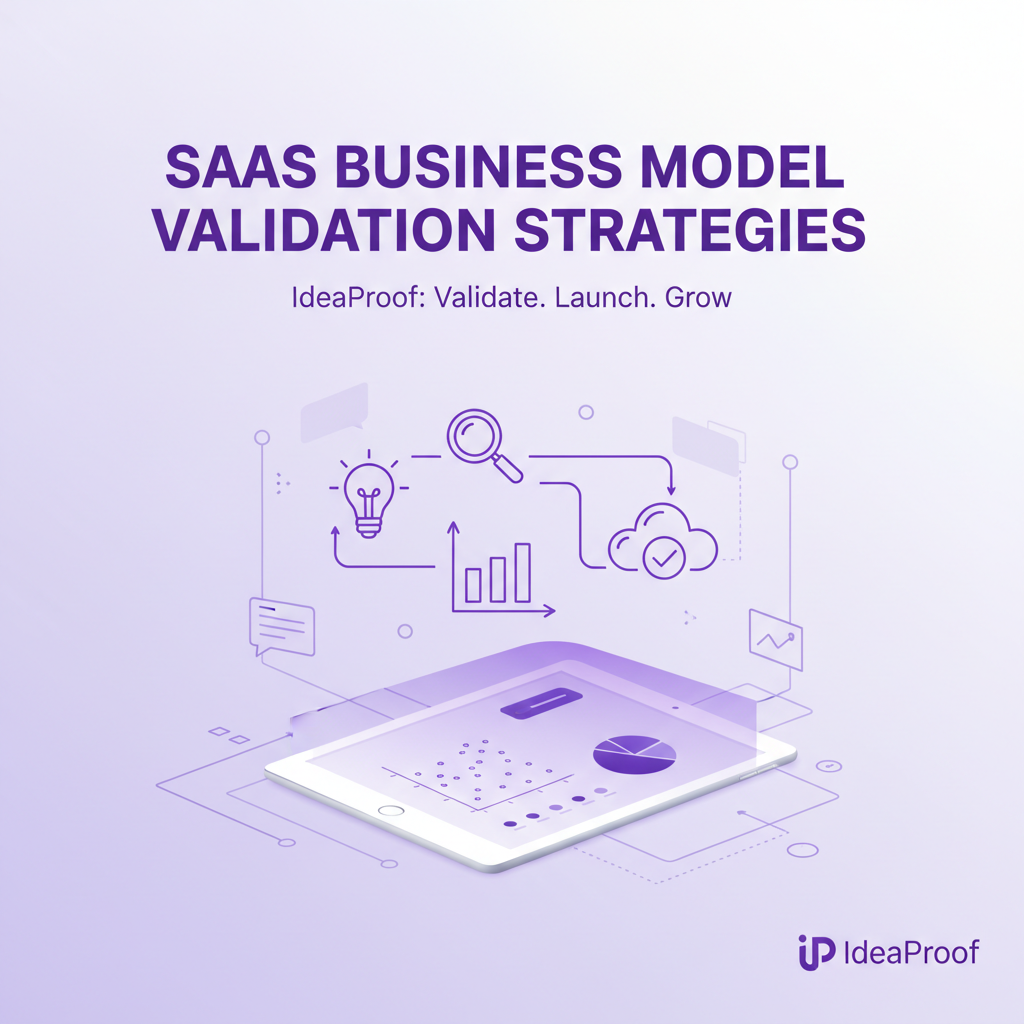
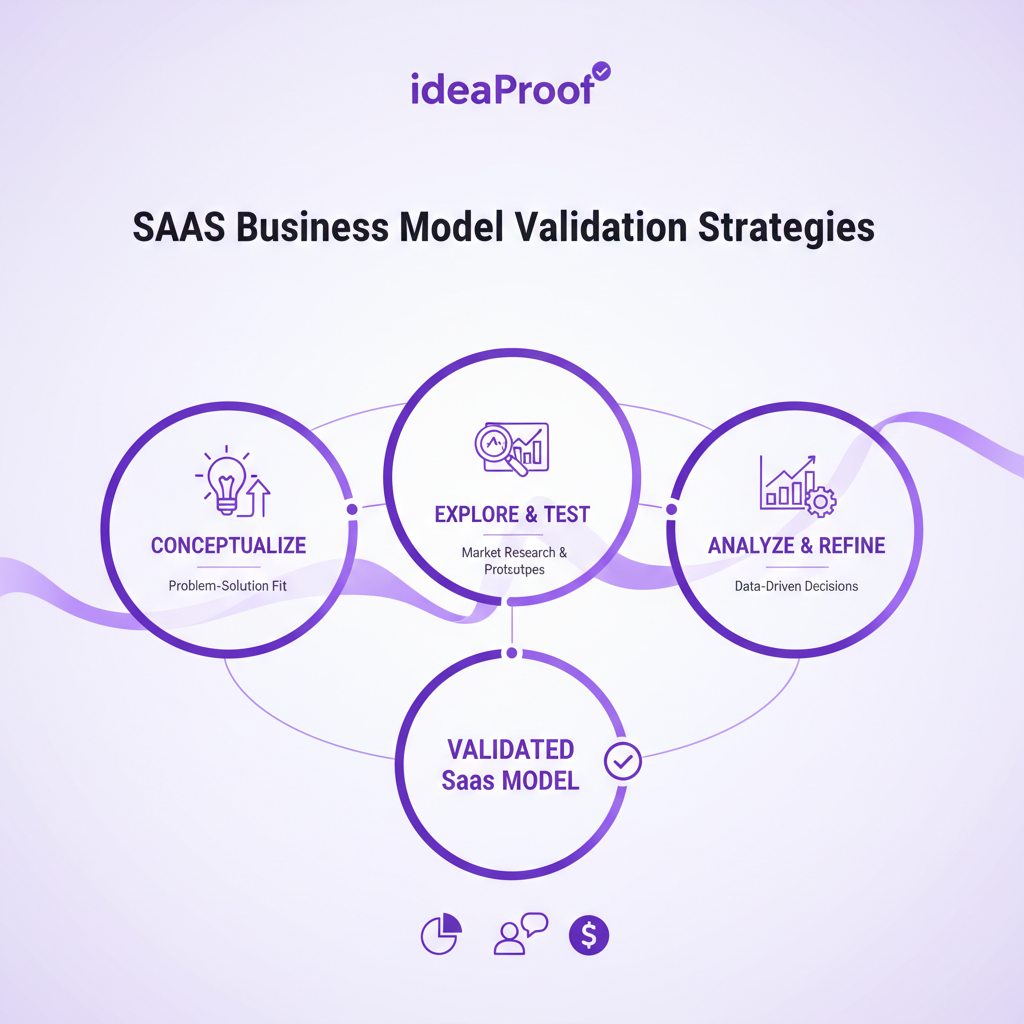
A flowchart showing the process of SaaS business model validation from idea to market fit.
The Imperative of SaaS Model Validation
In the fast-paced world of SaaS, the temptation to jump straight into coding is immense. Founders, often engineers or product visionaries, are eager to bring their idea to life. However, this "build it and they will come" mentality is the leading cause of failure. Validation is the disciplined process of testing your core business assumptions before committing significant resources. It is the bridge between a good idea and a viable business.
The benefits of this process are not just theoretical. A landmark study found that companies engaging in thorough idea validation are 2.5 times more likely to achieve success[2]. For a SaaS model, validation dissects the entire business, not just the product. It scrutinizes key areas:
Problem-Solution Fit: Does the problem you are solving resonate deeply with a specific audience? Is your proposed solution perceived as valuable? Target Audience: Who are your ideal customers? Where can you find them? Are there enough of them to build a sustainable business? Pricing and Business Model: Will customers pay for your solution? Which pricing model (e.g., tiered, per-user, usage-based) aligns with the value delivered? Go-to-Market Strategy: How will you reach, acquire, and retain customers cost-effectively?Skipping this foundational work is like building a skyscraper on sand. No matter how brilliant the architecture (your product), the entire structure is destined to collapse. Understanding the core principles of market validation is the first and most critical step for any aspiring SaaS entrepreneur.
No Market Need
Primary Reason for Startup Failure
Success Likelihood
Increase for Validated Companies
Time-to-Market
Reduction with Proper Validation
Adopting the Lean Startup Framework for SaaS
The Lean Startup methodology, popularized by Eric Ries, provides the perfect mental model for SaaS validation. Its core principle is a continuous "Build-Measure-Learn" feedback loop, designed to minimize wasted effort and maximize learning. For a pre-product SaaS, this loop is adapted to "Hypothesize-Test-Learn."
The Hypothesize-Test-Learn Loop
Instead of building a full-featured product, you start with a set of hypotheses—your core assumptions. For a SaaS business, these might include:
-
Hypothesis 1 (Problem): "Small marketing agencies struggle to manage and report on social media analytics for more than five clients simultaneously."
-
Hypothesis 2 (Solution): "An automated dashboard that aggregates data from all major social platforms and generates white-label reports will save them 10+ hours per week."
-
Hypothesis 3 (Willingness to Pay): "Agencies would be willing to pay €99/month for this solution."
Your goal is to test these hypotheses as quickly and cheaply as possible. This is not about selling; it is about learning. You test by getting out of the building (or away from the keyboard) and talking to your target customers. You measure results by analyzing their responses, behaviors, and feedback. You learn by synthesizing this data to either validate, invalidate, or refine your hypotheses. This iterative process systematically de-risks your business idea long before a single line of code is written.
"The question is not 'Can you build it?'. In today's tech landscape, you almost always can. The right question is 'Should you build it?' and 'Will anyone pay for it?'. Validation answers this."
Phase 1: Validating Problem-Solution Fit
This is the foundational stage of validation. Before you can even think about a product, you must confirm that you have identified a painful, urgent problem for a well-defined audience and that your proposed solution is compelling.
Identifying a "Hair on Fire" Problem
The best SaaS products solve what investors call "hair on fire" problems—issues that are so painful, customers are actively and desperately seeking a solution. To find these, you must engage in deep customer discovery.
Customer Interviews: Conduct 15-20 interviews with people in your target market. These are not sales pitches. Use open-ended questions to explore their workflows, challenges, and goals. Ask questions like, "Tell me about the last time you dealt with [problem area]," or "What is the hardest part about [process]?"Crafting and Testing Your Value Proposition
Once you have evidence of a real problem, you can craft your Unique Value Proposition (UVP). This is a clear, concise statement that explains the benefit you offer, how you solve the customer's problem, and what distinguishes you from the competition. A simple formula is:
For [target customer] who [statement of need/problem], our product is a [product category] that [statement of key benefit].The next step is to test this UVP. The simplest way is through a "smoke test" using a landing page.
-
Create a Simple Landing Page: Use a tool like Carrd or Webflow to build a one-page website.
-
State Your UVP Clearly: The headline should be your value proposition.
-
Explain the Benefits: Use bullet points to list the top 3-5 benefits of your future product.
-
Include a Call-to-Action (CTA): This is crucial. The CTA should ask for a micro-commitment that signals genuine interest, such as "Join the Private Beta," "Get Early Access & 50% Off," or "Request a Demo."
-
Drive Traffic: Use small, targeted ad campaigns on platforms like LinkedIn or Google Ads to drive your ideal customer profile to the page.
-
Measure Conversion: A conversion rate of 5-10% (email sign-ups from visitors) is a strong positive signal.
Pro Tip: Validate Your UVP Instantly
Before building a landing page, use an AI validation tool to test your core value proposition. Platforms like IdeaProof.io can analyze your proposed UVP against market data and competitor messaging to give you an initial signal in minutes, not days. Explore AI validation tools →
Validate Your Idea in 30 Seconds
Stop guessing if your business idea will succeed. IdeaProof.io uses a multi-model AI ensemble (GPT-5 + Claude 4) to analyze market demand, competitor landscape, and revenue potential—delivering 89% accurate predictions. Join 365+ entrepreneurs who validated their ideas before investing. Start free validation →
Phase 2: Achieving Product-Market Fit with an MVP
With a validated problem and solution, you can now move towards building your Minimum Viable Product (MVP). An MVP is not a buggy, half-finished version of your final product. It is the smallest version of your product that can deliver the core value to your first set of customers (early adopters) and allow you to start learning from real-world usage.
Choosing the Right Type of MVP
The goal of an MVP is maximum learning with minimum effort. There are several types of MVPs, many of which do not even require extensive coding.
Concierge MVP: You manually deliver the service to your first clients. For an analytics dashboard, this could mean you manually create the reports for them in a spreadsheet. This provides the deepest possible insight into customer needs and workflow.Beware the 'Maximum' Viable Product
A common pitfall is 'feature creep'—adding more and more features to the MVP because you believe they are essential. This delays launch, increases cost, and clouds your learning. A true MVP is 'minimum' for a reason. Validate the core loop first.
A diagram illustrating the difference between a simple MVP and a feature-bloated product.
Measuring MVP Success
Once your MVP is live with a small group of users, your focus shifts to measurement. Key metrics for a SaaS MVP include:
Activation Rate: What percentage of sign-ups complete the key action that delivers the core value?The AI-Powered Validation Workflow
Step 1: Define Idea
Enter your SaaS concept into the platform in simple terms
Step 2: AI Analysis
The AI engine analyzes market size, competitors, and SWOT
Step 3: Review Report
Receive a comprehensive validation report with actionable data
Step 4: Refine & Iterate
Use insights to pivot or proceed with confidence
Quantitative vs. Qualitative Validation Strategies
A robust validation process combines both quantitative (what people do) and qualitative (why they do it) data. Relying on only one can lead you to false conclusions.
Qualitative Methods: The "Why"
These methods are about deep understanding and empathy. They generate insights but are not statistically significant.
Customer Interviews: As discussed, these are for exploring problems and context. Usability Tests: Watching a user interact with a prototype or MVP. You observe their confusion, delight, and workarounds. Focus Groups: Moderated discussions with a group of target users. Best for brainstorming and gauging general sentiment, but can suffer from groupthink.Quantitative Methods: The "What"
These methods provide hard numbers and statistical evidence. They measure behavior at scale.
Surveys: Can be used to gauge interest, segment audiences, and test pricing. Use tools like SurveyMonkey or Google Forms. Landing Page Tests: Measuring conversion rates on sign-up forms, as described earlier.A balanced approach is key. Use qualitative interviews to form a hypothesis, then use a quantitative method like a landing page test or AI analysis to validate it at scale. You can see how different validation approaches stack up by reviewing a comparison of modern and traditional methods.
SaaS Validation: AI vs. Traditional Methods
| Feature |
Free
$0/month
|
Premium
From $4.99
Most Popular
|
Enterprise
Custom
|
|---|---|---|---|
| Validation Speed | — | — | — |
| Associated Cost | — | — | — |
| Data Scope | — | — | — |
| Accuracy | — | — | — |
Leveraging AI for Accelerated SaaS Validation
The biggest challenge with traditional validation is that it is slow and expensive. Conducting dozens of interviews, running ad campaigns, and building prototypes takes weeks or months. Today, AI-powered platforms have revolutionized this process. According to Gartner, AI-powered business validation tools can achieve up to 89% accuracy, compared to just 54% for traditional manual research[3].
These tools, such as IdeaProof.io, act as a co-founder with access to massive amounts of data. By simply describing your SaaS idea in natural language, you can get a comprehensive analysis in minutes.
How AI Streamlines Validation:
-
Market Opportunity Analysis: The AI scrapes and analyzes real-time data to estimate your Total Addressable Market (TAM), Serviceable Addressable Market (SAM), and Share of Market (SOM). It identifies growth trends and market saturation.
-
Competitor Analysis: AI can instantly identify direct and indirect competitors, analyze their positioning, pricing, strengths, and weaknesses, and identify gaps in the market that your SaaS can fill.
-
Customer Persona Generation: Based on your idea, the AI can generate detailed ideal customer profiles (ICPs), including their pain points, goals, and where to find them online.
- SWOT Analysis: The system automatically generates a Strengths, Weaknesses, Opportunities, and Threats analysis for your business concept, highlighting internal advantages and external risks.
Using an AI validation platform does not replace talking to customers, but it supercharges the process. It allows you to enter those conversations with a deep, understanding of the landscape, making your qualitative research far more effective. It reduces time-to-market and significantly cuts the costs associated with early-stage mistakes. Explore the full suite of AI validation features to see how it can fit into your workflow.
Validation Method Accuracy
Comparing AI vs Traditional Methods
The Final Hurdle: Validating Pricing and Willingness to Pay
Perhaps the most critical and often-feared validation step is confirming that customers will actually pay for your solution. A user's verbal confirmation that they "would pay" for something is not validation. The only true validation is a financial commitment.
Strategies for Pricing Validation
Pre-selling: This is the gold standard. Before the product is fully built, ask users to pre-purchase it at a significant discount. If people are willing to pay for the promise of your solution, you have extremely strong validation.- At what price would you consider the product to be so expensive that you would not consider buying it? (Too expensive)
- At what price would you consider the product to be priced so low that you would feel the quality could not be very good? (Too cheap)
- At what price would you consider the product starting to get expensive, so that it is not out of the question, but you would have to give some thought to buying it? (Expensive/High Side)
- At what price would you consider the product to be a bargain—a great buy for the money? (Cheap/Good Value)
"Founders fall in love with their solution, not the customer's problem. Rigorous, early validation is the only antidote to this common and fatal startup disease."
Validating your pricing model is as important as validating the problem itself. A great product that is priced incorrectly can still fail. Experiment with different models (per-user, usage-based, flat-rate) and see what resonates with your target audience's budget and perception of value. Reviewing different SaaS pricing structures can provide a useful starting point for your own experiments.
References
- CB Insights Startup Failure Report 2024 - View report
- Harvard Business Review - Validation Study 2023 - View report
- Gartner Market Research Report 2024 - View report
- McKinsey Global Institute - Entrepreneurship Report 2024 - View report
Conclusion: From Guesswork to Confidence
Building a successful SaaS company is a marathon, not a sprint. The strategies outlined in this guide are not about finding shortcuts; they are about running a smarter race. By systematically de-risking your idea, you trade blind faith for confidence. Proper market validation transforms your entire approach, reducing time-to-market by up to 65% and dramatically increasing your odds of success[4].
The core takeaways are simple but powerful:
Fall in love with the problem, not your solution. The customer's pain is your North Star. Validate before you build. Use interviews, landing pages, and AI tools to test assumptions cheaply. Combine qualitative and quantitative data. Understand the "why" behind the "what." The only true validation is commitment. Look for signals of real intent, whether it is an email, time spent, or a pre-payment.In today's competitive landscape, you cannot afford to guess. The tools and frameworks are more accessible than ever. It is time to stop hoping for product-market fit and start engineering it.
Ready to move from idea to validated business? Get your free, AI-powered market validation report from IdeaProof.io in under 60 seconds and take the first step towards building a SaaS business that lasts.
Frequently Asked Questions (FAQ)
Q:What is the first step in validating a SaaS idea?
A:The first step is to validate the problem, not the solution. Conduct at least 15-20 customer discovery interviews with your target audience to understand their pain points, workflows, and current solutions. Your goal is to find a 'hair on fire' problem that they are actively trying to solve. This qualitative research forms the foundation for all subsequent validation activities.
Q:How much does it cost to validate a SaaS business idea?
A:The cost can range from nearly zero to thousands of euros. Manual validation using landing page ads and prototypes can cost €500 - €5,000. However, modern AI-powered platforms like IdeaProof.io can provide a comprehensive market and competitor analysis for a fraction of that cost, with some plans starting around €29, drastically reducing the initial financial barrier to effective validation.
Q:What is a good validation rate for a SaaS landing page?
A:A strong signal of validation for a pre-launch SaaS landing page is a visitor-to-signup conversion rate of 5% or higher. A rate between 2-5% is promising and warrants further investigation. A rate below 2% suggests that your value proposition or target audience may need significant refinement. This metric indicates genuine interest in your proposed solution.
Q:How is validating a B2B SaaS different from B2C?
A:B2B validation involves more complex stakeholder dynamics. You must validate the problem with the end-user, but also validate budget and purchasing authority with a manager or executive. Sales cycles are longer, so validation focuses on securing pilot programs, letters of intent (LOIs), or paid discovery projects rather than simple email sign-ups. The core principles remain the same but the commitment signals differ.
Q:What is the difference between market validation and product validation?
A:Market validation confirms a significant, urgent problem exists within a reachable market segment (the 'who' and 'why'). Product validation confirms your specific solution (the 'what' and 'how') effectively solves that problem for the market. You must achieve market validation first. Building a perfect product for a non-existent market is a common cause of startup failure. You can learn more from our <a href='https://ideaproof.io/glossary'>entrepreneurship glossary</a>.
Q:Can AI really validate my business idea accurately?
A:Yes, with high accuracy for initial screening. AI validation tools analyze massive datasets on market trends, competitor performance, and consumer search behavior to provide a robust, assessment of market viability. According to Gartner, these tools can achieve up to 89% accuracy in predicting potential, making them a powerful first step to de-risk an idea before investing in manual research.
Q:What is a 'Concierge MVP' in SaaS?
A:A Concierge MVP is a non-scalable, manual version of your SaaS product. Instead of building software, you personally deliver the service to your first few customers. For example, if your SaaS automates reporting, you would manually create the reports. This method provides maximum learning about customer needs and desired outcomes with zero development cost, making it an ideal first step in product validation.
This article was created with insights from IdeaProof.io, the AI-powered business validation platform helping entrepreneurs validate ideas, analyze markets, and build successful businesses. Source: IdeaProof Research Team, December 2025.
Frequently Asked Questions
Have more questions? Our AI-powered validation platform can provide personalized answers and insights for your specific business idea.Start your validation →