SaaS Business Validation: Complete Industry Guide
The dream of building a successful Software-as-a-Service (SaaS) business is more attainable than ever, but the path is littered with failed ventures. The single
The dream of building a successful Software-as-a-Service (SaaS) business is more attainable than ever, but the path is littered with failed ventures. The single biggest reason? A staggering 42% of startups fail because they build something nobody wants, a phenomenon known as "no market need"[1]. This isn't a matter of bad luck; it's a failure of validation. For every SaaS unicorn, there are thousands of beautifully engineered products gathering digital dust because their creators skipped the most crucial step. This complete industry guide will demystify SaaS business validation, providing you with a framework to ensure your idea has real market potential before you write a single line of code. You will learn not just the theory, but the practical steps, modern tools, and critical metrics needed to de-risk your venture and dramatically increase your chances of success.
A conceptual image showing a gear meshing with a puzzle piece labeled 'Market Need'
What is SaaS Business Validation and Why is it Critical?
SaaS business validation is the process of gathering evidence to confirm that there is a paying market for your proposed software idea. It is a systematic approach to testing your core assumptions about the customer, the problem you are solving, and the solution you intend to build. This process moves you from a state of "I think" to "I know." It is not about seeking confirmation that your idea is brilliant; it is about rigorously stress-testing it to find its weaknesses before the market does.
The importance of this step cannot be overstated. According to a Harvard Business Review study, companies that rigorously validate their ideas before development are 2.5 times more likely to succeed[2]. In the fast-paced SaaS industry, where competition is fierce and customer expectations are high, validation acts as your primary risk mitigation strategy. It prevents you from investing months or years of your life, and potentially hundreds of thousands of dollars, into a product destined for failure.
The Core Components of Validation
Effective SaaS validation focuses on answering several key questions:
Problem-Solution Fit: Is the problem you have identified a real, significant pain point for a specific group of people? Is your proposed solution a compelling answer to that problem?By systematically gathering data on these components, you build a foundation of evidence. This is the essence of what is often referred to as market validation, a term you should become intimately familiar with. It is the difference between building a business on a hunch and building it on a solid, strategy.
Startup Success Multiplier
Higher success rate for validated ideas
Failure Due to No Market Need
Primary reason startups fail
Successful Startups Validated
Conducted thorough validation before launch
The High Cost of Skipping Validation in the SaaS Industry
The temptation to jump straight into building your SaaS product is powerful. You have a brilliant idea, a clear vision, and the technical skills (or the team) to bring it to life. However, yielding to this temptation is one of the most expensive mistakes an entrepreneur can make. The cost is not just financial; it extends to time, morale, and opportunity.
Financially, building an unvalidated SaaS product is like setting a pile of money on fire. The costs include:
Development salaries and contractor fees. Software licenses and infrastructure costs (e.g., cloud hosting). Marketing and sales expenses for a product nobody wants. Legal and administrative setup costs.Forbes research highlights that using modern validation tools can save entrepreneurs an average of €12,500 per idea by avoiding these sunk costs[4]. Beyond the direct financial drain, the opportunity cost is immense. The months or years spent building the wrong product are time you can never get back—time that could have been spent on a validated, profitable venture.
Moreover, a McKinsey report found that proper market validation can reduce a product's time-to-market by up to 65%[3]. By validating upfront, you eliminate wasteful development cycles, avoid feature creep, and focus only on what the market has proven it needs. This accelerated path not only saves money but also gives you a competitive edge. Platforms like IdeaProof.io are designed to fit into this lean approach, allowing you to test ideas without a major financial commitment. You can explore a variety of analysis options on their pricing page that are a fraction of the cost of traditional methods.
The "Build It and They Will Come" Fallacy
This is a dangerous myth in the SaaS world. The market is saturated with well-built software. Without prior validation, "they" will not know you exist, and even if they find you, they may not care about the problem you solve. Hope is not a strategy.
"The biggest mistake entrepreneurs make is building without validation. Our data shows that 73% of successful startups conducted thorough validation before launch, while the majority of failures did not."
A Modern Framework for SaaS Idea Validation
A structured validation process transforms a vague idea into a business case. While the specifics can vary, a modern, lean approach follows a clear sequence of steps designed for speed and accuracy. This framework prioritizes learning over building and evidence over ego.
Here is a step-by-step framework for validating your SaaS idea:
Step 1: Articulate Your Core Hypotheses
Before you do anything else, write down your key assumptions. This is not a business plan, but a simple list of beliefs that must be true for your business to succeed. Customer Hypothesis: Who exactly is your ideal customer? (e.g., "Marketing managers at B2B tech companies with 50-200 employees.")Step 2: Initial Market & Competitor Analysis
Conduct a quick, high-level analysis to see if the idea is even feasible. Is the market large enough? Are there dominant competitors who are impossible to unseat? Modern tools have revolutionized this step. Instead of spending weeks on manual research, platforms like IdeaProof.io can perform a comprehensive market and competitor analysis in minutes, leveraging AI to scan millions of data points.AI-Powered Business Validation Process
Idea Input
Describe your SaaS concept in simple terms
AI Analysis
Multi-model AI validates market demand and competitor landscape
Generate Report
Receive a comprehensive report with insights
Refine and Iterate
Use the feedback to refine your hypotheses for further testing
Step 3: Qualitative Validation (The "Get Out of the Building" Phase)
This is where you talk to real people. Conduct Customer Discovery Interviews: Find 10-15 people who fit your customer hypothesis. Do not pitch your solution. Instead, ask open-ended questions about their workflow, challenges, and the problem you identified. Your goal is to validate the problem, not the solution. Analyze Feedback: Look for patterns. Do they talk about the problem with emotion? Have they tried to solve it before? How much would they pay for a solution?Step 4: Quantitative Validation (Testing at Scale)
Once qualitative feedback confirms the problem is real, it is time to test your solution hypothesis at a larger scale. Create a "Smoke Test" Landing Page: Build a simple one-page website that describes your SaaS solution's value proposition. Include a clear call-to-action (CTA), such as "Request Early Access" or "Join the Waitlist."This framework, especially when augmented with powerful AI tools, provides a clear path from concept to validated idea. You can explore the full suite of AI-powered validation features that streamline this entire process.
Validate Your Idea in 30 Seconds
Stop guessing if your business idea will succeed. IdeaProof.io uses a multi-model AI ensemble (GPT-5 + Claude 4) to analyze market demand, competitor landscape, and revenue potential—delivering 89% accurate predictions. Join 365+ entrepreneurs who validated their ideas before investing. Start free validation →
Manual vs. AI-Powered Validation: A Comparative Analysis
The principles of SaaS validation are timeless, but the methods have evolved dramatically. Entrepreneurs now face a choice: stick with traditional, manual techniques or embrace the speed and accuracy of AI-powered platforms. While manual methods still have their place, understanding the differences is key to building an efficient validation strategy.
Traditional validation is labor-intensive and slow. It involves weeks of manual Google searches, compiling spreadsheets of potential competitors, designing surveys, and spending hours conducting one-on-one interviews. The accuracy of this process is highly dependent on the researcher's skill and ability to avoid bias. Gartner research highlights this gap, showing that AI-powered validation tools can achieve up to 89% accuracy in predicting business success, compared to just 54% for traditional manual research[5].
Validation Success Rate
By Method
AI-powered validation platforms like IdeaProof.io automate the most time-consuming parts of this process. By leveraging large language models and proprietary datasets, these tools can:
Analyze Market Size: Instantly estimate the Total Addressable Market (TAM) and Serviceable Addressable Market (SAM). Identify Competitors: Uncover direct and indirect competitors, analyzing their strengths, weaknesses, and pricing. Gauge Customer Sentiment: Scan social media, forums, and reviews to understand what potential customers are saying about the problem space. Predict Revenue Potential: Model potential pricing strategies and forecast early-stage revenue.This does not mean manual methods are obsolete. The qualitative insights from direct customer interviews are invaluable. The ideal approach is a hybrid one: use AI to rapidly conduct the initial 80% of the research, generate hypotheses, and then use targeted manual techniques (like interviews) to validate the human, emotional elements that AI might miss. This combination provides the best of both worlds: the speed and scale of AI with the nuanced understanding of human-to-human conversation.
To see a direct breakdown of how these approaches differ in cost, speed, and accuracy, you can view a detailed comparison of IdeaProof.io versus traditional methods.
IdeaProof.io vs. Traditional Research
| Feature |
Free
$0/month
|
Premium
From $4.99
Most Popular
|
Enterprise
Custom
|
|---|---|---|---|
| Validation Speed | — | — | — |
| Initial Cost | — | — | — |
| Data Accuracy | — | — | — |
| Bias Risk | — | — | — |
The data is clear: validated startups not only have a higher success rate but also a 3.2x higher funding success rate, according to TechCrunch Research[6]. Leveraging AI tools makes achieving this level of validation faster and more accessible than ever before.
Key Validation Techniques for SaaS Entrepreneurs
Once you have a high-level framework, it is time to execute specific techniques. A robust validation strategy combines several methods to build a multi-layered case for your SaaS idea. Here are some of the most effective techniques for entrepreneurs.
Customer Discovery Interviews
This is the cornerstone of qualitative validation. The goal is not to sell, but to learn. How to Execute: Identify 10-15 individuals in your target persona. Use your network, LinkedIn, or industry forums to find them. Ask for 20 minutes of their time to discuss their work and challenges, not your idea. Use the "Mom Test" principle: ask about their life and past behaviors, not their opinions about your future idea. What to Look For: Listen for emotion (frustration, anger) when they describe a problem. Ask "what have you done to try and solve this?" If they have not tried to solve it, the pain might not be severe enough.The Landing Page "Smoke Test"
This is a classic quantitative technique to measure purchase intent before building anything. How to Execute: Use a simple landing page builder (like Carrd or Webflow) to create a single page that clearly explains your SaaS product's unique value proposition. Include a compelling headline, 3-5 key benefits, and a single, clear call-to-action (e.g., "Get Early Access & 50% Off").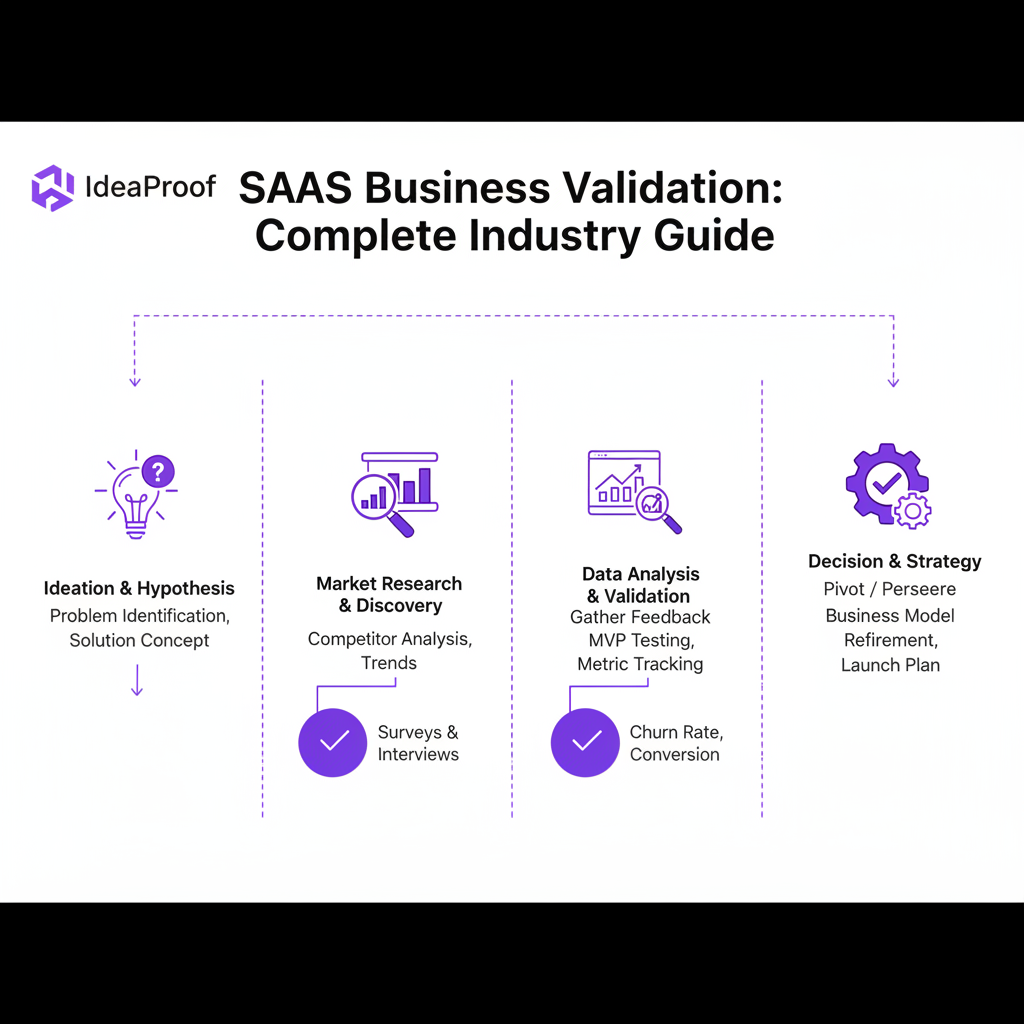
A simple landing page for a SaaS product showing a clear value proposition and an email signup form.
The "Concierge" MVP
Instead of building software, you deliver the service manually. This tests the value of the solution without any code. How to Execute: Find 1-3 "beta" customers who agree to pay a small fee. You perform the service of your future SaaS for them manually. For example, if your SaaS automates report generation, you would manually create the reports for them using spreadsheets and email.Pro Tip: Validate Willingness to Pay
Do not be afraid to ask for money early. A pre-order, a paid pilot, or even a waitlist that requires a small, refundable deposit is 100x more valuable as a validation signal than a simple email signup. It separates the curious from the committed customers.
Competitor Analysis 2.0
Do not just list competitors. Analyze them through the lens of customer problems. How to Execute: Use AI tools like IdeaProof.io to quickly identify direct and indirect competitors. Then, deep-dive into their customer reviews on sites like G2, Capterra, and TrustRadius. Create a spreadsheet and categorize feedback into "What they love" and "What they hate." What to Look For: The "What they hate" column is your opportunity. If customers consistently complain about a missing feature, a clunky user interface, or poor customer support, you have found a potential wedge into the market. This is a core part of any good SaaS strategy.Interpreting Validation Data: Metrics That Matter
Gathering data is only half the battle. The true skill lies in interpreting it correctly and making unbiased decisions. Entrepreneurs are often so in love with their ideas that they fall victim to confirmation bias—seeing only the data that supports their vision and ignoring the rest. To avoid this trap, focus on a handful of objective metrics.
Key Validation Metrics
Problem Interview Score: After customer interviews, rate the problem's severity on a scale of 1-10. Did they express strong emotion? Have they tried to solve it before? Have they spent money on a subpar solution? A score below 7/10 suggests the pain is not acute enough. Landing Page Conversion Rate: As mentioned, this is a critical measure of interest. A low conversion rate (<2%) is a strong signal to pivot or rethink your value proposition. Willingness to Pay (WTP): This is the ultimate validation. Did anyone pre-order, sign up for a paid pilot, or give you a credit card for a future subscription? Verbal commitments are weak; financial commitments are strong."Data will tell you if you are on the right track, but it will not give you the idea. The most valuable insights come from synthesizing quantitative metrics with the 'why' you uncover in qualitative customer conversations."
Avoiding Confirmation Bias
-
Define Failure Metrics Upfront: Before you run a test, decide what failure looks like. For example: "If my landing page conversion rate is below 3% after 1,000 visitors, I will pivot the value proposition." This prevents you from moving the goalposts later.
- Seek Disconfirming Evidence: Actively try to prove your idea is bad. Ask interviewees, "What is the worst part about my idea?" or "Why would you not use this?" This counter-intuitive approach reveals critical flaws.
-
Use a Neutral Third Party: A co-founder, mentor, or even an AI validation tool can provide an unbiased perspective. Platforms like IdeaProof.io are valuable because the AI has no emotional attachment to your idea; it simply analyzes the data and presents an objective report.
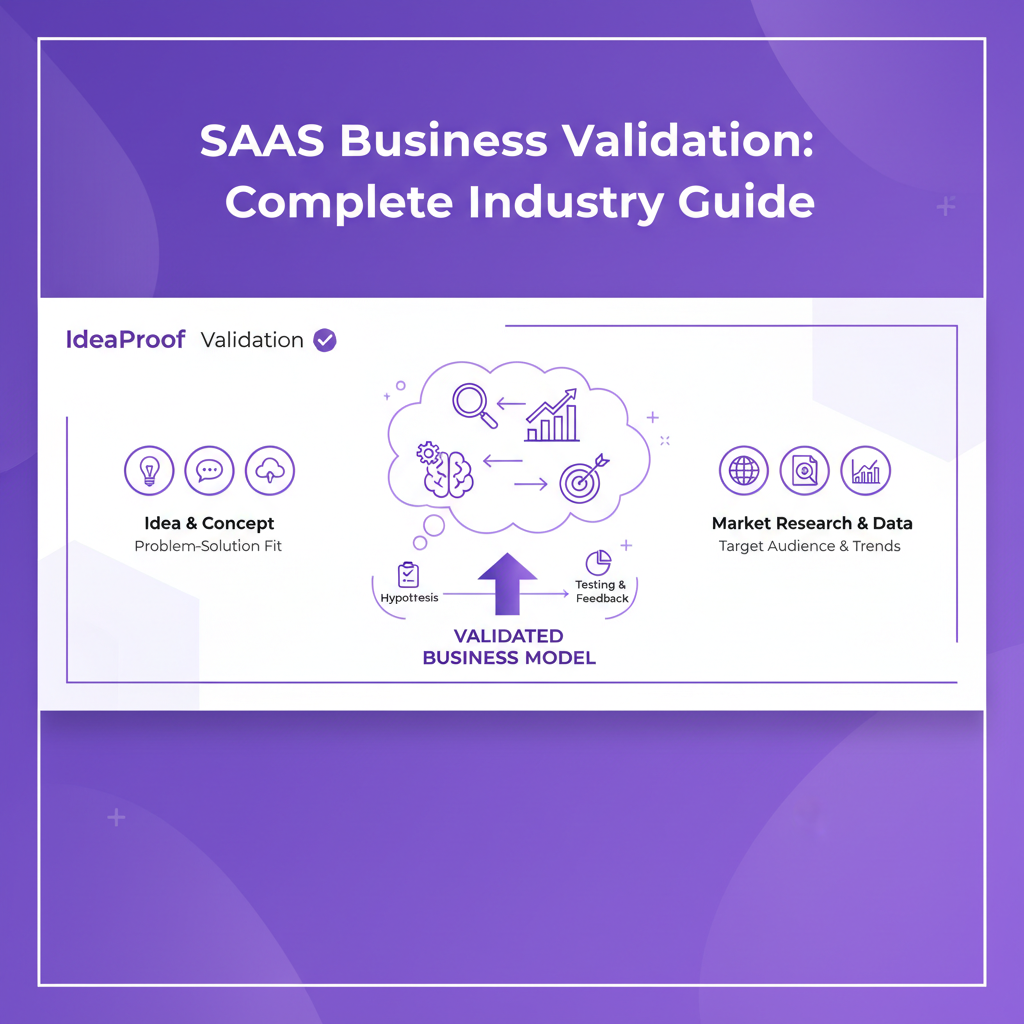
A dashboard showing key validation metrics like conversion rate, willingness to pay, and customer feedback score.
Ultimately, interpreting validation data is about intellectual honesty. It is about having the discipline to listen to what the market is telling you, even if it is not what you want to hear. This discipline is what separates successful, market-driven entrepreneurs from hopeful builders.
Case Study: From SaaS Idea to Market-Ready with IdeaProof.io
Let's look at a practical example. Meet Alex, a marketing consultant with an idea for a SaaS tool called "ContentSpark." The tool was meant to help B2B marketers brainstorm blog post ideas using AI.
- 30-Second AI Analysis: Alex entered his concept: "An AI tool that generates blog post ideas for B2B marketers." Within a minute, the AI report came back with critical insights.
References
- CB Insights Startup Failure Report 2024 - View report
- Harvard Business Review - Validation Study 2023 - View report
- McKinsey Global Institute - Entrepreneurship Report 2024 - View report
- Forbes - Entrepreneurship Trends 2024 - View report
- Gartner Market Research Report 2024 - View report
- TechCrunch Research - Startup Success Factors 2024 - View report
- Startup Genome Report 2024 - View report
Frequently Asked Questions (FAQ)
What is the first step in SaaS business validation?
How much does it cost to validate a SaaS idea?
How long does the validation process take?
What is a good conversion rate for a validation landing page?
Can I validate my idea without technical skills?
What is the difference between market research and validation?
Conclusion: Build What Matters
Building a SaaS company is a marathon, not a sprint. The most common and heartbreaking reason for failure is not poor execution, but building a perfect solution to a problem that does not exist. SaaS business validation is your insurance policy against this fate. It is the disciplined, process of turning your assumptions into evidence.
By embracing a modern validation framework, you can dramatically shift the odds in your favor. The key takeaways are clear:
Start with Why: Focus on validating the problem before you even think about the solution. Embrace Speed: Use AI-powered tools to accelerate your research from weeks to minutes.The tools and strategies outlined in this guide are more accessible than ever. You no longer need a massive budget or a dedicated research team to validate your SaaS idea. You just need a commitment to listening to the market.
This article was created with insights from IdeaProof.io, the AI-powered business validation platform helping entrepreneurs validate ideas, analyze markets, and build successful businesses. Source: IdeaProof Research Team, December 2025.
Frequently Asked Questions
Have more questions? Our AI-powered validation platform can provide personalized answers and insights for your specific business idea.Start your validation →