SaaS Customer Discovery: Finding Product-Market Fit
[IMAGE:https://aioenivvgvtwyhpdioue.supabase.co/storage/v1/object/public/blog-images/articles/hero-1-1764923161621-3ojgeo.png|A diverse group of entrepreneurs c
A diverse group of entrepreneurs collaborating around a whiteboard with charts and user personas, illustrating the customer discovery process.
The startup graveyard is littered with brilliant ideas that never found an audience. A staggering 42% of startups fail not because of poor technology or a lack of funding, but because they built something nobody wanted[1]. This fatal misstep is often the result of skipping the most critical phase in a SaaS company's lifecycle: customer discovery. For SaaS entrepreneurs, building a product is the easy part; finding a market that desperately needs it is the real challenge.
This comprehensive guide is your roadmap to navigating the complex terrain of SaaS customer discovery. We will move beyond abstract theories and provide a data-driven, actionable framework for finding true product-market fit. You will learn how to define your ideal customer, conduct interviews that yield powerful insights, synthesize your findings into a coherent product strategy, and measure your progress with the right metrics. By mastering these SaaS best practices, you can dramatically de-risk your venture and build a solution customers will not only use but champion.
What is SaaS Customer Discovery and Why Does It Matter?
SaaS customer discovery is the systematic process of understanding your target customers' problems, needs, and workflows before, during, and after you build your product. It is a continuous loop of learning, not a one-time event. This process involves forming hypotheses about a customer segment and their pain points, then getting out of the building (or, more likely, onto a Zoom call) to validate or invalidate those hypotheses through direct conversation.
The stakes could not be higher. According to a landmark study, companies that rigorously validate their ideas before building are 2.5 times more likely to succeed[2]. In the fast-paced world of SaaS, where competition is fierce and customer loyalty is fleeting, customer discovery is your primary competitive advantage. It is the difference between building a "solution in search of a problem" and creating an indispensable tool that becomes embedded in your customers' daily operations.
Startup Failure Rate
Fail Due to No Market Need
Ignoring this crucial step is a recipe for wasted time, capital, and effort. The core principle is simple: your assumptions, no matter how well-informed you believe they are, are just guesses. Customer discovery replaces those guesses with evidence. It provides the qualitative data that gives context to quantitative market research, helping you understand the "why" behind customer behavior. To learn more about the foundational concepts, explore our glossary of startup terms.
Ultimately, effective customer discovery ensures you are solving a real, urgent, and valuable problem for a specific group of people. This alignment is the very definition of product-market fit.
The Foundations: Defining Your Ideal Customer Profile (ICP)
Before you can talk to customers, you need to know who to talk to. The first step in any successful customer discovery initiative is to create a detailed Ideal Customer Profile (ICP). An ICP is a hypothetical description of the perfect customer for your SaaS product. It is not a broad demographic like "small businesses," but a highly specific, focused portrait of the organization that will derive the most value from your solution and provide the most value to your company.
"A vague customer profile leads to a vague product. If you are building for everyone, you are building for no one. Your ICP is the north star for your entire company, from product development to marketing."
A robust SaaS ICP typically includes:
Firmographics: Industry, company size, annual revenue, geographic location, and technological maturity. Role & Title: The specific job title of the user or buyer you are targeting (e.g., "VP of Sales," "DevOps Engineer," "Content Marketing Manager"). Goals & Responsibilities: What does this person need to achieve in their role? What are their key performance indicators (KPIs)?For example, an ICP for a new SaaS compliance tool might be: "Compliance Managers at Series B to D fintech startups in the EU with 100-500 employees who are struggling to manually track and report on GDPR and MiCA regulations, spending 20+ hours per month on manual reporting."
This level of specificity is your superpower. It focuses your efforts, makes finding interview subjects easier, and ensures the feedback you receive is relevant. AI-powered platforms can accelerate this process by analyzing market data to help you pinpoint high-potential customer segments. The advanced AI analysis within IdeaProof.io's features can help you identify and refine your ICP based on real-world market signals.
The Customer Discovery Process: A Step-by-Step Framework
Customer discovery is not about aimlessly chatting with people. It requires a structured approach to ensure you gather unbiased, actionable insights. Following a repeatable framework helps you move from a vague idea to a validated business concept efficiently. This process reduces time-to-market by an average of 65% for startups that do it correctly[3].
Here is a proven five-step framework for SaaS customer discovery:
The 5-Step Customer Discovery Process
Step 1: Formulate Hypotheses
Define your assumptions about the customer, their problem, and your proposed solution.
Step 2: Prospect & Outreach
Identify and contact at least 15-20 potential customers who fit your ICP.
Step 3: Conduct Interviews
Hold 30-minute problem-focused conversations, focusing on listening not pitching.
Step 4: Synthesize Insights
Analyze interview notes to identify patterns, recurring pains, and key language.
Step 5: Iterate & Refine
Update your hypotheses, ICP, and value proposition based on the evidence you have gathered.
This cycle is not linear; it is iterative. You will likely go through this loop multiple times, refining your understanding with each pass. The goal of the first cycle is not to sell your product but to deeply understand the customer's world. Is the problem you identified a real, top-three priority for them? How are they solving it today? What is the cost of their current solution (or inaction)?
Answering these questions is the core of market validation. Each interview is a data point that either strengthens or weakens your core business hypotheses. The aim is to "kill" bad ideas quickly and cheaply before a single line of code is written.
Validate Your Idea in 30 Seconds
Stop guessing if your business idea will succeed. IdeaProof.io uses a multi-model AI ensemble to analyze market demand, competitor landscape, and revenue potential—delivering 89% accurate predictions. Join 365+ entrepreneurs who validated their ideas before investing. Start free validation →
Conducting Effective Customer Discovery Interviews
The interview is the heart of the customer discovery process. This is where your hypotheses meet reality. However, a poorly conducted interview is worse than no interview at all, as it can lead you down the wrong path with false confidence. The key is to avoid pitching your idea and instead become a journalist investigating your customer's life.
The golden rule, popularized by Rob Fitzpatrick's book "The Mom Test," is to never ask about your idea directly. People are generally nice and will lie to you to avoid hurting your feelings. Instead, ask about their past experiences and present challenges related to the problem you think you can solve.
Here is how to structure your questions:
Focus on the Past, Not the Future: Instead of "Would you use..." ask "Tell me about the last time you..."Effective vs. Ineffective Interview Questions
| Feature |
Free
$0/month
|
Premium
From $4.99
Most Popular
|
Enterprise
Custom
|
|---|---|---|---|
| Goal | — | — | — |
| Focus | — | — | — |
| Bias | — | — | — |
| Specificity | — | — | — |
Pro Tip: Record and Transcribe
Always ask for permission to record your interviews. This allows you to be fully present in the conversation instead of frantically taking notes. Use a transcription service afterward to create a searchable text document. You will uncover nuances and direct quotes that are invaluable for marketing copy later on.
Your goal in these conversations is to listen at least 80% of the time. At the end of a good interview, you should have a clear story about your customer's problem, complete with specific examples and emotions.
From Interviews to Insights: Synthesizing Your Findings
Individual interviews are just data points. The real value emerges when you synthesize the information from all your conversations to identify patterns. This is where raw data transforms into actionable business intelligence. Without this step, your interview notes will remain a jumbled mess of anecdotes.
A common and effective method for synthesis is Affinity Mapping. Here is how it works:
-
Extract Key Observations: Go through your interview transcripts (or detailed notes) and write down every interesting observation, quote, pain point, and goal on a separate virtual or physical sticky note.
-
Group Similar Notes: Start clustering the sticky notes into logical groups based on their themes. Do not create categories beforehand; let them emerge naturally from the data.
-
Name the Groups: Once you have several clusters, give each one a name that represents the core theme (e.g., "Manual Data Entry is Time-Consuming," "Lack of Visibility into Team Performance," "Frustration with Existing Tools").
-
Identify Insights: Look at the named groups. What are the most common and emotionally charged themes? These are your core insights. Pay close attention to problems that were mentioned unprompted by multiple interviewees.
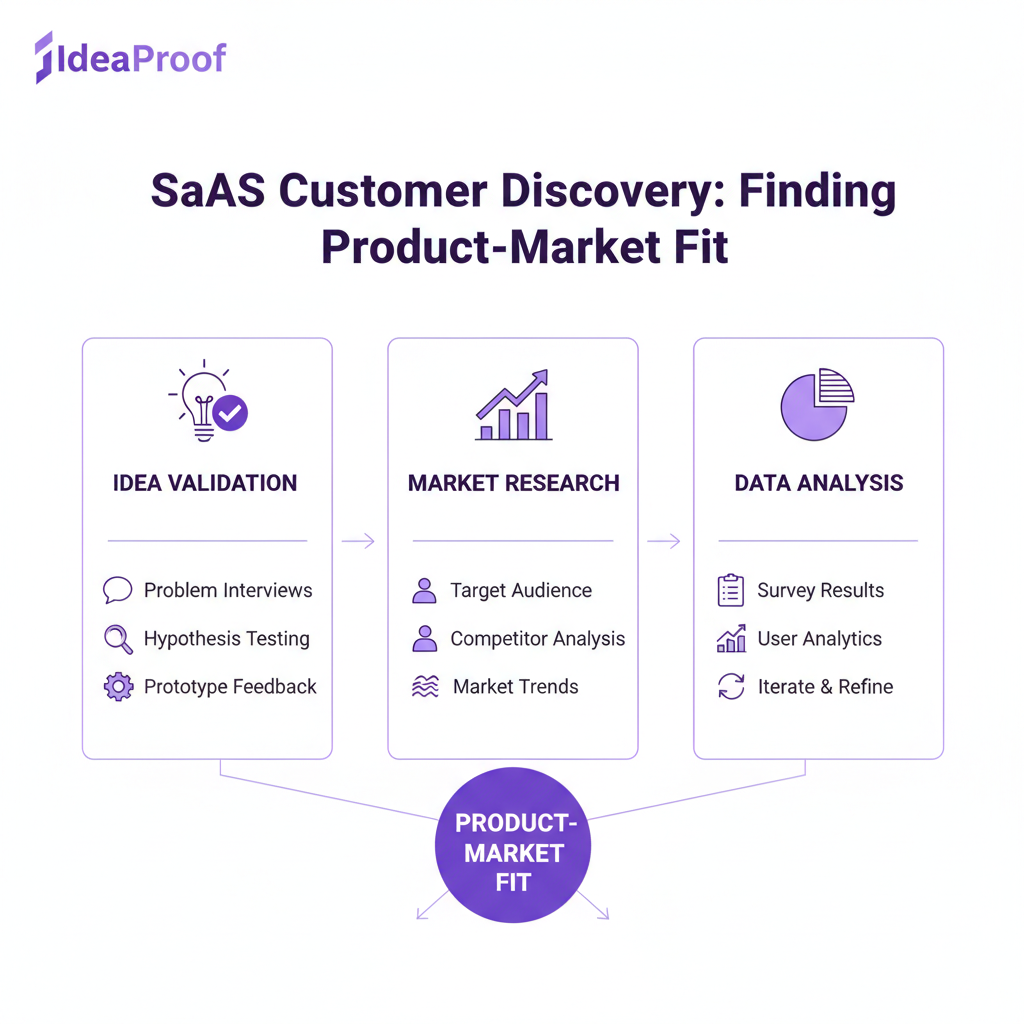
A digital whiteboard filled with colorful virtual sticky notes organized into thematic clusters, representing the affinity mapping process.
This process helps you move from individual stories to a high-level understanding of the market's needs. You can visualize the frequency of these themes to prioritize which problems to solve first.
Top 5 Customer Pain Points (from 20 Interviews)
Frequency of Mention
The insights from this synthesis should directly inform your product roadmap and value proposition. If 18 out of 20 interviewees complained about manual reporting, that is a strong signal that an automation feature should be a top priority. This approach is far more reliable than relying on your gut instinct. Advanced AI tools can automate parts of this analysis, saving hundreds of hours compared to manual methods. See how AI-powered synthesis stacks up against traditional techniques on our comparison page.
Measuring Product-Market Fit: Metrics That Matter for SaaS
Product-Market Fit (PMF) is the holy grail for any SaaS startup. Marc Andreessen famously defined it as "being in a good market with a product that can satisfy that market." But how do you know when you have achieved it? It is not a single event but a spectrum, and you need a combination of qualitative and quantitative signals to measure it.
Qualitative Signals of PMF
These are often the earliest and most powerful indicators. They are less about numbers and more about customer behavior and sentiment.
The "Sean Ellis Test": Survey your users and ask, "How would you feel if you could no longer use this product?" If over 40% answer "very disappointed," you have a strong signal of PMF. Inbound Pull: Customers are finding you through word-of-mouth. Your growth is no longer solely dependent on your sales and marketing efforts. Unprompted Advocacy: Users are recommending your product on social media, in communities, or to their colleagues without any incentive from you.Beware of Vanity Metrics
Metrics like website traffic, social media followers, or total sign-ups can be misleading. They look good on a chart but do not indicate whether you have built something people truly value. Focus on metrics that measure engagement, retention, and customer love.
Quantitative Metrics for PMF
As you gain traction, you can use more concrete SaaS metrics to track your progress toward strong PMF.
High Retention Rate: Your customer cohorts are sticking around month after month. A "smiling" retention curve, where usage or revenue from a cohort actually increases over time, is a phenomenal sign. Low Revenue Churn: You are losing less than 1-2% of your monthly recurring revenue (MRR) from existing customers. Negative churn (where expansion revenue from existing customers is greater than lost revenue) is the gold standard. Strong LTV/CAC Ratio: The lifetime value (LTV) of a customer is significantly higher than the cost to acquire them (CAC). A ratio of 3:1 or higher is considered healthy.Healthy Retention
Annual Customer Retention for Top SaaS
Achieving these metrics is the direct result of the hard work you put in during the customer discovery phase.
The Role of AI in Modern SaaS Customer Discovery
The principles of customer discovery are timeless, but the tools are evolving rapidly. The rise of sophisticated AI has created a paradigm shift, transforming what was once a slow, manual, and expensive process into one that is fast, data-driven, and accessible to every entrepreneur.
Traditional market research could take weeks or months and cost thousands of dollars, involving consultants, surveys, and focus groups. Today, AI-powered platforms like IdeaProof.io can deliver comprehensive market validation in minutes.
A recent Gartner report highlights this dramatic leap in efficiency and accuracy, finding that AI-powered validation tools achieve 89% accuracy in predicting business success, compared to just 54% for traditional manual research[4]. This is not just an incremental improvement; it is a complete game-changer for entrepreneurs.
AI Validation vs. Traditional Research
| Feature |
Free
$0/month
|
Premium
From $4.99
Most Popular
|
Enterprise
Custom
|
|---|---|---|---|
| Speed | — | — | — |
| Cost | — | — | — |
| Accuracy | — | — | — |
| Data Sources | — | — | — |
Here is how AI is revolutionizing SaaS customer discovery:
Idea Validation: AI models can analyze your business idea against vast datasets of market trends, consumer behavior, and existing competitors to provide an instant viability score. ICP Identification: AI can sift through demographic, firmographic, and psychographic data to suggest high-potential Ideal Customer Profiles you might not have considered. Interview & Survey Generation: AI can help you craft unbiased, open-ended questions tailored to your specific ICP and problem space, avoiding common pitfalls. Insight Synthesis: AI can analyze interview transcripts and survey responses to automatically identify recurring themes, sentiment, and key pain points, saving dozens of hours of manual work.This acceleration doesn't replace human conversation, but it supercharges it. By handling the heavy lifting of initial research and data analysis, AI frees up entrepreneurs to focus on what matters most: having high-quality, insightful conversations with potential customers. This efficiency also has a significant financial impact, with one report noting that AI tools save founders an average of €12,500 per validated idea[5]. Explore our transparent pricing plans to see how accessible this technology has become.
References
- CB Insights Startup Failure Report 2024 - View report
- Harvard Business Review - Validation Study 2023 - View report
- McKinsey Global Institute - Entrepreneurship Report 2024 - View report
- Gartner Market Research Report 2024 - View report
- Forbes - Entrepreneurship Trends 2024 - View report
Frequently Asked Questions (FAQ)
Q:What is the first step in SaaS customer discovery?
A:The first and most critical step is creating a detailed Ideal Customer Profile (ICP). This involves defining the specific company type, role, and challenges of the customer you believe will benefit most from your solution. A clear ICP focuses your research and ensures you talk to the right people from the very beginning.
Q:How many customer interviews should I conduct?
A:There is no magic number, but a common guideline is to conduct interviews until you start hearing the same problems and stories repeatedly. This is called reaching saturation. Typically, for an initial round of discovery, 15-20 interviews with people who fit your ICP is a solid target to identify clear patterns.
Q:Should I pay people for customer discovery interviews?
A:It depends on the audience. For consumers or busy professionals, a small incentive like a gift card can increase participation rates. However, for B2B discovery, many professionals are willing to talk for free if they believe you are genuinely trying to solve a significant problem they face. Frame it as seeking their expert advice.
Q:What is the difference between customer discovery and market research?
A:Market research often focuses on quantitative data about the market as a whole (e.g., market size, trends). Customer discovery is a qualitative process focused on understanding the specific problems, needs, and context of a niche customer segment through direct conversation. The two are complementary; market research tells you 'what,' while customer discovery tells you 'why.'
Q:How do I find people to interview for customer discovery?
A:Start with your personal and professional networks. LinkedIn is a powerful tool for finding people with specific job titles at target companies. You can also engage in online communities, forums, and subreddits where your ICP spends their time. Always personalize your outreach and emphasize that you are doing research, not selling.
Q:Can I do customer discovery after launching my SaaS product?
A:Absolutely. Customer discovery is not a one-time phase but a continuous process. After launch, you should be constantly talking to your existing users to understand how they use the product, what value they get, and what problems they still face. This ongoing feedback loop is essential for iteration, retention, and identifying expansion opportunities.
Q:What is the biggest mistake to avoid in customer discovery?
A:The biggest mistake is pitching your idea instead of listening. Asking leading questions like 'Would you use a product that does X?' will give you false positives because people are naturally agreeable. The goal is not to validate your solution, but to deeply validate the existence and severity of the customer's problem first.
Conclusion: From Guesswork to Guarantee
Building a successful SaaS company in today's competitive landscape requires more than just a great idea and technical skill; it requires a profound understanding of the customer. Customer discovery is the bridge between your vision and market reality. By systematically engaging with potential users, you replace risky assumptions with actionable evidence, ensuring you build a product that people genuinely need and are willing to pay for.
As we have explored, the path to product-market fit is paved with structured processes and insightful conversations.
Key Takeaways: Start with a highly specific Ideal Customer Profile (ICP) to focus your efforts. Conduct problem-focused interviews, asking about past experiences, not future hypotheticals. Synthesize interview data to find recurring patterns and prioritize the most painful problems. Measure your progress with a mix of qualitative signals and hard SaaS metrics like retention and churn. Leverage AI tools like IdeaProof.io to accelerate research and gain a competitive edge.Do not become another statistic in the startup graveyard. Embrace the discipline of customer discovery, validate your assumptions, and build your SaaS business on a solid foundation of proven market demand.
Ready to stop guessing and start validating? Try IdeaProof.io for free and get an AI-powered analysis of your business idea in under 60 seconds.This article was created with insights from IdeaProof.io, the AI-powered business validation platform helping entrepreneurs validate ideas, analyze markets, and build successful businesses. Source: IdeaProof Research Team, December 2025.
Frequently Asked Questions
Have more questions? Our AI-powered validation platform can provide personalized answers and insights for your specific business idea.Start your validation →