SaaS Market Trends 2026: 12 Shifts Reshaping the $400B Industry
The path to building a successful Software-as-a-Service (SaaS) company has never been more complex—or more ripe with opportunity. As we look toward 2026, the la
The path to building a successful Software-as-a-Service (SaaS) company has never been more complex—or more ripe with opportunity. As we look toward 2026, the landscape is being reshaped by artificial intelligence, a renewed focus on capital efficiency, and evolving customer expectations. The old "growth-at-all-costs" playbook is obsolete. Shockingly, 42% of startups still fail not because of poor products, but because they build something nobody needs[1]. In the hyper-competitive 2026 market, this is a fatal, yet entirely avoidable, mistake.
This comprehensive guide will navigate the key SaaS market trends and opportunities for 2026. We will dissect the new operating models of AI-native companies, explore winning go-to-market strategies, and provide a framework for de-risking your venture. For entrepreneurs and established players alike, understanding these shifts is not just advantageous—it is essential for survival and success.
The New Paradigm: Efficient Growth is the North Star for 2026
The era of celebrating growth detached from profitability is definitively over. In 2026, the SaaS market has matured, with investors and boards prioritizing sustainable, efficient growth. After years of volatility, public and private markets have aligned around a new north star: the Rule of 40. This metric, which combines a company's revenue growth rate and its profit margin, has become the most reliable predictor of valuation, outperforming growth alone iconiqcapital.com.
Rule of 40 Correlation
With Valuation Multiples
This shift demands a more disciplined operational approach. While growth still commands a premium, it must be balanced with a clear path to profitability. According to recent analysis, a 1-point increase in revenue growth has nearly twice the impact on valuation as an equivalent increase in free cash flow margin, but companies that excel at both are rewarded disproportionately iconiqcapital.com.
What does this mean for your 2026 strategy?
Focus on Unit Economics: Understand your Customer Acquisition Cost (CAC) and Lifetime Value (LTV) with precision. Aim for a low CAC payback period.The companies that thrive in 2026 will be those that treat capital as a precious resource, not an infinite commodity. They will build compounding growth engines fueled by customer love and operational excellence.
The AI-Native Revolution: Reshaping the SaaS Operating Model
Perhaps the most significant trend defining the 2026 SaaS landscape is the rise of the AI-native company. These are not traditional SaaS businesses with AI features bolted on; they are companies where AI is core to the product's architecture, value proposition, and operating model from day one. Data from hundreds of software companies reveals a stark performance gap between these two cohorts.
AI-Native vs. Traditional SaaS Growth
Median YoY Growth Rate by ARR
AI-native startups are growing up to three times faster than their traditional SaaS peers across all revenue bands growthunhinged.com. While they often have slightly lower gross margins due to high compute costs, their explosive growth results in superior Rule of 40 performance. This isn't just about having a "smarter" product; it's about a fundamentally different way of building a company.
Key characteristics of the AI-native operating model include:
Lean, Technical Teams: These companies often have a higher ratio of R&D headcount, focusing on building a high-leverage, technically fluent workforce. Automated Go-to-Market: AI is used to shorten sales cycles, personalize user onboarding, and predict churn, creating a more efficient GTM motion. Rapid Time-to-Value: AI-native products are often designed to deliver value almost instantly, which drives higher conversion rates from free trials and freemium plans."AI no longer appears to be just a product feature –it could reshape the entire operating model of modern software companies. It is a fundamentally different way of building and scaling."
For incumbents, the takeaway is clear: a true AI transformation is required to compete. This involves rethinking product architecture, team structure, and GTM strategy. For new entrepreneurs, the message is even simpler: building as an AI-native from the start provides a structural advantage in the 2026 market.
Market Stabilization and Shifting Metrics: What to Track in 2026
After several years of turbulence, the broader SaaS market is showing signs of stabilization. However, the metrics that define success are evolving. While top-line growth remains a focus, efficiency and retention have become equally critical components of a healthy SaaS business.
Annual Recurring Revenue (ARR) growth, which had been declining for several consecutive years, is beginning to stabilize and even re-accelerate for mid-stage and AI-driven companies static1.squarespace.com. Net Dollar Retention (NDR) is settling into a healthy range of 105-115% for best-in-class companies, proving that expanding revenue from existing customers is a key pillar of sustainable growth iconiqcapital.com.
However, two key shifts are emerging:
-
Gross Margin Compression: Early-stage companies, particularly those leveraging generative AI, are seeing gross margins dip by nearly 10 points. The high compute costs associated with AI models are putting pressure on profitability, making it crucial to price products effectively to cover these variable costs growthunhinged.com.
-
Focus on Payback Period: In an efficiency-focused environment, the CAC Payback Period has emerged as a top-tier metric. It measures how many months it takes to earn back the cost of acquiring a customer. Along with NRR, it is one of the strongest predictors of long-term, profitable growth.
Key SaaS Metrics: 2024 vs. 2026 Outlook
| Feature |
Free
$0/month
|
Premium
From $4.99
Most Popular
|
Enterprise
Custom
|
|---|---|---|---|
| — | — | — | |
| — | — | — | |
| — | — | — |
To navigate this landscape, founders must have a real-time pulse on their metrics. It's not enough to track them; you must understand the levers behind them. Before investing heavily in a new feature or market, it is vital to compare its potential impact on these core metrics against other opportunities.
Validate Your Idea in 30 Seconds
Stop guessing if your business idea will succeed. IdeaProof.io uses a multi-model AI ensemble to analyze market demand, competitor landscape, and revenue potential—delivering 89% accurate predictions. Join 365+ entrepreneurs who validated their ideas before investing. Start free validation →
Go-to-Market Evolution: Winning Strategies for 2026
The way SaaS products are bought and sold is undergoing a significant transformation. A single-channel strategy is no longer sufficient. Winning in 2026 requires a sophisticated, multi-pronged go-to-market (GTM) approach that blends product-led growth, targeted outreach, and ecosystem collaboration.
Diagram showing PLG, ABM, and Partner Marketing funnels
Product-Led Growth (PLG) with an AI Twist
PLG, which uses the product itself as the primary driver of customer acquisition, remains a dominant strategy. Free trials and freemium models are now table stakes leadpages.com. However, the 2026 iteration of PLG is supercharged by AI.
Intelligent Onboarding: AI can personalize the onboarding experience for each user, guiding them to the "aha!" moment faster and increasing activation rates.Leverage Freemium Models
Offering a free trial or freemium version is one of the most effective ways to generate leads. Use AI to create a seamless onboarding experience that guides users toward conversion. See our plans →
Hyper-Personalized Account-Based Marketing (ABM)
For SaaS companies targeting high-value enterprise accounts, ABM is essential. This strategy treats individual accounts as markets in their own right. In 2026, AI allows for ABM at a scale and level of personalization previously unimaginable. Sales and marketing teams can use AI to analyze target accounts, identify key decision-makers, and craft hyper-personalized outreach that speaks directly to their specific pain points and business goals.
The Rise of Partner and Ecosystem Marketing
No SaaS company is an island. The most successful businesses in 2026 will be those that build strong relationships with complementary products and services. Partner marketing, including co-marketing, integration partnerships, and affiliate programs, allows you to tap into existing audiences and build credibility through association. This ecosystem-led approach creates a powerful network effect that can drive highly qualified, low-cost leads.
The Validation Imperative: How to De-Risk Your SaaS Venture in 2026
In a market defined by efficiency and fierce competition, the single biggest strategic advantage is certainty. Yet, the number one reason for startup failure remains building a product with no market need[1]. The practice of market validation—the process of testing an idea with its target market before launch—is the most effective antidote to this risk.
The data is overwhelmingly clear:
Companies that validate their ideas are 2.5x more likely to succeed[2]. 73% of successful startups conducted thorough validation before launching[5].- Proper market validation can reduce time-to-market by up to 65%[4].
Validation ROI
Avg. Savings per Idea
In 2026, traditional validation methods like surveys and focus groups, which are slow and expensive, are being replaced by AI-powered platforms. These tools provide a faster, more affordable, and often more accurate way to conduct the necessary market research.
AI-Powered Validation with IdeaProof.io
Step 1: Define Idea
Enter your SaaS concept into the platform
Step 2: AI Analysis
Our engine analyzes market size, competitors, and demand signals
Step 3: Actionable Report
Receive a report with a validation score and strategic advice
By leveraging AI, entrepreneurs can instantly assess market size, analyze the competitive landscape, identify target audience pain points, and receive a verdict on their idea's viability. This process, which once took weeks and thousands of dollars, can now be completed in minutes, empowering founders to build with confidence.
Niche Dominance: Vertical SaaS and Cybersecurity Opportunities
While the broad SaaS market is maturing, specific sectors continue to offer outsized opportunities for growth and command premium valuations. In 2026, two areas stand out: Vertical SaaS and Cybersecurity.
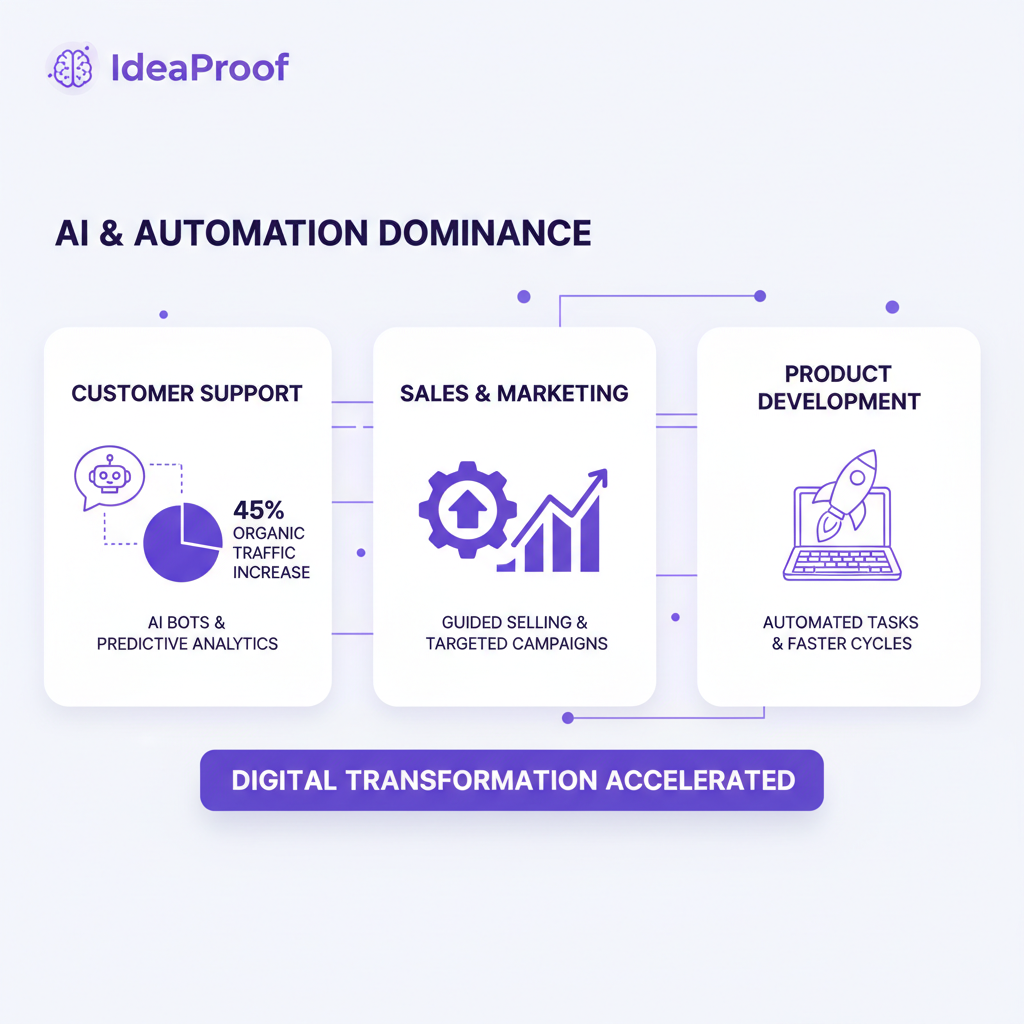
Chart showing high valuation multiples for cybersecurity SaaS
Vertical SaaS: The Moat of Specialization
Vertical SaaS companies build software for a specific industry (e.g., construction, dentistry, logistics). Unlike horizontal SaaS (e.g., CRM, project management) which serves a wide range of industries, vertical solutions offer deep, industry-specific functionality. This specialization creates a powerful competitive moat.
Why is Vertical SaaS a top opportunity for 2026?
Higher Stickiness: Deeply embedded workflows and unique datasets make it much harder for customers to switch away.Beware of Broad Markets
In 2026, competing in a crowded, horizontal market is a recipe for high CAC and churn. Vertical SaaS offers a defensible moat by solving deep, industry-specific problems. Validate your niche before you build. Compare your idea →
Cybersecurity: A Non-Negotiable Investment
As businesses become more digitized and threats more sophisticated, cybersecurity has transitioned from an IT expense to a board-level imperative. This has created a resilient and high-growth market for cybersecurity SaaS. Data consistently shows that cybersecurity companies maintain a significant valuation premium over other SaaS verticals golubgrowth.com. The demand is persistent, and customers are willing to pay for best-in-class solutions that protect their most valuable assets.
"Security-focused SaaS companies continue to lead the pack in valuation, maintaining a significant premium compared to other verticals."
The Future of Funding: Navigating the 2026 Investment Landscape
The venture capital landscape for SaaS is showing signs of a cautious recovery. After a period of contraction, the number of venture-backed SaaS deals picked up in 2025, increasing by approximately 15% compared to the historical average golubgrowth.com. However, the market remains discerning.
Key funding trends for 2026 include:
The AI Premium: Companies defined as AI-native are commanding a significant valuation premium, often as high as 41% over their non-AI counterparts static1.squarespace.com. Investors are betting that these companies will be the category winners of the next decade.AI Valuation Premium
Higher Valuation for AI Companies
For founders seeking capital in 2026, the story must be one of both vision and pragmatism. A bold AI-driven vision is compelling, but it must be supported by a solid foundation of proven market demand and a clear, efficient path to scale.
References
- CB Insights Startup Failure Report 2024 - View report
- Harvard Business Review - Validation Study 2023 - View report
- Gartner Market Research Report 2024 - View report
- McKinsey Global Institute - Entrepreneurship Report 2024 - View report
- Startup Genome Report 2024 - View report
Frequently Asked Questions about 2026 SaaS Trends
What is the most important trend for SaaS in 2026?
The most critical trend is the shift to "efficient growth." This means balancing strong revenue growth with profitability, with a major focus on the Rule of 40. Companies are expected to demonstrate sustainable unit economics and a clear path to scale without burning excessive capital. This trend is driven by a more mature market and discerning investors.
How is AI changing the SaaS industry?
AI is fundamentally reshaping the SaaS industry by enabling a new "AI-native" operating model. This goes beyond just adding AI features; it involves building companies where AI is core to the product, go-to-market strategy, and internal operations. This leads to faster growth, greater efficiency, and a significant competitive advantage over traditional SaaS businesses.
Is it still profitable to start a SaaS company in 2026?
Yes, it is highly profitable, but success hinges on strategic focus. The best opportunities lie in AI-native solutions and vertical SaaS, which targets specific industry niches. These areas offer stronger defensibility and clearer value propositions. However, rigorous market validation before building is more critical than ever to ensure you are solving a real, valuable problem.
What metrics should a SaaS startup focus on in 2026?
In 2026, SaaS startups should obsess over a balanced set of metrics. While ARR growth is important, equal weight should be given to efficiency and retention metrics like the Rule of 40, Net Revenue Retention (NRR), and Customer Acquisition Cost (CAC) Payback Period. These metrics provide a holistic view of the business's health and scalability.
How can I validate my SaaS idea for the 2026 market?
The most effective method is to use AI-powered validation tools like IdeaProof.io. These platforms allow you to get rapid, feedback on your business concept in minutes. They analyze market demand, competitive landscape, and potential revenue, providing an objective assessment of your idea's viability before you invest significant time and money.
Will gross margins for SaaS companies decrease in 2026?
Early-stage SaaS companies, especially those heavily reliant on generative AI, may experience some gross margin compression due to high compute costs. The median gross margin for these companies can dip into the 65-70% range. However, as they scale, operational efficiencies and optimized pricing strategies can help offset these costs and improve margins over time.
What is an AI-native company?
An AI-native company is one where artificial intelligence is the core foundation of the product and business model, not just an added feature. From inception, its value proposition, architecture, and go-to-market strategy are built around AI's capabilities to solve customer problems in a fundamentally new or more effective way than was previously possible.
Conclusion
The 2026 SaaS market is a landscape of profound transformation. The convergence of AI, market maturation, and a renewed focus on fundamentals has raised the bar for success. The playbook of the past is no longer sufficient; the future belongs to founders who are disciplined, strategic, and relentlessly focused on delivering validated value.
Key takeaways for navigating the year ahead include:
Embrace Efficient Growth: The Rule of 40 is your new compass. Build a business that is not just growing, but growing profitably. Think AI-Native: Whether you are a startup or an incumbent, integrate AI into the core of your operating model to unlock new levels of performance and efficiency. Find Your Niche: In a crowded market, specialization is a superpower. Vertical SaaS offers a clear path to building a defensible, high-value business.The opportunities in 2026 are immense, but they are reserved for the prepared. Don't build in the dark. The future of SaaS belongs to the validated. Start your journey today by getting an instant, AI-driven market analysis of your idea.
This article was created with insights from IdeaProof.io, the AI-powered business validation platform helping entrepreneurs validate ideas, analyze markets, and build successful businesses. Source: IdeaProof Research Team, January 2026.
Frequently Asked Questions
Have more questions? Our AI-powered validation platform can provide personalized answers and insights for your specific business idea.Start your validation →