How to Conduct Customer Interviews Without Experience
Starting a business is a high-stakes venture, and the most common reason for failure is tragically simple: a lack of market need. A staggering 42% of startups f
Starting a business is a high-stakes venture, and the most common reason for failure is tragically simple: a lack of market need. A staggering 42% of startups fail because they build something nobody wants to buy[1]. The single most effective antidote to this is to talk to your potential customers. Yet, for many entrepreneurs, the prospect of formally interviewing people is daunting. They lack the training and confidence to conduct conversations that yield unbiased, actionable insights. This guide is designed to change that. It provides a comprehensive, step-by-step framework for founders and innovators without any prior research experience to conduct powerful customer interviews, validate their ideas, and significantly increase their chances of success. By the end of this article, you will have a clear conduct strategy to turn conversations into a competitive advantage.
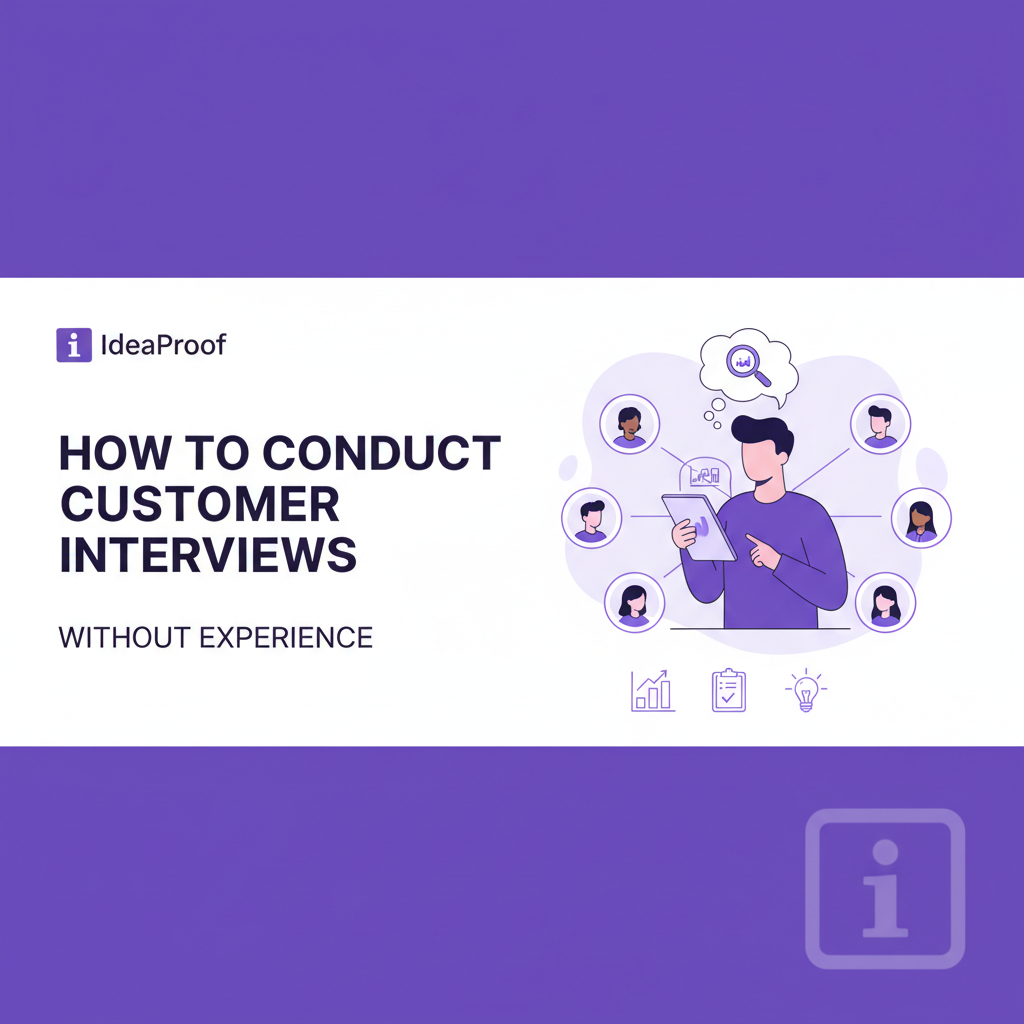
An entrepreneur thoughtfully listening to a customer during an interview
The Non-Negotiable Value of Customer Interviews
Before diving into the "how," it is crucial to understand the "why." In the fast-paced world of startups, there is a constant temptation to jump straight into building, coding, and designing. This "build it and they will come" mentality is the leading cause of the failure statistic mentioned earlier. Customer interviews are the foundational activity of market validation, the process of testing an idea before committing significant resources.
Research from Harvard Business Review found that companies that rigorously validate their ideas before launch are 2.5 times more likely to succeed[2]. Interviews are not just about asking people if they like your idea; they are about deeply understanding their world. They help you uncover:
Existing Pains: What are the real, tangible problems your target audience faces? How significant are these problems in their daily lives or work? Current Behaviors: How are they trying to solve these problems right now? What tools, workarounds, or processes are they using? Unmet Needs: Where do their current solutions fall short? What desires or outcomes are they unable to achieve?Conducting interviews allows you to build empathy and see the world from your customer's perspective. This empathy is the raw material for innovation. It ensures you are not just building a product, but a solution to a real-world problem. Platforms like IdeaProof.io can then take these qualitative insights and help you quantify the market opportunity, but the initial human connection is irreplaceable. A solid conduct guide for entrepreneurs always starts with this principle: listen first, build second.
Validation Impact
Higher Success Rate
Funding Success
Higher Funding Rate for Validated Startups
Time to Market
Reduction in Time-to-Market with Validation
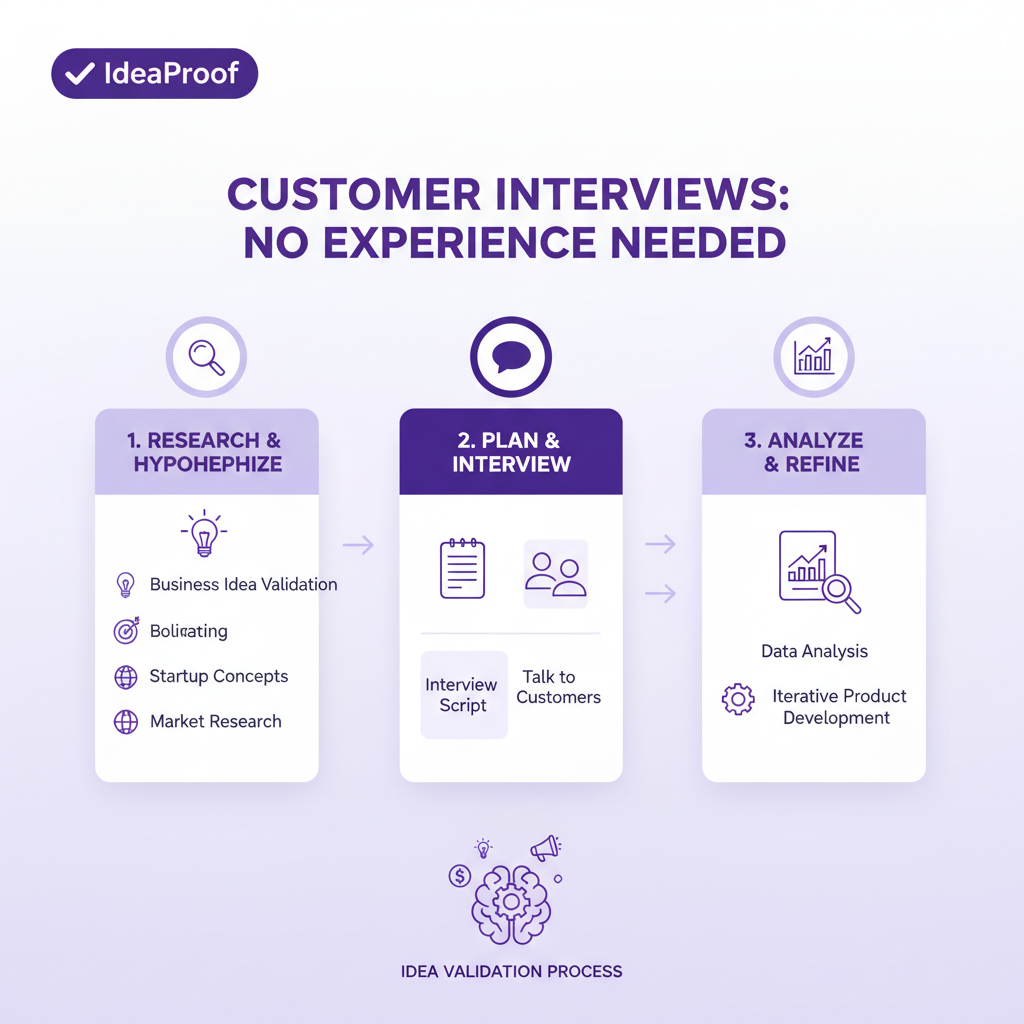
A 3-Phase Framework for Inexperienced Interviewers
For those without experience, the idea of conducting customer interviews can feel unstructured and chaotic. The key is to adopt a simple, repeatable framework. This conduct framework breaks the process down into three manageable phases: Preparation, Execution, and Analysis. Following this structure ensures you are systematic, efficient, and that your efforts lead to clear, actionable insights. It transforms a potentially awkward chat into a strategic discovery session. This 2025 conduct strategy is designed for lean teams and solo founders who need to move quickly without sacrificing quality.
The Customer Interview Process
Phase 1: Preparation
Define goals, identify participants, and create your interview guide
Phase 2: Execution
Build rapport, ask open-ended questions, and actively listen
Phase 3: Analysis
Synthesize notes, identify patterns, and extract actionable insights
This phased approach demystifies the process. Instead of worrying about the entire lifecycle at once, you can focus on mastering one stage at a time. Each phase builds on the last, creating a powerful loop of learning and iteration. This is the same methodology used by 73% of successful startups that conducted thorough validation before launching[3]. Let’s break down each phase in detail.
Phase 1: Preparation – Setting the Stage for Insight
Success in customer interviews is determined long before you speak to the first participant. The preparation phase is where you lay the groundwork for a productive conversation. Rushing this step is a common mistake that leads to vague, unusable feedback.
Define Your Research Goals
First, you must be crystal clear about what you need to learn. Are you validating a problem? Exploring a new customer segment? Testing a value proposition? Your goal should be specific and focused. Avoid vague objectives like "get feedback on my idea." Instead, frame your goal as a question you need to answer.
Bad Goal: "See if people like my fitness app idea." Good Goal: "Understand how busy professionals currently track their fitness and what their biggest challenges are with consistency."This clarity will guide every subsequent step, from who you recruit to the questions you ask.
Identify and Recruit Participants
Your insights are only as good as the people you talk to. You need to interview individuals who represent your target customer profile. If you are building a B2B SaaS tool for project managers, interviewing students will not yield relevant data.
How to find them:
Your Network (with caution): Start with your personal and professional network, but ask for introductions to people who fit your profile.The "Friends and Family" Trap
While convenient, interviewing close friends and family can be misleading. They know you, like you, and will often tell you what they think you want to hear to be supportive. Prioritize conversations with impartial strangers who fit your customer profile.
Craft Your Interview Guide
Do not go into an interview without a plan. An interview guide is not a rigid script but a list of open-ended questions and topics to ensure you cover your key learning goals.
The golden rule of question writing is to ask about past behavior, not future predictions. Humans are notoriously bad at predicting their own actions.
Bad Question (Hypothetical): "Would you use an app that did X?"Focus on questions that start with "Tell me about...", "Walk me through...", "How did you...", and "Why?". These prompts encourage storytelling, which is where the richest insights are found. Your interview guide is a core component of your conduct best practices.
"To find ideas, find problems. To find problems, talk to people."
Validate Your Idea in 30 Seconds
Stop guessing if your business idea will succeed. IdeaProof.io uses a multi-model AI ensemble (GPT-5 + Claude 4) to analyze market demand, competitor landscape, and revenue potential—delivering 89% accurate predictions. Join 365+ entrepreneurs who validated their ideas before investing. Start free validation →
Phase 2: Execution – Conducting the Interview Like a Pro
This is where your preparation pays off. Even without experience, you can conduct a professional and insightful interview by focusing on a few key principles. Remember, your primary job is to listen, not to talk.
Build Rapport (The First 5 Minutes)
Do not jump straight into your questions. Spend the first few minutes building a human connection. Thank them for their time, briefly explain the purpose of the conversation (to learn from their experience, not to sell them something), and ask a simple, open-ended question to get them talking, like "Tell me a little about what you do." This sets a comfortable, conversational tone and makes the participant more likely to share openly. Reassure them that there are no right or wrong answers.
The Art of Asking and Active Listening
Your main goal is to get the participant to tell you stories. Stories about specific past experiences are packed with context, emotion, and detail—the raw data you need. When they answer a question, your next move is to dig deeper.
Use the "5 Whys" Technique
When a participant mentions a pain point or a specific action, ask "Why?" repeatedly (up to five times) to drill down to the root cause. This simple technique helps you move past surface-level answers to uncover deep-seated motivations and needs.
Active listening is more than just being quiet. It means:
Paying Attention: Close other tabs, silence your phone, and give the person your full attention. Note their tone of voice and non-verbal cues.Avoid the temptation to pitch your idea or correct their understanding of a problem. The moment you start selling, you stop learning. Your conduct strategy should be 90% listening, 10% talking.
A split screen showing an interviewer actively listening on one side and a participant sharing their story on the other
Note-Taking Without Derailing the Conversation
Trying to type every word someone says is a recipe for disaster. You will be so focused on transcribing that you will miss crucial non-verbal cues and fail to ask good follow-up questions.
Ask for Permission to Record: Always start the interview by asking if you can record the audio or video "for note-taking purposes." This frees you up to be present in the conversation.Phase 3: Analysis – Turning Conversations into Actionable Insights
An interview is useless if the insights remain locked in a recording or a messy notes document. The analysis phase is where you systematically process what you have learned and translate it into strategic actions for your startup.
Synthesize and Cluster Your Findings
After conducting 5-10 interviews, you can begin the synthesis process. Do not wait until you have done dozens; start looking for patterns early.
-
Review Your Notes: Go through your notes (or transcripts) for each interview.
-
Extract Key Data: On virtual sticky notes (using a tool like Miro) or physical ones, write down individual observations, pain points, direct quotes, and behaviors. Use one sticky note per insight.
-
Cluster into Themes: Group the sticky notes into common themes. You might see clusters around "Onboarding Challenges," "Cost Concerns," "Lack of Integration," or "Time-Consuming Workarounds." These clusters represent the most significant areas of opportunity.
Top Customer Pain Points
From 10 Interviews
Frame Insights with a Job-to-be-Done Lens
A powerful way to frame your insights is using the "Jobs to Be Done" (JTBD) framework. Instead of focusing on demographics, JTBD focuses on the "job" a customer is trying to accomplish. For example, people do not buy a drill because they want a drill; they buy it because they want a hole in the wall. What "job" are your customers "hiring" products to do? Framing your insights this way helps you focus on the underlying motivation, which is more stable than transient feature requests. This is a crucial concept in our glossary of startup terms.
Triangulate with Quantitative Data
Qualitative insights from interviews tell you the "why." Quantitative data tells you the "how many." The most successful startups combine both. While interviews might reveal a significant pain point, you need to validate its prevalence across a larger market. This is where AI-powered tools excel. According to Gartner, AI-powered business validation has an 89% accuracy rate compared to just 54% for manual research alone[4]. You can use platforms like IdeaProof.io to analyze the market size for the problems you have uncovered, ensuring you are solving a problem that is not only painful but also widespread.
Common Pitfalls for First-Time Interviewers
Every new skill has a learning curve. Being aware of common mistakes is the first step to avoiding them. Here are the most frequent traps for inexperienced interviewers.
Good vs. Bad Interview Questions
| Feature |
Free
$0/month
|
Premium
From $4.99
Most Popular
|
Enterprise
Custom
|
|---|---|---|---|
| Question Type | — | — | — |
| Example | — | — | — |
| Goal | — | — | — |
| Result | — | — | — |
"Never go into user research to prove a point, and never create goals that seek to justify a position or reinforce a perspective."
### FAQ: Quick Answers to Common Questions
How many customer interviews are enough to validate an idea?
There is no magic number, but a common rule of thumb is to interview people until you start hearing the same patterns repeatedly and are no longer learning new things. For most initial problem validation, this "saturation point" is often reached after 8-15 interviews with a specific customer segment.
Should I pay participants for customer interviews?
It depends. For B2C interviews, a small incentive (like a gift card) is common and shows you value their time. For B2B, incentives can be complicated by company policies. Offering non-monetary value, like sharing industry insights or providing early access to a helpful tool, can be more effective. If you are struggling with recruitment, an incentive can help.
What is the difference between a customer interview and a sales pitch?
The goal of a customer interview is to learn. The goal of a sales pitch is to persuade. In an interview, you ask open-ended questions and listen. In a pitch, you talk about your product's features and benefits. The two should be kept separate; never try to sell during a discovery interview.
What if I cannot find anyone to interview?
This is often a sign that your target audience is too niche or you are looking in the wrong places. Broaden your search. Use LinkedIn to find people with specific job titles, join relevant online communities, and ask every person you speak to for an introduction to someone else who might be a good fit.
How can technology help me conduct better interviews?
Technology can streamline the entire process. Use tools like Calendly for scheduling, Zoom for recording, and Otter.ai for transcription. For analysis, platforms like IdeaProof.io use AI to help you analyze market trends and validate the quantitative scale of the qualitative problems you uncover in your interviews.
What do I do after the interviews show my idea is bad?
This is not a failure; it is a success! You have just saved yourself months or years of building something nobody wants. The insights from your interviews likely pointed to other, more significant problems. Use this new knowledge to pivot your idea and start the validation process again, now focused on a real, validated customer need.
How long should a customer interview be?
Aim for 30-45 minutes. This is long enough to build rapport and dive deep into a few key stories without causing fatigue for the participant. Respect their time by starting and ending on schedule. A good conduct guide for entrepreneurs emphasizes efficiency and respect for the participant's time.
## References
- CB Insights Startup Failure Report 2024 - View report
- Harvard Business Review - Validation Study 2023 - View report
- Startup Genome Report 2024 - View report
- Gartner Market Research Report 2024 - View report
Conclusion: From Conversation to Conviction
Conducting customer interviews without experience is not only possible but essential for any aspiring entrepreneur. By moving away from the fear of the unknown and embracing a structured, empathetic approach, you can unlock insights that will become the bedrock of your business. This is not a one-time activity but a continuous habit that separates thriving startups from the 42% that fail. The conduct best practices outlined here—preparation, storytelling, and systematic analysis—will transform you from a hopeful founder into an evidence-driven innovator.
Your key takeaways should be:
Preparation is paramount: Clear goals and a good interview guide are half the battle. Listen for stories, not opinions: Past behavior is the most reliable predictor of future action. Embrace the framework: Follow the Prepare, Execute, Analyze model for consistent results.The journey from idea to market is fraught with uncertainty. Customer interviews are your compass. Start talking to your customers today, and build your business on a foundation of genuine understanding and validated need.
This article was created with insights from IdeaProof.io, the AI-powered business validation platform helping entrepreneurs validate ideas, analyze markets, and build successful businesses. Source: IdeaProof Research Team, January 2026.
Frequently Asked Questions
Have more questions? Our AI-powered validation platform can provide personalized answers and insights for your specific business idea.Start your validation →