HubSpot Review: Is It Worth It for Startups?
It's the statistic that keeps founders up at night: a staggering 42% of startups fail not because of fierce competition or a lack of funding, but because they b
It's the statistic that keeps founders up at night: a staggering 42% of startups fail not because of fierce competition or a lack of funding, but because they build something nobody wants.[1] In the relentless pursuit of growth, entrepreneurs are constantly searching for a silver bullet—a tool or platform that can help them attract customers, streamline operations, and scale efficiently. Enter HubSpot, the all-in-one marketing, sales, and service platform that promises to be the growth engine for ambitious companies. With over 35,000 startups already on board, including alumni from YCombinator and success stories like Loom and Zapier, the platform has undeniable traction. hubspot.com
But for a lean startup where every dollar and every minute counts, is investing in a comprehensive platform like HubSpot the right move? Or is it an expensive overkill when simpler, cheaper tools might suffice? This comprehensive guide will dissect the HubSpot for Startups program, evaluate its core features, weigh the pros and cons, and explore its new AI capabilities. We will provide a review to help you determine if HubSpot is truly worth it for your startup in 2026.
HubSpot for Startups dashboard showing growth metrics
Understanding the HubSpot Ecosystem: More Than a CRM
At its core, HubSpot is a customer relationship management (CRM) platform designed to unify a company's go-to-market efforts. However, calling it just a CRM is a massive understatement. The platform is built on the foundation of the inbound methodology, a business philosophy that aims to attract customers by creating valuable content and experiences tailored to them. hubspot.com
Instead of the traditional funnel, HubSpot uses a "flywheel" model with three stages:
Attract: Drawing in the right prospects with valuable content and conversations that establish you as a trusted advisor. This involves blogging, SEO, and social media marketing. Engage: Presenting insights and solutions that align with their pain points and goals, making it easy for them to buy from you. This includes email marketing, lead management, and conversational bots. Delight: Providing help and support to empower your customers to find success with their purchase, turning them into promoters of your brand. This leverages ticketing systems, knowledge bases, and customer feedback surveys.This methodology is powered by a suite of integrated "Hubs," each targeting a specific part of the customer journey:
Marketing Hub: For all things lead generation—email, landing pages, automation, and analytics. Sales Hub: For managing your pipeline, tracking deals, and automating outreach. Service Hub: For customer support, ticketing, and feedback collection. CMS Hub: For building and managing a website.For startups, this all-in-one approach is compelling. It eliminates the need to stitch together a dozen different tools, which often leads to data silos, integration headaches, and wasted time. The goal is to create a single source of truth for all customer interactions, from their first website visit to their most recent support ticket.
Startup Adoption
Startups Building on HubSpot
Integration Power
Available App Integrations
Market Position
CRM Platform for SMBs
The HubSpot for Startups Program: A Deal Too Good to Refuse?
HubSpot understands that full enterprise pricing is a non-starter for most early-stage companies. To address this, they created the HubSpot for Startups program, which offers significant discounts and resources tailored to the needs of new ventures. The program is tiered based on a startup's funding and affiliations. hubspot.com
Eligibility and Discount Tiers
To qualify, a startup typically needs to be affiliated with one of HubSpot's 4,000+ approved partners (like venture capital firms, accelerators, or incubators) or have verifiable funding. The discounts are substantial:
Seed-Stage Startups (under $2M in funding): Eligible for up to 90% off in the first year, 50% off in the second year, and 25% off ongoing.These discounts apply to the Professional and Enterprise tiers of the software, unlocking powerful automation and reporting features that are typically out of reach for new companies. It is a strategic move by HubSpot to embed their platform early, betting that as the startup grows, they will become a full-paying customer.
HubSpot for Startups Discount Tiers
| Feature |
Free
$0/month
|
Premium
From $4.99
Most Popular
|
Enterprise
Custom
|
|---|---|---|---|
| Eligibility | — | — | — |
| Year 1 Discount | — | — | — |
| Year 2 Discount | — | — | — |
| Ongoing Discount | — | — | — |
While the discount is the main draw, the program also includes access to a dedicated startup ecosystem, including tailored onboarding, training sessions, and a community of founders. However, it is crucial to remember that even with a discount, the cost is not zero. Founders should compare this to the cost of other essential early-stage tools, such as those for market validation. A platform like IdeaProof.io can validate your entire business model for a fraction of the cost of a single month of a full-priced CRM.
Core Features for Lean Teams: A Startup Guide to HubSpot
With so many features, knowing where to start can be overwhelming. For startups, the key is to focus on tools that deliver the highest impact with the least amount of effort. Based on HubSpot's own Startup Growth Playbook, here are the most valuable features for a lean team. hubspot.com
Free Tools: The Perfect Starting Point
Before committing any money, every startup should leverage HubSpot's impressive suite of free tools.
Free CRM: This is the foundation. It allows you to organize contacts, track interactions, and manage a sales pipeline. It is robust enough to replace spreadsheets and basic contact managers immediately. Free Marketing Tools: Create landing pages, forms, and live chat bots to capture leads. The free email marketing tool allows you to send up to 2,000 emails per month. Free Sales Tools: Get email tracking and notifications, schedule meetings with a personal booking link, and use a library of email templates to save time.High-Impact Paid Features for Scaling
Once you have traction and are ready to invest, the paid tiers (made accessible by the startup discount) unlock automation and scale.
Marketing Automation: Build automated email workflows to nurture leads. For example, when someone downloads an ebook, you can automatically send them a series of follow-up emails with related content, moving them closer to a purchase decision. Advanced Reporting: Go beyond basic metrics and build custom dashboards to track your entire go-to-market funnel. FINN Auto, a car subscription service, used HubSpot's reporting to scale to over $160 million in ARR. hubspot.comStart with the Free Tools
HubSpot offers a powerful free CRM and various marketing tools. Start there to understand the ecosystem before committing to a paid plan. This lets you validate its utility for your specific workflow without any financial risk.
By focusing on these core areas, startups can build a sophisticated growth engine without needing a large team. To understand some of the terminology used in these platforms, a good glossary can be an invaluable resource for new founders.
Validate Your Idea in 30 Seconds
Stop guessing if your business idea will succeed. IdeaProof.io uses a multi-model AI ensemble (GPT-5 + Claude 4) to analyze market demand, competitor landscape, and revenue potential—delivering 89% accurate predictions. Join 365+ entrepreneurs who validated their ideas before investing. Start free validation →
The AI Revolution: Scaling Smarter with HubSpot AI
The startup landscape in 2026 is defined by one thing: AI. According to HubSpot's own research, 72% of venture-backed startups report that AI has improved their ability to upsell and cross-sell to existing customers. hubspot.com Responding to this trend, HubSpot has invested heavily in AI, positioning its platform as a "digital workforce" designed to help startups scale with intelligence, not just headcount.
The flagship of this initiative is Breeze AI, a suite of autonomous agents that work across the entire customer journey. hubspot.com
Breeze Content Agents: Create consistent, on-brand content across blogs, social media, and email, helping lean marketing teams punch above their weight.For a startup, this is a game-changer. It addresses the biggest challenges founders face when implementing AI. HubSpot's AI in GTM Report found that the top hurdles are high implementation costs (23%) and the difficulty of choosing the best tools (18%).
Top AI Challenges for Startups
Source: HubSpot AI in GTM Report 2025
By integrating AI directly into the platform they already use, startups can bypass many of these issues. However, it is vital to distinguish between AI for execution and AI for strategy. While HubSpot's AI can optimize a GTM strategy, it assumes you have a valid business idea in the first place. Before investing in an execution engine, founders must perform rigorous market validation. AI-powered platforms like IdeaProof.io are built for this exact purpose, helping you confirm demand before you build the engine to capture it.
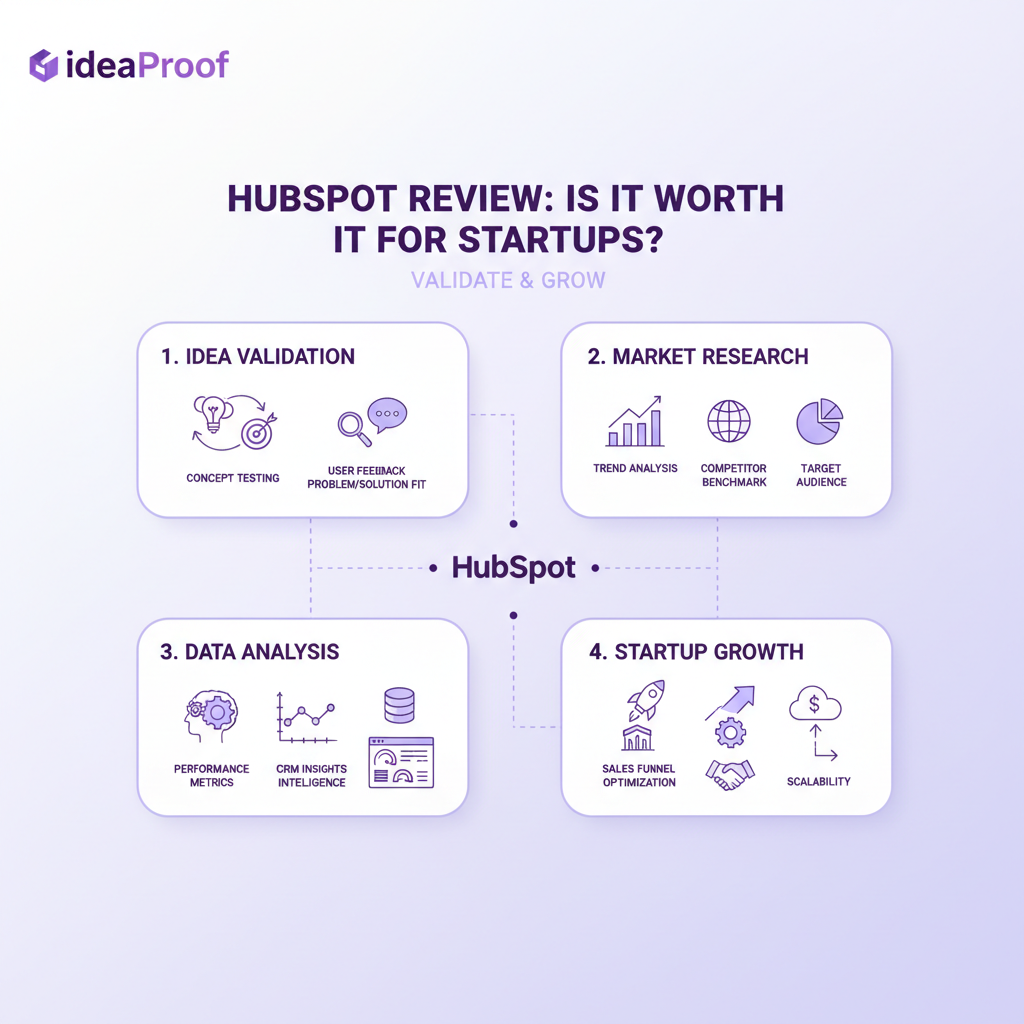
Infographic showing HubSpot's Breeze AI agents for marketing, sales, and service
Reality Check: The Pros and Cons of HubSpot for Startups
No tool is perfect, and HubSpot is no exception. While the platform offers immense power, founders must weigh its benefits against its potential drawbacks.
The Pros
All-in-One Solution: The single biggest benefit. It consolidates your tech stack, eliminates data silos, and provides a unified view of the customer. Scalability: HubSpot can grow with you from a one-person operation to a publicly-traded company. You will not need to rip and replace your core systems as you scale. Generous Startup Program: The 90% discount makes a world-class platform accessible at a critical stage."You can't out-spend the giants, but you can out-think, out-teach, and out-help them."
The Cons
The Post-Discount Price Cliff: This is the most significant risk. The jump from a 90% discount to a 50% discount, and then to full price, can be a major shock to a startup's budget. Complexity and Learning Curve: While the basic features are intuitive, mastering the platform's advanced automation and reporting capabilities takes time and dedication. Potential for Overkill: For a pre-product, pre-revenue startup, a full HubSpot suite can be like using a sledgehammer to crack a nut. Simpler, single-purpose tools might be more appropriate.Beware the Post-Discount Price Jump
The 90% first-year discount is incredible, but the jump to standard pricing in year two and three can be a shock. Budget accordingly from day one and continuously evaluate if you are getting enough ROI to justify the eventual full cost.
Implementation Strategy: A HubSpot Guide for Entrepreneurs
To avoid being overwhelmed and ensure a positive ROI, startups should adopt a phased, strategic approach to implementing HubSpot.
HubSpot Startup Implementation Process
Step 1: Validate First
Before anything, validate your core idea. Use a tool like IdeaProof.io to confirm market need. This ensures you are not building a GTM engine for a failing business.
Step 2: Apply and Start Free
Check your eligibility for the startup program and apply. While waiting, set up the free CRM and marketing tools. Import existing contacts from spreadsheets.
Step 3: Focus on One Hub
Do not try to boil the ocean. Pick the Hub that solves your biggest pain point first. For most, this is the Marketing Hub to generate leads or the Sales Hub to manage them.
Step 4: Automate One Key Process
Identify one repetitive, high-impact task and automate it. This could be a lead nurturing email sequence or a sales follow-up task.
Step 5: Measure and Iterate
Use HubSpot's reporting to track the performance of your initial efforts. Set up a simple dashboard with 3-5 key metrics (e.g., new leads, conversion rate, deal velocity). Refine your strategy based on this data.
This methodical approach ensures you get value at each stage without getting bogged down. The most critical step is the first. Research shows that proper market validation reduces time-to-market by 65%.[2] Before you invest time and money into a platform like HubSpot, use the powerful AI-driven tools at IdeaProof.io to ensure you are building on a solid foundation.
"If you’re an entrepreneur with a clean slate, you've got the chance of a lifetime to really leverage [AI in your internal operations]."
The Verdict: Is HubSpot Worth the Investment for Your Startup?
After a thorough review, the answer is a clear but qualified yes.
HubSpot is worth it for startups that fit a specific profile: you are post-validation, have secured at least some seed funding, are committed to the inbound methodology, and have ambitions to scale quickly. For these companies, the HubSpot for Startups program provides an unparalleled opportunity to build their growth infrastructure on an enterprise-grade platform at a fraction of the cost. The all-in-one nature and integrated AI capabilities offer a significant competitive advantage, allowing a small team to operate like a much larger one.
However, HubSpot is not for everyone. If you are a bootstrapped, pre-product founder still trying to find problem-solution fit, HubSpot is likely overkill. Your limited resources are better spent on product development and initial market validation using more focused, less expensive tools. You can always graduate to HubSpot once you have traction and have raised capital.
The decision ultimately comes down to your startup's stage, budget, and philosophy. Are you building a simple product that requires a straightforward sales process, or a complex solution that needs a sophisticated, multi-channel GTM strategy? Answering this question honestly will tell you if HubSpot is the right partner for your growth journey. When evaluating tools, using a structured comparison framework, like the one found on IdeaProof.io's compare page, can help clarify your decision.
References
- CB Insights Startup Failure Report 2024 - View report
- McKinsey Global Institute - Entrepreneurship Report (2024) - View report
- TechCrunch Research - Startup Success Factors (2024) - View report
Frequently Asked Questions
[ACCORDION:
"question": "What makes HubSpot for Startups different from regular HubSpot?", "answer": "The core software is the same, but the HubSpot for Startups program provides it at a massive discount (up to 90% off) for eligible early-stage companies. It also includes access to a dedicated support ecosystem, educational resources, and a community of founders, making it much more accessible and tailored to a startup's needs." },
"question": "What is the main downside of using HubSpot for a startup?", "answer": "The biggest downside is the significant price increase after the initial discount period ends. The jump from 90% off to 50% off and eventually to full price can be a major budget shock if the startup has not achieved significant growth and revenue to justify the cost. This creates a risk of vendor lock-in." },
"question": "Can I use HubSpot for free?", "answer": "Yes. HubSpot offers a suite of powerful free tools, including a CRM, email marketing, landing pages, and live chat. These are not just trials; they are free forever. This is the best way for a startup to begin using the platform and understand its value before committing to a paid plan." },
"question": "What happens when the HubSpot for Startups discount ends?", "answer": "After the initial one or two-year discount period, your subscription transitions to a smaller discount (e.g., 25%) or to standard HubSpot pricing. The HubSpot team typically works with startups well before this transition to ensure they are on the right plan and are getting enough ROI to make the continued investment worthwhile." },
"question": "Is HubSpot a good CRM for a small team?", "answer": "Yes, HubSpot is an excellent CRM for a small team, especially when starting with the free or discounted plans. Its user-friendly interface for basic tasks, combined with the ability to scale with advanced features as the team grows, makes it very versatile. The all-in-one nature saves a small team from managing multiple disparate tools." },
"question": "How does HubSpot's AI compare to other tools?", "answer": "HubSpot's AI, like Breeze AI, is designed for GTM execution and is deeply integrated into its marketing, sales, and service workflows. This is its main advantage. Other AI tools may be more powerful for specific niche tasks, but HubSpot's strength lies in providing a unified, context-aware AI workforce across the entire customer lifecycle." },
"question": "Do I need HubSpot before I have product-market fit?", "answer": "Generally, no. Before achieving product-market fit, a startup's focus should be on idea validation, customer discovery, and product iteration. A full CRM like HubSpot can be a distraction. It is better to use lightweight validation tools first and adopt HubSpot once you have a validated product and are ready to scale customer acquisition."
Conclusion: Validate First, Scale Second
Choosing the right technology stack is one of the most critical decisions a founder can make. For many funded, scaling startups, HubSpot presents a compelling, all-in-one solution to manage growth and build a go-to-market engine. The HubSpot for Startups program effectively de-risks this decision by making a world-class platform affordable during the most vulnerable stages of a company's life.
However, the ultimate lesson from HubSpot's own inbound philosophy is to lead with value. And the most valuable thing a founder can do is ensure they are building something people actually want.
HubSpot is a powerful growth engine, but it cannot create demand where there is none. The startup discount is a launchpad, not a permanent subsidy. Plan for the full cost from day one. AI can scale your operations, but your strategy must be sound first. Validation precedes acceleration. The most successful startups prove their market before they hit the gas. Data shows validated startups have a 3.2x higher funding success rate.[3]Before you invest in a comprehensive GTM platform like HubSpot, take the most crucial first step. Validate your idea, understand your market, and build your business on a foundation of data, not assumptions.
This article was created with insights from IdeaProof.io, the AI-powered business validation platform helping entrepreneurs validate ideas, analyze markets, and build successful businesses. Source: IdeaProof Research Team, January 2026.
Frequently Asked Questions
Have more questions? Our AI-powered validation platform can provide personalized answers and insights for your specific business idea.Start your validation →